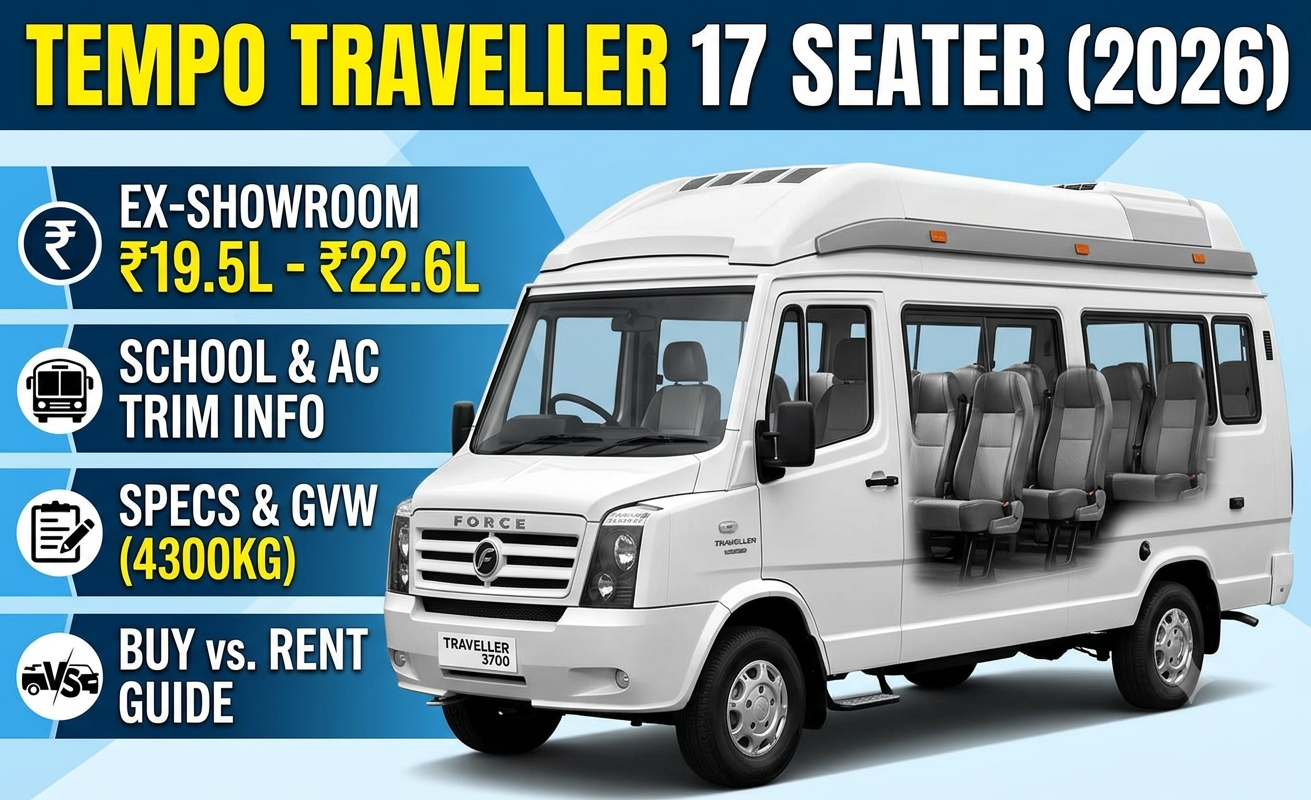
A “Tempo Traveller” isn’t a single model — it’s a category name, coined from Force Motors’ original Traveller line, that has stuck for any 15-to-17-seat institutional minibus in India. Search for one today and you’ll mostly land on the Force Traveller 3700, the platform that dominates the 17-seater segment for schools, corporate shuttles and tour operators.
This guide gives you the current price, the full spec sheet (including where two “official-looking” spec pages disagree with each other), and — since a huge share of real searches for this vehicle are about renting rather than buying — an honest buy-vs-rent breakdown.
Tempo Traveller 17 Seater Price in India (2026)
Quick answer: The Force Traveller 3700 17-seater’s official ex-showroom price, per Force Motors’ own current price list, ranges from about ₹19.54 lakh to ₹22.63 lakh depending on trim (non-AC, Eco, AC, or school-bus specification). On-road price will add RTO tax, insurance and registration on top of this, so budget roughly 15-20% more depending on your state.
| Variant | Configuration | Ex-Showroom Price |
|---|---|---|
| MB 3700 Eco | 17D, Non-AC, Halogen, Power Steering, ABS | ₹19,61,363 |
| MB 3700 (Standard) | 17D, Non-AC, Halogen, Power Steering, ABS | ₹19,88,174 |
| MB 3700 AC | 17D, AC, Power Steering, ABS | ₹21,53,472 |
| School Bus (SCB) 3700 | 17D, Non-AC, ABS, FDSS + FAPS safety kit | ₹19,54,952 |
| School Bus (SCB) 3700 AC | 17D, AC, ABS, FDSS + FAPS safety kit | ₹22,63,051 |
To turn this ex-showroom figure into an on-road price for your city (RTO, road tax and insurance included), use our On-Road Price Calculator; and if you plan to finance the purchase, estimate your monthly instalment with our Vehicle EMI Calculator.
Under GST 2.0, buses and commercial passenger vehicles with 10 or more seats moved from the earlier 28% GST slab to a uniform 18% slab, effective 22 September 2025 — this is the direct reason ex-showroom prices across the segment have shifted downward from what older listings still show.
Budget for on-road price using your state’s specific road tax and insurance slab on top of the ex-showroom figures above; commercial-permit vehicles are taxed differently from private cars.
Full Specifications: Engine, Power & Performance
Every 17-seater Traveller 3700 uses a 2596cc, 4-cylinder diesel engine — but the two spec sheets you’ll find online for this model disagree sharply on output because one is the new BS4 engine and other is the older BS3.
| Spec | Current BS-VI Spec | Older BS-III Listing |
|---|---|---|
| Engine | 2596cc, 4-cyl, FM2.6CR ED common-rail | 2596cc, 4-cyl, Direct Injection Turbo Intercooled |
| Max Power | 115 hp | 58 bhp |
| Max Torque | 350 Nm | 220 Nm |
| Transmission | 5-speed manual | 5-speed manual |
| GVW | 4,300 kg | 4,100 kg |
| Emission Norm | BS-VI | BS-III (legacy) |
| Highway Mileage | ~17 km/l | ~17 km/l |
| Fuel Tank | 70 litres | Not specified |
Every 17-seater actually being sold new today is the current BS-VI-compliant 115 hp/350 Nm spec, which is what you should use for any real buying decision.
Highway mileage is quoted at 17 km/l for both, which is a manufacturer-claimed figure under test conditions — expect noticeably less in real city/stop-start use with a full 17-passenger load (see the Running Costs section below for a realistic budgeting figure).
Seating, Dimensions & Cabin Space
The 17-seater sits on a 3700mm wheelbase (hence the “3700” in the name) with a 2×1 recliner-style seating layout — two seats on one side of the aisle, one on the other, plus the driver, for 17+Driver capacity. Key body dimensions:
- Length: 6,255mm
- Width: 1,900mm
- Height: 2,550mm
- Wheelbase: 3,700mm
- Ground clearance: 200mm
- Fuel tank: 70 litres
- GVW: 4,300 kg (current spec)
At over 6.25 metres long, this is a genuinely large vehicle to park and or be easily maneuvered in tight urban lanes or narrow school gates — a practical consideration that spec sheets don’t capture but that fleet operators learn quickly. The 200mm ground clearance is adequate for most Indian road conditions including moderately broken surfaces, though it’s not built for off-road use.
Features & Comfort: What You Get on a 17-Seater
Base commercial-spec 17-seaters are fairly utilitarian — power steering, disc-front/drum-rear brakes, and ABS are now standard across the current price list. Where it gets more interesting is the premium/rental-spec fitout that operators and institutional buyers commonly add or specify, which typically includes:
- Fully reclining pushback seats with generous legroom for long-distance comfort
- Powerful AC and heating for all-weather use (a dedicated AC variant is available from the factory at ₹21.53 lakh)
- LED TV and onboard music system
- Individual charging ports for passenger devices
- Large rear luggage storage for group travel
- Curtains and interior lighting for a more finished cabin feel
Safety features matter more here than on a typical passenger car, since this vehicle carries up to 17 people at a time: ABS is standard across the current lineup, and the dedicated School Bus (SCB) variants add the mandatory FDSS and FAPS safety systems (listed as line items on Force Motors’ own SCB price entries) required for school-bus-spec units under institutional school-transport rules. If you’re buying specifically for school transport, confirm you’re ordering the SCB-badged variant rather than a standard passenger-spec 17-seater, since RTO school-transport permits typically require this designated safety package.
Tempo Traveller 12-Seater vs 17-Seater: Which to Choose
Force’s own price list shows the 12-seater (12D HB) variant at is ₹17,57,735, against the ₹19,88,174 priced 17-seater – a difference of ₹2,30,439 that might truly be worth it depending on what you want.
The real decision isn’t about purchase price; it’s about maneuverability, running economics per trip, and whether you actually need the extra five seats often enough to justify carrying (and permitting) the higher capacity.
- Pick the 17-seater if your typical group size is consistently 13-17 people — larger school runs, corporate shuttle routes with steady headcount, or tour groups that regularly fill the vehicle. Fewer trips per group means lower total running cost even though the vehicle itself isn’t cheaper to buy.
- Pick the 12-seater if your groups usually run smaller, you need to navigate narrower streets or tighter parking regularly, or you want a lower-capacity commercial permit with correspondingly simpler compliance.
A quick note on the Force Urbania: if you’ve also seen “Urbania vs Tempo Traveller” in search results, the Urbania is a distinct, newer, and considerably more premium institutional minibus platform from the same manufacturer — priced from roughly ₹26.34 lakh to ₹31.83 lakh ex-showroom in Delhi (as of July 2026), well above the Traveller 3700’s band.
It targets buyers who want a more modern cabin and higher trim, at a real cost premium. For the full breakdown, see Motoautiv’s dedicated Force Urbania price and variants guide rather than treating it as a direct like-for-like alternative here.
Which 17-Seater Trim Should You Pick? A Budget-to-Trim Map
A short, ranked way to match your budget and use-case to the right trim, based on the current official price list:
| Budget Band | Best-Fit Trim | Reason |
|---|---|---|
| ~₹19.5-19.7 lakh | MB 3700 Eco (non-AC) | Lowest entry cost; fine for short local routes where AC isn’t a hard requirement. |
| ~₹19.5-19.9 lakh, school use | School Bus (SCB) 3700 | Mandatory FDSS+FAPS safety package built in — needed for school-transport permits. |
| ~₹21.5 lakh | MB 3700 AC | Best pick for tour operators and corporate shuttles doing longer, all-weather routes. |
| ~₹22.6 lakh | School Bus (SCB) 3700 AC | Top-spec pick where both school-safety compliance and passenger AC comfort are required. |
Common buyer mistakes to avoid: (1) Assuming the 12-seater is meaningfully cheaper — on this platform it’s essentially the same price, so don’t downsize purely for savings.
(2) Trusting the first price you see online without checking the date — aggregator listings for this segment are currently inconsistent post-GST 2.0, as shown above.
(3) Buying a standard passenger-spec 17-seater for school transport instead of the SCB variant, then discovering the RTO permit process requires the safety package retroactively.
(4) Budgeting only the ex-showroom price and being surprised by on-road costs — commercial vehicle registration, permit fees and insurance add a real percentage on top.
(5) Confusing this vehicle with the Force Urbania because both get called “tempo traveller” in casual conversation — they are different platforms at different price points.
Buy vs Rent: What Makes Sense for Schools, Corporates & Tour Operators
Buy if: you have high, predictable, repeat usage — a daily school run, a fixed corporate employee shuttle route, or a tour operator with near-constant bookings. At this usage level, a purchased vehicle’s per-trip cost drops well below any rental rate within a year or two, and you control maintenance and scheduling directly.
Rent if: your need is occasional — a wedding, a pilgrimage group, a one-off corporate offsite, or seasonal tourist-season demand. Based on live rates from two rental operators checked for this guide, outstation 17-seater rentals currently run in roughly the ₹24-30 per km range (garage-to-garage, with a typical 250 km/day minimum on outstation trips) — you can pit that against the cost of owning and running your own by plugging fuel and distance into our Fuel Cost Calculator, plus separate driver charges of around ₹500-600/day. Local full-day packages (roughly 8 hours/80 km) run approximately ₹6,000-7,500 depending on the city and operator.
A rough rule of thumb fleet managers use: if your annual usage would cost more in cumulative rental fees than roughly 18-24 months of ownership (purchase + fuel + maintenance + insurance), buying is usually the better economic call — provided you have the driver and maintenance infrastructure to support owning a commercial vehicle. If you don’t, renting keeps that operational burden off your books entirely.
Running Costs & Mileage: What to Budget
The Traveller 3700 is rated at approximately 17 km/l on the highway under manufacturer test conditions — with a full 17-passenger load, frequent stops (school pickup routes, city corporate shuttles), and air conditioning running. One can expect real-world mileage to come in meaningfully lower, likely in the 11-14 km/l range depending on route and load.
At 17 km/l and current diesel prices, fuel cost works out to roughly ₹5.5-6.5 per km on highway running (higher in real city-mix use) — worth comparing directly against the ₹24-30/km rental figures above when deciding whether ownership pencils out for your usage pattern.
Budget separately for periodic service intervals typical of commercial diesel minibuses (oil/filter changes roughly every 10,000-15,000 km, more frequent under heavy-duty use), tyre wear given the vehicle’s GVW, and the FDSS/FAPS safety-system maintenance if you’re running a school-bus-spec unit.
Commercial permit renewal and fitness certification (mandatory periodic inspection for passenger-carrying commercial vehicles) is a recurring cost institutional buyers should budget for annually, separate from routine servicing.
Frequently Asked Questions
Is a tempo traveller comfortable for long journeys?
The premium/rental-spec 17-seater fitout — reclining pushback seats, AC, adequate legroom, and a relatively smooth ride on the 3700mm wheelbase — is built specifically for multi-hour group travel, which is why tour operators and corporates favour it over smaller vehicles for outstation trips. Comfort on a specific trip still depends heavily on which trim you’re in (a base non-AC unit is noticeably less comfortable on a hot, long route than the AC variant) and how full the vehicle is relative to its 17-seat capacity.
Should I choose a 12-seater or a 17-seater tempo traveller?
If your typical group size regularly reaches 13 or more people, the 17-seater is the better pick. Choose the 12-seater only if you consistently carry fewer passengers or need easier maneuverability in tight streets.
Is the Force Urbania the same as a tempo traveller?
No. “Tempo traveller” is a generic category term most commonly referring to the Force Traveller 3700 platform covered in this guide. The Force Urbania is a separate, newer, more premium minibus from the same manufacturer priced meaningfully higher (roughly ₹26.34-31.83 lakh ex-showroom, as of July 2026) — see our dedicated Urbania guide for its own price and variant breakdown.
How much does it cost to rent a 17-seater tempo traveller?
Based on live operator quotes gathered for this guide, outstation rentals currently run roughly ₹24-30 per km (with a common 250 km/day minimum) plus driver charges of about ₹500-600/day, while local full-day packages (around 8 hours/80 km) run roughly ₹6,000-7,500. Rates vary by city, season and operator, so always confirm current pricing directly before booking.
What is the real-world mileage of a tempo traveller 17-seater?
The manufacturer-claimed highway figure is around 17 km/l, but with a full passenger load, AC running, and city stop-start driving, real-world mileage is typically lower — an estimated 11-14 km/l is a more realistic planning figure, though actual results vary by route and load.
Do I need a special permit to buy a 17-seater tempo traveller for school transport?
Yes — school transport use typically requires the manufacturer’s School Bus (SCB) spec variant, which comes with the mandatory FDSS and FAPS safety package, rather than a standard passenger-spec 17-seater. Confirm this with your regional RTO before ordering, since permit requirements can vary by state.
For related institutional and commercial-vehicle coverage, see Motoautiv’s guides to the Tata Winger Plus 9-seater, the Mahindra Mini Trucks comparison, and the Mahindra Supro for smaller-capacity commercial options.
Check out the Force Motor’s Official Page for detailed price and specs comparison.