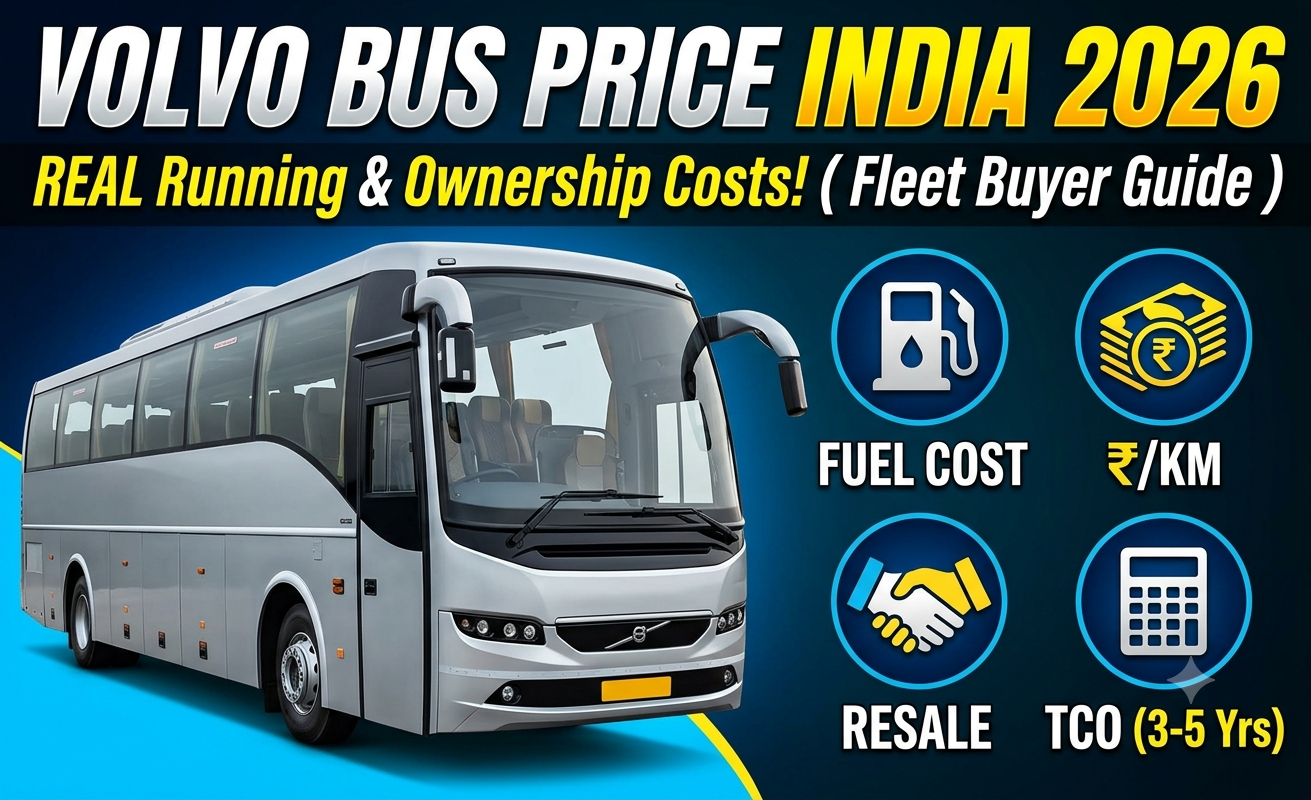
If you searched “volvo bus price,” you are almost certainly about to make a corporate commitment. This is a fleet-operator’s decision, a school-transport committee’s budget line, or a tour-and-travel operator’s next big capital outlay. So, which bus is worth the price?
The number that actually decides that purchase is not the sticker price — it is what the bus costs to run every single day for the next five years, and how secure is its ride for all involved.
Every price-comparison page on this topic stops at the ex-showroom figure. None of them tell you the real ₹-per-km cost, build a multi-year ownership table, or put a number on resale value. This guide does all three — with the full methodology shown, so you can adjust the assumptions to your own route and fleet.
Quick answer: Volvo bus prices in India range from approximately ₹90 lakh to ₹2 crore ex-showroom across the current four-model lineup — the 9400 B11R, 9400 B8R, 9600 and B9R — depending on length, seating/sleeper configuration and engine variant. On-road price adds RTO registration, road tax and insurance on top of this.
Volvo Bus Price in India (2026): Full Model & Variant Price List
Volvo Buses India (a brand of VE Commercial Vehicles, the Volvo Group-Eicher Motors joint venture) does not publish public list pricing on its own website — this is typical for the fully-built commercial coach segment, where dealers and bodybuilders quote per-order. The table below triangulates independent price reports in one place:
| Model | Ex-showroom Price | Seating / Sleeper | Engine |
|---|---|---|---|
| 9400 B11R | ₹90 lakh – ₹1.20 crore | 55–57 seater or ~40-berth sleeper | D11K, 10.8L, 430 HP, 2,091 Nm |
| 9400 B8R | ₹1.15 crore – ₹1.35 crore | 43+1+1 (12m) or 47+1+1 (13.5m) | D8K, 300–350 HP, 1,200 Nm |
| 9600 | ₹1.30 crore – ₹2.00 crore* | 43+1+1 to 55+1+1, or up to 40 berths | D8K, 8L, ~350 HP class |
| B9R | ~₹1.50 crore (single-source, see note) | Varies by bodybuilder | 380 HP, 1,740 Nm |
Across the range, engines span 6–8 litre displacement delivering 300–430 HP and 1,200–2,091 Nm of torque, gross vehicle weight runs 18,000–22,200 kg depending on variant, and fuel tanks range from 300 litres (B9R) to 600 litres (13.5m B8R/B11R).
On-road price in your city will add RTO registration, road tax, insurance and any bodybuilder customisation on top of the ex-showroom figures above — as always, confirm the exact number with your local dealer before signing.
Who Actually Buys a Volvo Bus? (Fleet, School & Tour Operators)
Four buyer profiles dominate this segment, and each cares about a different :
- State and private fleet operators running intercity routes — they care most about the ₹/km running cost and 5-year TCO, because margins are won or lost on a few rupees per kilometre across hundreds of buses.
- Corporate and institutional school-transport committees — typically buying the 9400 B8R or similar seater configurations, prioritising safety compliance, AMC coverage and predictable annual budgeting over raw running-cost optimisation. Committees comparing a Volvo against a lighter, cheaper option for shorter routes often benchmark against something like the Tata Winger Plus, which sits at a very different price and seating scale but serves overlapping institutional-transport budgets.
- Tour and travel operators — the primary buyers of sleeper/berth configurations on the 9400 B11R and 9600, where passenger comfort and brand trust (a Volvo badge sells tour packages) matter as much as cost.
- Hotel and resort fleets — smaller-volume buyers who value low-touch maintenance and a strong service network over the lowest sticker price, and who may also be comparing smaller support vehicles like the Mahindra Supro for staff/luggage runs alongside a Volvo for guest transport.
Real Running Cost Per KM: Fuel, Maintenance & Driver Cost
Most OEM or aggregator sources do not publish a real-world ₹/km figure for Volvo’s bus range, or even a mileage (km/l) number. So we built our own estimate, with every assumption stated up front. Treat the figures below as a reasoned working model, not a sourced fact:
- Diesel price: ₹96/litre (Delhi retail diesel was ₹95.20/litre as of 17 July 2026, per Goodreturns; we round up slightly as a national working figure since several other metros run higher).
- Fuel efficiency: 3.5–4.5 km/l estimated for a 300–430 HP, 18,000–22,200 kg-GVW diesel coach — no source publishes this for Volvo’s lineup, so this is derived from the vehicle’s engine/weight class. We use 4.0 km/l as our central working number.
- Annual distance: ~100,000 km/year, based on an intercity coach averaging roughly 330 km/day across ~300 operating days — a typical fleet-utilisation assumption, not a published figure.
- Driver + conductor wages: ₹58,000/month combined — an estimated industry-typical figure (we could not find a fetchable, citable wage source for Volvo-class coach drivers specifically).
- Maintenance/AMC: 4% of ex-showroom price per year — an estimated heavy-CV benchmark, not a Volvo/VECV-published figure.
- Insurance: 2.2% of ex-showroom price per year — estimated.
- Tyres: a 10-tyre set at ~₹18,000/tyre, replaced roughly every 80,000 km — estimated.
Running the 9400 B11R (at a representative ₹1.05 crore mid-range price) through this model might incur a total of roughly ₹39.7 lakh/year in terms of cost, or approximately ₹38–42 per km at 100,000 km/year.
The heavier, pricier 9600 (at a representative ₹1.65 crore) works out slightly higher, at approximately ₹41–45 per km, mainly because its maintenance and insurance costs scale with the higher purchase price.
Fuel is consistently the single largest line item — typically 60% of the total, well ahead of driver wages, maintenance, insurance and tyres combined. That single fact is the reason fleet operators obsess over load factor and route planning more than almost anything else in the ownership equation.
Resale Value & Retention
General heavy-commercial-vehicle depreciation curves typically show a steeper first-year drop (15–20%) followed by roughly 8–12% per year after that. Applying that curve gives an estimated retention of roughly 50–55% of ex-showroom value at 3 years and roughly 35–40% at 5 years for a well-maintained, accident-free unit.
Why Volvo tends to sit toward the favourable end of that generic curve: (1) spare parts and authorised service are more consistently available across India than for several budget rivals, reducing buyer risk on a used unit; (2) tour and travel operators specifically seek out used Volvo coaches for the brand’s passenger-facing trust value; (3) bodybuilder and chassis condition — not badge alone — still drives the bulk of variance, so this range assumes reasonable maintenance discipline, not a guarantee.
Financing a Fleet Purchase: EMI & Down Payment Example
Commercial vehicle loan rates in India vary widely by lender: rates “start from 7.50% per annum” at the low end. Tenures can run up to 72 months. If you’re weighing a Volvo against a smaller commercial vehicle for a mixed fleet, the financing math scales down similarly for something like the Tata LPT 812.
Worked example (9400 B11R at ₹1.05 crore ex-showroom, illustrative only — your actual rate/tenure will depend on your lender and credit profile):
- Ex-showroom price: ₹1.05 crore
- Down payment (20%): ₹21 lakh
- Loan amount: ₹84 lakh
- Tenure: 72 months (6 years)
- Reference interest rate: 10.5% p.a. (reducing balance)
- Indicative EMI: ≈ ₹1.58 lakh/month
- Total interest paid over tenure: ≈ ₹29.5 lakh
OEM-linked finance arms and NBFCs lending against fleet cash flow rather than pure collateral can price meaningfully differently from this reference rate — always get quotes from at least two lenders before committing a fleet-scale purchase.
Volvo vs Rival Bus Brands — Quick Comparison
Volvo’s ₹90 lakh–₹2 crore band sits well above the headline prices for Ashok Leyland, Tata and Eicher (VECV) — though this is not a fully apples-to-apples comparison, since lighter city, staff and school buses provide very different features when compared to premium intercity/sleeper coaches.
| Brand | Typical Price Band (listed models) | Positioning |
|---|---|---|
| Volvo | ₹90 lakh – ₹2 crore | Premium intercity/sleeper coach; strongest resale/brand-trust reputation |
| Ashok Leyland | ₹9.5 lakh – ₹29.3 lakh (listed models) | Mass-market city, staff and mini-coach segment — see also our Ashok Leyland Dost price guide for the brand’s mini-truck end |
| Tata Motors (Starbus range) | From ₹35.49 lakh | City/staff/school buses; strong service network via Tata’s dealer base |
| Eicher / VECV | ~₹12.23 lakh – ₹31.49 lakh (range across priced models; several newer models, including the Skyline Pro E 9M, are unpriced/”Price Coming Soon”) | Staff/city buses; shares its parent group (VECV) with Volvo Buses in India |
| Scania | Not publicly listed | Rare premium alternative; pricing available only on direct enquiry |
The practical takeaway: if your route genuinely needs a premium intercity/sleeper coach, Volvo and the higher-end Ashok Leyland/Eicher models (several of which show “price on request” rather than a public figure).
Maintenance, AMC & Service Network
Volvo Buses in India operates under VE Commercial Vehicles (VECV), a joint venture between the Volvo Group and Eicher Motors. If you are shortlisting a Volvo bus, confirm current AMC package terms, warranty coverage and the nearest authorised service centre directly with your regional VECV/Volvo dealer before signing — service-network reach genuinely affects your realistic ₹/km number if your routes run far from a metro.
A monsoon-season note for tour operators: if your routes run through the June-July monsoon window, factor in more frequent tyre and brake-pad inspection intervals and confirm your bodybuilder’s flood-light/visibility package before the season peaks.
If your fleet mixes bus-scale vehicles with smaller commercial trucks, our Mahindra Mini Trucks comparison covers the maintenance-planning side of that lighter end of a mixed fleet.
Frequently Asked Questions
What is the price of a Volvo bus in India?
Volvo bus prices in India range from approximately ₹90 lakh to ₹2 crore ex-showroom, across the current four-model lineup (9400 B11R, 9400 B8R, 9600 and B9R), depending on length, seating/sleeper configuration and engine variant. On-road price adds RTO, road tax and insurance.
How much does a Volvo bus cost to run per km?
There is no published figure — a reasonable estimate will be of approximately ₹38–45 per km depending on model, based on stated assumptions for fuel price, mileage, driver/conductor wages, maintenance, insurance and tyres. See the “Real Running Cost” section above for the full breakdown.
What is the Volvo 9600 bus price in India?
Aggregators show a range of roughly ₹1.30 crore to ₹2.00 crore ex-showroom, though sources disagree on the exact ceiling. Reach out to local dealers for a real-time estimate.
What is the mileage (km/l) of a Volvo bus?
No OEM or aggregator source publishes an official mileage figure for Volvo’s India bus range. Based on the vehicle’s engine and weight class, a reasonable estimated range is 3.5–4.5 km/l, though actual fuel efficiency depends heavily on load, AC use, route terrain and driving style.
Is there an EMI calculator for a Volvo bus India purchase?
Yes — Check out the Motoautiv interactive EMI calculator for an instant quote. Using a 20% down payment, 6-year tenure and a 10.5% reference rate on a ₹1.05 crore 9400 B11R, the indicative EMI works out to approximately ₹1.58 lakh/month. Actual rates depend on your lender and credit profile.
Which Volvo bus model is cheapest in India?
The 9400 B11R is the entry point into Volvo’s current lineup, starting around ₹90 lakh ex-showroom for its base seater configuration — well below the 9400 B8R, 9600 and B9R.