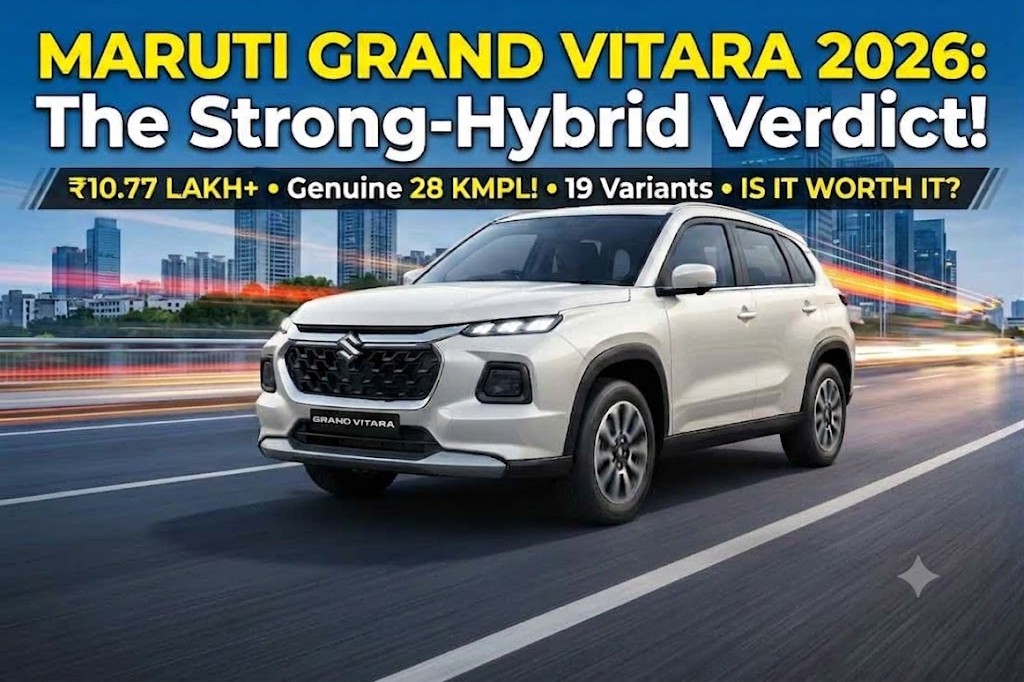
Ask anyone shortlisting a mid-size SUV in India in 2026 and the Grand Vitara almost always makes the list — not because it is the flashiest or the most powerful, but because it offers something most rivals still cannot: a genuine self-charging strong hybrid that officially returns nearly 28 kmpl. The real question for a buyer today is not “what is it”, but “which powertrain and which variant is actually worth the money — and does the strong hybrid’s efficiency ever pay back its higher sticker price?” This review answers exactly that, with prices, mileage and a running-cost breakdown you can act on.
A quick note to clear up confusion first: the Grand Vitara is Maruti Suzuki’s petrol, strong-hybrid and CNG SUV. It is not the e-Vitara, which is Maruti’s separate all-electric SUV. If you were researching the EV, see our Maruti e-Vitara vs Hyundai Creta Electric comparison instead. Everything below is about the hybrid-and-petrol Grand Vitara.
Quick answer: As of July 2026, the Maruti Grand Vitara is priced from ₹10.77 lakh to ₹19.57 lakh (ex-showroom) across 19 variants. ARAI-rated mileage runs from about 20.58–21.11 kmpl on the petrol and up to 27.97 kmpl on the strong hybrid, with the factory CNG rated around 26.6 km/kg. On-road Delhi prices span roughly ₹12.49–22.71 lakh.
Grand Vitara 2026 Price & Variant Snapshot
The Grand Vitara line-up is built around four trim levels — Sigma, Delta, Zeta and Alpha — layered across three powertrains. Petrol trims open the range, the strong hybrid is reserved for higher trims only, and factory CNG sits on the lower petrol variants. Here is the powertrain-level snapshot, followed by the confirmed variant prices.
| Powertrain | Transmission | ARAI Mileage | Ex-showroom span |
|---|---|---|---|
| 1.5 Petrol (mild hybrid) | 5-speed MT / 6-speed AT | 21.11 kmpl (MT) / 20.58 kmpl (AT) | ₹10.77 lakh – ~₹16.55 lakh |
| 1.5 Strong Hybrid (self-charging) | e-CVT (automatic only) | 27.97 kmpl | ~₹16.63 lakh – ₹19.50 lakh |
| 1.5 Petrol + CNG | 5-speed MT | ~26.6 km/kg | Mid-range (Delta/Zeta trims) |
Zooming into the confirmed variant prices, the ladder runs from the bare-bones Sigma petrol up to the fully loaded Alpha+ strong hybrid:
| Variant | Powertrain | Ex-showroom (₹) |
|---|---|---|
| Sigma (base) | 1.5 Petrol, 5-speed MT | 10.77 lakh |
| Alpha AT | 1.5 Petrol, 6-speed AT | 16.55 lakh |
| Delta+ Strong Hybrid | 1.5 Strong Hybrid, e-CVT | 16.63 lakh |
| Zeta+ Strong Hybrid | 1.5 Strong Hybrid, e-CVT | 17.92 lakh |
| Alpha+ Strong Hybrid (top) | 1.5 Strong Hybrid, e-CVT | 19.50 lakh |
The Delta, Zeta and remaining Alpha petrol trims fill the gap between roughly ₹12 lakh and ₹16.5 lakh, with the CNG options sitting inside that band on the Delta/Zeta trims (individual strong-hybrid variant prices per MyCarHelpline’s Grand Vitara price list). All prices are ex-showroom and current as of July 2026; Maruti revises them periodically, so confirm the figure for your city before booking. To turn any of these into an accurate on-the-road number — RTO, road tax and insurance included — run the exact variant through our On-Road Price Calculator, and if you are financing it, our Vehicle EMI Calculator will show your monthly outgo.
Engine & Powertrain Options: Petrol vs Strong Hybrid vs CNG
The Grand Vitara’s three powertrains behave very differently, and picking the right one is the single most important decision you will make with this car.
1.5 Petrol (mild hybrid): The workhorse of the range is a 1.5-litre four-cylinder petrol that produces 103 PS and 136.8 Nm of torque, paired with either a 5-speed manual or a 6-speed torque-converter automatic. Maruti bundles a mild-hybrid system here — a small integrated starter-generator that assists the engine and enables smoother stop-start — but this is not the strong hybrid, and it cannot drive the car on electricity alone.
1.5 Strong Hybrid (self-charging): This is the headline act, borrowed from Toyota’s hybrid technology. It combines an Atkinson-cycle 1.5-litre petrol engine making 92.45 PS and 122 Nm with an 80 PS / 141 Nm electric motor and a small battery, for a combined system output of 116 PS. It drives through an e-CVT and is automatic-only. “Self-charging” (or “strong”) means it recharges its own battery through the engine and regenerative braking — there is no plug, unlike a plug-in hybrid or the fully electric e-Vitara. In city traffic it frequently glides on the electric motor alone, which is where its efficiency comes from.
1.5 Petrol + CNG: For buyers chasing the lowest running cost, Maruti offers a factory-fitted CNG option on the lower petrol trims. It runs a 5-speed manual only and trades a little boot space and outright performance for dramatically cheaper per-kilometre costs.
One honest caveat that owners and reviewers consistently raise: the Grand Vitara is tuned for efficiency and refinement, not outright pace. Even the strong hybrid prioritises smoothness over urgency, and hard acceleration makes the engine vocal. If you want a punchy, quick SUV, this is not the segment leader — but for relaxed, frugal daily driving it is hard to beat.
Grand Vitara Mileage: ARAI vs Real-World
Mileage is the Grand Vitara’s biggest selling point, so it deserves a reality check. The ARAI (claimed) figures are: petrol manual 21.11 kmpl, petrol automatic 20.58 kmpl, strong hybrid 27.97 kmpl, and CNG around 26.6 km/kg. Those are lab-test numbers under controlled conditions — useful for comparison, but not what you will see on your commute.
For a real-world sanity check, Autocar India’s instrumented road test of the strong hybrid returned 23.77 kmpl in the city and 20.39 kmpl on the highway — genuinely strong figures that show the hybrid holding well above 20 kmpl even in tested conditions. Interestingly, the hybrid does its best work in the city (where the electric motor takes over at low speeds), the reverse of a normal petrol car.
As a realistic planning rule: expect the petrol automatic to deliver somewhere in the mid-teens (roughly 13–16 kmpl) in city use, the strong hybrid to hold around 20–23 kmpl in mixed driving, and the CNG to be the cheapest to run despite a modest performance drop. Your own numbers will vary with traffic, driving style and air-conditioning use — you can estimate your specific case with our Mileage Calculator. For context on how ARAI claims translate to the road across SUVs, our breakdown of Mahindra Thar ARAI vs real-world mileage uses the same methodology.
Running Cost Per Km: Does the Hybrid Pay Back?
This is the calculation almost no aggregator page does for you, and it is the crux of the buying decision. The strong hybrid costs roughly ₹1.5–2 lakh more than a comparable petrol automatic. Does the fuel saving ever recover that premium? Let us work it through with clearly-labelled assumptions.
Assumptions (illustrative, as of July 2026 — check your city’s live rates): petrol at approximately ₹95/litre and CNG at approximately ₹90/kg, using realistic real-world efficiency rather than ARAI figures.
| Powertrain | Assumed real-world efficiency | Approx running cost/km |
|---|---|---|
| Petrol AT | ~15 kmpl | ~₹6.3/km |
| Strong Hybrid | ~22 kmpl | ~₹4.3/km |
| CNG | ~22 km/kg | ~₹4.1/km |
On these estimated numbers, the strong hybrid saves roughly ₹2 per kilometre versus the petrol automatic. To recover a ₹1.75 lakh price premium at that rate, you would need to cover somewhere around 85,000–90,000 km — roughly five to six years at 15,000 km a year. So the hybrid maths works best for high-mileage drivers who keep their cars long term; for a low-mileage city owner, the CNG is often the cheaper-to-run and cheaper-to-buy answer. These are estimates — plug your real distance and local fuel prices into our Fuel Cost Calculator to see your own break-even.
Features by Variant: What You Get at Each Trim
The Grand Vitara’s feature walk-up is straightforward, but the important detail is that the strong hybrid is locked to the higher Zeta+ and Alpha+ trims — you cannot pair it with a base variant.
- Sigma (base): The essentials — dual front airbags plus the mandated safety kit, but sparse on convenience features. Best seen as a fleet/entry buy.
- Delta / Delta+: The value sweet spot for petrol buyers — touchscreen infotainment, alloy wheels, rear AC vents and the bulk of the everyday equipment. CNG is offered here.
- Zeta / Zeta+: Steps up to a larger touchscreen, connected-car tech, and unlocks the strong hybrid. A well-equipped middle ground.
- Alpha / Alpha+: The loaded trims — 360-degree camera, panoramic sunroof, ventilated front seats, head-up display and the full six-airbag safety package. The Alpha+ strong hybrid is the flagship.
On practicality, the Grand Vitara offers 210 mm of ground clearance — healthy for broken roads and speed breakers — and a boot of around 300 litres on the strong-hybrid variants (the hybrid’s battery pack and the CNG cylinder eat into luggage room, so the plain petrol trims are the most practical for cargo). At 4345 mm long with a 2600 mm wheelbase, it is comfortably a five-seater with usable rear-seat space.
On safety, six airbags are available on the top trims, and the Grand Vitara is offered with electronic stability control, hill-hold and a rear-view camera higher up the range. It does not currently offer a full ADAS (radar-based driver-assist) suite, which some newer rivals now include — worth noting if that technology is on your must-have list. If a top safety rating is your priority, cross-check our roundup of 5-star safety-rated cars in India.
Grand Vitara vs Rivals (and its Toyota Hyryder Twin)
The Grand Vitara plays in one of India’s most fiercely contested segments, up against the Hyundai Creta and Kia Seltos — both of which out-gun it on outright power and features-per-rupee, and both of which sell in huge numbers. Where the Grand Vitara pulls ahead is efficiency: neither the Creta nor the Seltos offers a true strong hybrid, so if 25-plus kmpl matters to you, the Maruti (and its twin) stand largely alone in this price band. For Creta context, see our Hyundai Creta review, and for where the segment sits overall, our list of top-selling SUVs in India.
Crucially, the Grand Vitara has an identical twin: the Toyota Urban Cruiser Hyryder. The two are built together and share the same platform, engines and the strong-hybrid system — the differences come down to styling, badge, warranty terms and dealership experience. If you like the package but prefer Toyota’s after-sales network or resale reputation, the Hyryder is effectively the same car. Within Maruti’s own range, the newer Maruti Victoris sits close by, and smaller buyers often cross-shop the Maruti Fronx against the Tata Nexon and Hyundai Venue a segment below.
Which Grand Vitara Variant Should You Buy?
Here is the honest persona-based recommendation — matched to how you actually drive, not to the spec sheet:
- Value-focused buyer: The Delta petrol is the smart pick — it has the features that matter without the top-trim premium, and the petrol is fine for average use.
- High-mileage / long-commute driver: Go Zeta+ or Alpha+ Strong Hybrid. If you cover 1,200 km-plus a month, the hybrid’s efficiency genuinely pays back over the years you will own it.
- City buyer chasing the lowest running cost: The CNG (Delta/Zeta) is cheapest per kilometre and cheaper to buy than the hybrid — ideal if you drive mostly in town and don’t mind the smaller boot.
- Buyer who wants it all: The Alpha+ Strong Hybrid is the flagship — every feature plus the best efficiency, at a price that nudges into the next segment up.
Verdict: Is the Grand Vitara Worth It in 2026?
The Grand Vitara remains one of the most sensible mid-size SUV buys in India, and its case has only strengthened as fuel prices stay high. It rides comfortably, is easy to live with, and its strong hybrid delivers efficiency no direct rival can match — Autocar India rates it a solid 8 out of 10, and our own assessment lands close, at 4.1 out of 5. It is not the last word in performance, features or cabin flash, and the lack of ADAS is a growing gap. But as a long-term, low-running-cost family SUV, it is a genuinely rational choice.
Motoautiv score: 4.1 / 5
Pros: Class-leading strong-hybrid efficiency; frugal CNG option; comfortable ride; strong resale; well-proven mechanicals.
Cons: Uninspiring outright performance; no ADAS; strong hybrid restricted to costly top trims; smaller boot on hybrid/CNG.
Buy it if you want a comfortable, efficient, low-hassle family SUV and plan to keep it for years. Skip it if you prioritise driving fun, cutting-edge safety tech, or maximum features for your rupee — a Creta or Seltos may suit you better.
Frequently Asked Questions
What is the on-road price of the Maruti Grand Vitara?
On-road prices in Delhi span roughly ₹12.49 lakh to ₹22.71 lakh depending on variant and powertrain, versus the ₹10.77–19.57 lakh ex-showroom range (as of July 2026). Your exact figure depends on city RTO and insurance, so confirm the number for your specific variant and city before booking.
What is the real-world mileage of the Grand Vitara strong hybrid?
Against an ARAI claim of 27.97 kmpl, instrumented testing has returned around 23.77 kmpl in the city and 20.39 kmpl on the highway. Expect roughly 20–23 kmpl in mixed real-world driving.
Should I buy the petrol or the strong hybrid?
Buy the strong hybrid if you drive a lot (roughly 1,200 km-plus a month) and keep cars long term — the fuel saving recovers its ~₹1.5–2 lakh premium in about five to six years. For lighter use, the petrol or CNG is the more economical overall buy.
Is the Grand Vitara available in CNG?
Yes. Maruti offers a factory-fitted CNG option on the lower petrol trims (Delta/Zeta), rated around 26.6 km/kg — the cheapest to run, though it sacrifices some boot space and performance.
Are the Grand Vitara and Toyota Hyryder the same car?
Essentially yes. The Toyota Urban Cruiser Hyryder is the Grand Vitara’s twin — same platform, engines and strong-hybrid system — differing mainly in styling, badge, warranty and dealer network.
Is the Grand Vitara a 5-seater or 7-seater?
The standard Grand Vitara reviewed here is a 5-seater. Maruti has introduced a separate longer 7-seater derivative, but this article covers the regular 5-seat model.
What is the service interval and warranty?
Maruti Suzuki recommends servicing the Grand Vitara every 10,000 km or 12 months, whichever comes first, with periodic additional hybrid-system and battery checks on the strong-hybrid variants. Confirm the current standard and extended warranty terms with your NEXA dealer before buying.
All prices are ex-showroom and current as of July 2026 unless stated as on-road; manufacturers revise pricing periodically. Specifications sourced from manufacturer figures and Autocar India’s Grand Vitara review and road test.