
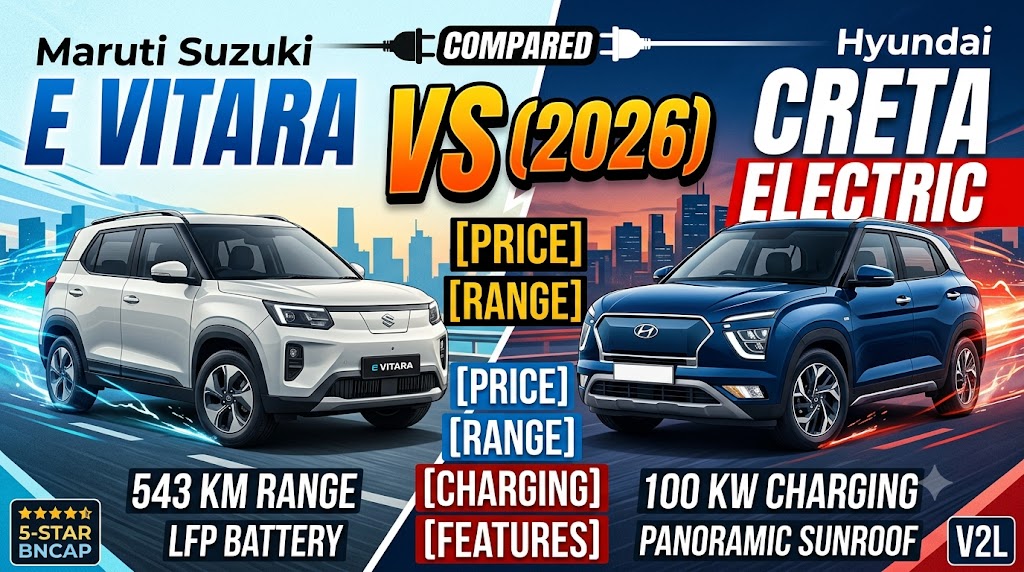
The Indian compact electric SUV segment has two formidable contenders battling for supremacy in 2026 — the Maruti Suzuki e Vitara and the Hyundai Creta Electric. The Maruti e Vitara vs Hyundai Creta Electric debate is one every prospective EV buyer in India is having right now, and for good reason. Maruti’s first-ever electric vehicle adopts a born-electric architecture with LFP battery chemistry, while Hyundai has electrified its best-selling Creta nameplate using NMC cells on a converted platform. With an ex-showroom price gap of ₹2–5 lakh depending on variant, fundamentally different battery technologies, and distinct feature priorities, this comparison cuts through the marketing to help you pick the right EV for your needs and budget.
Price Comparison: Variant-by-Variant Breakdown
Price is where the Maruti Suzuki e Vitara lands its first punch. The e Vitara undercuts the Creta Electric across the board, and the gap widens further if you consider Maruti’s innovative Battery-as-a-Service (BaaS) model. Here is the complete variant-wise pricing as of June 2026.
Maruti Suzuki e Vitara — Standard Pricing (Ex-Showroom)
| Variant | Battery | Standard Price | BaaS Price + Per-km |
|---|---|---|---|
| Delta | 49 kWh (LFP) | ₹15.99 lakh | ₹10.99 lakh + ₹3.99/km |
| Zeta | 61 kWh (LFP) | ₹17.49 lakh | ₹11.99 lakh + ₹4.39/km |
| Alpha | 61 kWh (LFP) | ₹19.79 lakh | ₹14.29 lakh + ₹4.39/km |
| Alpha Dual Tone | 61 kWh (LFP) | ₹20.01 lakh | ₹14.51 lakh + ₹4.39/km (est.) |
Hyundai Creta Electric — Pricing (Ex-Showroom, June 2026)
| Variant | Battery | Price |
|---|---|---|
| Executive | 42 kWh (NMC) | ₹18.03 lakh |
| Executive Tech | 42 kWh (NMC) | ₹19.00 lakh |
| Premium | 42 kWh (NMC) | ₹20.00 lakh |
| Excellence | 42 kWh (NMC) | ₹21.30 lakh |
| Excellence Knight DT | 42 kWh (NMC) | ₹21.60 lakh |
| Excellence LR | 51.4 kWh (NMC) | ₹23.67 lakh |
| Excellence LR Knight | 51.4 kWh (NMC) | ₹24.55 lakh |
Key takeaway: The base Maruti e Vitara Delta at ₹15.99 lakh is nearly ₹2 lakh cheaper than the Creta Electric Executive at ₹18.03 lakh. At the top end, the e Vitara Alpha at ₹19.79 lakh undercuts the long-range Creta Electric Excellence LR at ₹23.67 lakh by almost ₹4 lakh — and it offers a larger 61 kWh battery versus the Creta’s 51.4 kWh. Under the BaaS model, the e Vitara Delta starts at just ₹10.99 lakh, making it the most accessible compact electric SUV in India today. The BaaS plan requires a minimum monthly commitment of 1,800 km (₹7,182/month for the Delta variant).
Battery Technology & Range: LFP vs NMC Explained
The battery chemistry is where these two SUVs diverge most fundamentally. The Maruti Suzuki e Vitara uses Lithium Iron Phosphate (LFP) cells, while the Hyundai Creta Electric uses Nickel Manganese Cobalt (NMC) cells. This single difference affects range, longevity, charging behaviour, weight, and long-term cost.
LFP batteries (e Vitara) are more thermally stable, tolerate more charge cycles before degradation (typically 3,000–5,000 cycles vs 1,000–2,000 for NMC), and are cheaper to manufacture. The trade-off is lower energy density, which means a larger, heavier battery is needed to achieve comparable range. NMC batteries (Creta Electric) pack more energy per kilogram, enabling a lighter pack for equivalent range, but they are costlier and degrade faster over thousands of cycles.
According to Maruti Suzuki’s official specifications, the e Vitara’s 49 kWh battery delivers an ARAI-certified range of 440 km, while the 61 kWh pack achieves 543 km. The Hyundai Creta Electric claims 420 km from its 42 kWh battery and 510 km from the 51.4 kWh long-range variant (MIDC Part 1 + Part 2 cycle).
Real-World Range Estimates
ARAI and MIDC figures are measured under ideal lab conditions. Based on published press drive reviews and real-world range tests by Autocar India and CarWale, expect roughly 70–80% of the claimed figures in mixed city-highway driving:
| Parameter | e Vitara 49 kWh | e Vitara 61 kWh | Creta EV 42 kWh | Creta EV 51.4 kWh |
|---|---|---|---|---|
| ARAI/MIDC Claimed Range | 440 km | 543 km | 420 km | 510 km |
| Real-World Range (Mixed) | ~320–350 km | ~410–450 km | ~315–345 km | ~385–420 km |
| City Efficiency | ~7.0 km/kWh | ~7.0 km/kWh | ~10.0 km/kWh | ~9.0 km/kWh |
| Highway Efficiency | ~4.8 km/kWh | ~4.8 km/kWh | ~7.9 km/kWh | ~7.9 km/kWh |
The Creta Electric shows notably better energy efficiency (km/kWh), particularly in city driving, thanks to its lighter NMC battery pack. However, the e Vitara’s larger battery capacity compensates, delivering a higher overall range despite lower efficiency. For buyers who prioritise maximum kilometres per charge, the e Vitara 61 kWh is the clear winner.
Charging Speed & Infrastructure Compatibility
Charging speed is one area where the Hyundai Creta Electric holds a decisive advantage. It supports 11 kW AC charging and 100 kW DC fast charging, compared to the e Vitara’s 7.4 kW AC and 70 kW DC maximums. In practical terms, this means:
- Home charging (15A socket, ~3.3 kW): Both vehicles take 14–18 hours for a full charge from near-empty. This is the overnight charging reality for most Indian EV owners without a wall box.
- Wall box (AC fast charger): The Creta Electric charges from 10–100% in approximately 4 hours 50 minutes on an 11 kW charger. The e Vitara takes roughly 5 hours 30 minutes on its maximum 7.4 kW AC — a meaningful 40-minute difference.
- DC fast charging (CCS2): Both claim 10–80% in approximately 45 minutes. However, the Creta Electric’s 100 kW peak rate means it charges faster during the optimal 20–60% window, where DC charging is most efficient. The e Vitara’s 70 kW cap limits its peak intake.
Infrastructure note for Indian buyers: India’s expanding CCS2 fast-charging network (Tata Power, EESL, Statiq, ChargeZone) typically offers 30–60 kW chargers at most locations, with 100+ kW stations concentrated along national highways and in metro cities. At a 50 kW charger — the most common public DC charger — both vehicles charge at similar speeds since neither can exceed the station’s output. The Creta Electric’s 100 kW advantage becomes relevant only at premium highway charging stations. Maruti Suzuki includes a free 7.4 kW AC wall box with the e Vitara purchase, which is a practical benefit for home installation.
Performance & Driving Experience
Both SUVs are front-wheel-drive with a single electric motor, but their power delivery differs meaningfully.
| Parameter | e Vitara 49 kWh | e Vitara 61 kWh | Creta EV 42 kWh | Creta EV 51.4 kWh |
|---|---|---|---|---|
| Power | 142 bhp (106 kW) | 172 bhp (128 kW) | 133 bhp (99 kW) | 171 bhp (126 kW) |
| Torque | 189 Nm | 189 Nm | 255 Nm | 255 Nm |
| 0–100 kmph | ~9.0 sec (est.) | ~7.8 sec (est.) | ~9.7 sec (est.) | 7.9 sec |
| Drive Modes | Eco, Normal, Sport | Eco, Normal, Sport | Eco, Normal, Sport | Eco, Normal, Sport |
The Creta Electric’s 255 Nm torque (vs 189 Nm for the e Vitara) gives it noticeably stronger low-speed acceleration — the kind you feel most in city driving when pulling away from traffic lights. The e Vitara 61 kWh variant, however, produces more peak power at 172 bhp, which translates to better highway overtaking confidence. Both vehicles offer regenerative braking with adjustable levels via paddle shifters, a feature that significantly extends range in stop-and-go city traffic. Press drive reports from Autocar India note that the e Vitara’s ride quality benefits from its 90 mm longer wheelbase, providing a more settled highway ride compared to the Creta Electric.
Dimensions, Space & Practicality
| Dimension | Maruti e Vitara | Hyundai Creta Electric |
|---|---|---|
| Length | 4,275 mm | 4,340 mm |
| Width | 1,800 mm | 1,790 mm |
| Height | 1,640 mm | 1,655 mm |
| Wheelbase | 2,700 mm | 2,610 mm |
| Ground Clearance | ~180 mm (est.) | ~185 mm (unladen) |
| Boot Space | 306 litres | 433 litres |
| Frunk | None | 22 litres |
The Creta Electric is 65 mm longer overall, which gives it a more imposing road presence. However, the e Vitara’s 90 mm longer wheelbase is the more important measurement for rear-seat passengers — it translates to better legroom and a flatter floor, thanks to the born-electric platform that does not need to accommodate a transmission tunnel. The e Vitara also offers a 40:20:40 split-folding rear seat with a 2-step recline and sliding function, providing impressive flexibility for a vehicle of this size.
Where the Creta Electric wins decisively is boot space: 433 litres vs 306 litres. That 127-litre difference is significant — roughly the volume of a large suitcase. Families who frequently travel with luggage will find the Creta Electric more accommodating. The Creta Electric also offers a small 22-litre frunk for storing the charging cable or small items — a convenience the e Vitara lacks. The Creta Electric also offers slightly higher ground clearance at approximately 185 mm (unladen), which is useful for Indian road conditions and speed breakers.
Features & Technology Face-Off
Both vehicles are generously equipped at their respective top variants, but their feature priorities differ. Here is what each offers that the other does not:
Hyundai Creta Electric Exclusive Features
- Panoramic sunroof spanning both rows — the e Vitara does not get a sunroof at all
- Dual-zone automatic climate control (e Vitara gets single-zone)
- V2L (Vehicle-to-Load) — power external devices up to 3.6 kW from the charging port or cabin outlet
- Boss mode — powered passenger seat adjustment for rear-seat comfort
- Wireless rear-seat charger
- Cooled glovebox
- Shift-by-wire gear selector
- Bose 8-speaker premium audio (on Premium and above trims)
Maruti Suzuki e Vitara Exclusive Features
- Leatherette dashboard inserts for a premium cabin feel
- Extra driver seat adjustments (more ways of seat adjustment)
- Additional speakers (2 more than Creta Electric at comparable trims)
- More USB ports for rear passengers
- Free 7.4 kW AC wall box charger included with purchase
- One-year complimentary charging at Maruti Suzuki dealer locations via ‘e for me’ app
Both vehicles feature a 10.25-inch touchscreen infotainment system with wireless Apple CarPlay and Android Auto, connected car technology with remote features via smartphone app, automatic LED headlamps, and a digital instrument cluster. The Creta Electric’s feature list is objectively richer, particularly for buyers who value the panoramic sunroof, V2L capability, and dual-zone AC — features the e Vitara simply does not offer at any price point. If you are shopping for a feature-loaded compact SUV, the Creta Electric has the edge.
Safety Ratings & ADAS Comparison
Safety is where the Maruti Suzuki e Vitara makes its strongest case. The e Vitara has been tested and awarded a 5-star Bharat NCAP (BNCAP) safety rating, scoring an impressive 31.49 out of 32 in Adult Occupant Protection and 43 out of 49 in Child Occupant Protection. This makes it the safest Maruti Suzuki vehicle ever tested. As of June 2026, the Hyundai Creta Electric has not yet been tested by BNCAP, so no direct safety rating comparison is available.
Standard Safety Equipment
| Safety Feature | e Vitara | Creta Electric |
|---|---|---|
| Airbags | 7 (standard across all variants) | 6 (standard across all variants) |
| ESC (Electronic Stability Control) | Yes | Yes |
| Hill Hold Assist | Yes | Yes |
| Hill Descent Control | Yes | Yes |
| TPMS | Yes | Yes |
| 360-Degree Camera | Yes (Zeta and above) | Yes (Premium and above) |
| ISOFIX Child Seat Anchors | Yes | Yes |
| Front & Rear Parking Sensors | Yes | Yes |
| ABS with EBD | Yes | Yes |
| Electronic Parking Brake | Yes | Yes |
ADAS Features
Both vehicles offer Level 2 ADAS on their top variants, though the specific features differ:
- e Vitara (Alpha): Adaptive Cruise Control, Lane Departure Warning, Lane Keep Assist, Automatic Emergency Braking, Rear Cross Traffic Alert
- Creta Electric (Excellence): Hyundai SmartSense suite with Forward Collision Avoidance Assist (FCA), Lane Keeping Assist (LKA), Smart Cruise Control with Stop & Go, Blind Spot Collision Avoidance Assist (BCA), Rear Cross Traffic Collision Avoidance Assist (RCCA), and a dashcam with surround-view monitor
The e Vitara’s 7 standard airbags across all variants (vs Creta Electric’s 6) and its verified 5-star BNCAP rating give it a measurable safety advantage. For first-time EV buyers or families prioritising crash safety above all else, the e Vitara is the stronger choice. The Creta Electric’s ADAS suite is marginally more comprehensive with Blind Spot Collision Avoidance and the dashcam integration, but the lack of a BNCAP rating is a notable gap. You may also want to read our coverage of Maruti Suzuki’s approach to vehicle safety for more context.
Ownership Cost: Maintenance, Warranty & Total Cost of Ownership
This is where the comparison gets truly interesting — and where most competitor articles fall short. Buying an EV is not just about the sticker price; it is about the total cost of ownership (TCO) over 5 years. Let us break it down for a buyer doing 15,000 km per year.
Warranty Comparison
| Coverage | Maruti e Vitara | Hyundai Creta Electric |
|---|---|---|
| Vehicle Warranty | 3 years / 1,00,000 km | 3 years / unlimited km |
| Extended Warranty | Up to 5 years / 1,40,000 km | Up to 7 years (optional) |
| Battery Warranty | 8 years / 1,60,000 km | 8 years / 1,60,000 km |
| Roadside Assistance | Included | 3 years complimentary |
Service Network
Maruti Suzuki claims over 1,500 EV-ready service centres across India — the largest EV service network in the country by a significant margin. Hyundai has a well-established network of approximately 1,400+ service points, with expanding EV-trained technicians. For buyers in smaller cities and towns, Maruti’s service reach is a genuine practical advantage.
5-Year TCO Analysis (15,000 km/year, Delhi)
Below is an estimated 5-year TCO comparison between the e Vitara Zeta 61 kWh (₹17.49 lakh) and the Creta Electric Excellence 42 kWh (₹21.30 lakh) — the two most closely matched mid-spec variants.
| Cost Component | e Vitara Zeta (Standard) | e Vitara Zeta (BaaS) | Creta EV Excellence |
|---|---|---|---|
| Ex-Showroom Price | ₹17.49 lakh | ₹11.99 lakh | ₹21.30 lakh |
| On-Road Price (Est., Delhi) | ₹19.50 lakh | ₹13.40 lakh | ₹23.75 lakh |
| Electricity / BaaS Cost (5 yrs) | ₹1.03 lakh* | ₹3.29 lakh** | ₹0.71 lakh* |
| Insurance (5 yrs, est.) | ₹2.80 lakh | ₹2.10 lakh | ₹3.40 lakh |
| Maintenance (5 yrs, est.) | ₹0.40 lakh | ₹0.40 lakh | ₹0.45 lakh |
| Total 5-Year TCO | ₹23.73 lakh | ₹19.19 lakh | ₹28.31 lakh |
*Electricity cost assumes ₹8/unit residential tariff, 75,000 km over 5 years. Vehicle-specific average efficiency used: ~5.8 km/kWh for the e Vitara (mixed city-highway, accounting for heavier LFP battery) and ~8.5 km/kWh for the Creta Electric (lighter NMC pack). This gives approximately ₹1.03 lakh electricity cost for the e Vitara and ₹0.71 lakh for the Creta Electric over 5 years.
**BaaS cost: ₹4.39/km × 75,000 km = ₹3.29 lakh. BaaS minimum monthly: ₹4.39 × 1,800 = ₹7,902/month.
Analysis: The e Vitara Zeta (standard purchase) saves approximately ₹4.58 lakh over 5 years compared to the Creta Electric Excellence. Under the BaaS model, the savings jump to nearly ₹9.12 lakh — though you never own the battery. BaaS makes financial sense if you drive 15,000+ km/year and plan to upgrade within 5 years, since you avoid battery depreciation risk entirely. However, if you keep the vehicle for 8+ years and drive less than 10,000 km/year, standard purchase is more economical. For a deeper look at how EV market trends are reshaping ownership economics in India, see our earlier analysis.
Verdict: Which Electric SUV Should You Buy?
After analysing every aspect — price, range, charging, features, safety, space, and ownership costs — here is our recommendation based on three distinct buyer profiles:
Buyer Profile 1: Budget-Conscious Buyer Who Wants Maximum Range
Pick: Maruti Suzuki e Vitara Zeta 61 kWh (Standard or BaaS)
At ₹17.49 lakh (or ₹11.99 lakh under BaaS), you get the largest battery in the segment (61 kWh), the highest claimed range (543 km), a 5-star BNCAP safety rating, and access to India’s largest service network. The e Vitara offers unbeatable value for money in the compact electric SUV segment. If upfront affordability matters most, the BaaS Delta at ₹10.99 lakh makes EV ownership accessible to a much wider audience.
Buyer Profile 2: Feature-Hungry Buyer Who Wants Premium Tech
Pick: Hyundai Creta Electric Excellence LR 51.4 kWh
If you want V2L capability, a panoramic sunroof, dual-zone AC, boss mode, 100 kW DC fast charging, and the Creta badge’s established resale appeal — the Creta Electric Excellence LR justifies its ₹23.67 lakh price tag. The feature set is objectively richer than the e Vitara Alpha at any price point. Just be prepared for the higher TCO and the absence of a BNCAP-tested safety rating. The Hyundai Creta nameplate has a decade of proven resale value in India.
Buyer Profile 3: First-Time EV Buyer Prioritising Safety and Peace of Mind
Pick: Maruti Suzuki e Vitara Alpha 61 kWh
The 5-star BNCAP rating, 7 standard airbags, Level 2 ADAS, LFP battery longevity (better cycle life), Maruti’s 1,500+ service centre network, and the included wall box charger make the e Vitara Alpha the most reassuring choice for a first-time EV buyer. You sacrifice the panoramic sunroof and V2L, but gain verified crash safety, lower running costs, and the backing of India’s largest carmaker.
Market reception: Early FADA (Federation of Automobile Dealers Associations) registration data for 2026 indicates strong consumer interest in both models, with the Creta Electric benefiting from Hyundai’s established dealer and service ecosystem for the Creta nameplate, while the e Vitara has drawn significant footfall as Maruti Suzuki’s first-ever electric vehicle. As monthly registration volumes stabilise through the year, clearer demand trends will emerge — we will update this section when full quarterly data is available.
Quick Comparison Summary
| Parameter | Winner |
|---|---|
| Pricing (Value for Money) | Maruti e Vitara |
| Battery Range (Maximum) | Maruti e Vitara (543 km) |
| Charging Speed | Hyundai Creta Electric (100 kW DC) |
| Torque & City Acceleration | Hyundai Creta Electric (255 Nm) |
| Boot Space | Hyundai Creta Electric (433 L) |
| Features & Technology | Hyundai Creta Electric |
| Safety Rating | Maruti e Vitara (5-star BNCAP) |
| 5-Year Ownership Cost | Maruti e Vitara |
| Service Network | Maruti e Vitara |
| Rear-Seat Space (Wheelbase) | Maruti e Vitara (2,700 mm) |
FAQ: Maruti e Vitara vs Hyundai Creta Electric
Which has better range — Maruti e Vitara or Hyundai Creta Electric?
The Maruti e Vitara offers a higher claimed range. The e Vitara 61 kWh variant delivers up to 543 km (ARAI-certified) compared to the Creta Electric 51.4 kWh’s 510 km (MIDC-certified). In real-world mixed driving, expect approximately 410–450 km from the e Vitara 61 kWh and 385–420 km from the Creta Electric 51.4 kWh.
Which charges faster — e Vitara or Creta Electric?
The Hyundai Creta Electric charges faster. It supports 100 kW DC fast charging and 11 kW AC charging, while the e Vitara is limited to 70 kW DC and 7.4 kW AC. On a high-speed DC charger, the Creta Electric’s higher peak rate translates to faster charging in the 20–60% sweet spot, though both claim approximately 45 minutes for a 10–80% DC charge.
Is the Maruti e Vitara BaaS plan worth it?
The BaaS plan is worth considering if you drive 15,000 km or more per year and plan to upgrade your vehicle within 5–6 years. At ₹3.99–4.39/km, it adds ₹59,850–65,850 per year (at 15,000 km/year) but reduces your upfront cost by ₹5–5.50 lakh. You also avoid battery depreciation risk. However, if you drive less than 10,000 km/year, the minimum monthly commitment of 1,800 km means you pay for kilometres you may not use.
Which is safer — Maruti e Vitara or Hyundai Creta Electric?
Based on available data, the Maruti e Vitara is the safer choice. It has earned a 5-star Bharat NCAP (BNCAP) safety rating with 31.49/32 in adult protection and 43/49 in child protection. It also offers 7 standard airbags across all variants. The Hyundai Creta Electric has not been BNCAP-tested yet and comes with 6 standard airbags.
What is the price difference between Maruti e Vitara and Hyundai Creta Electric?
The Maruti e Vitara starts at ₹15.99 lakh (ex-showroom) for the Delta 49 kWh, while the Creta Electric starts at ₹18.03 lakh for the Executive 42 kWh — a difference of about ₹2 lakh at base level. At the top end, the e Vitara Alpha at ₹19.79 lakh is nearly ₹4 lakh cheaper than the Creta Electric Excellence LR at ₹23.67 lakh. Under BaaS, the e Vitara starts at just ₹10.99 lakh.
Which has lower maintenance cost — e Vitara or Creta Electric?
Both electric SUVs have similarly low maintenance costs — approximately ₹1,500–2,000 per annual service for basic maintenance (filter changes, brake fluid checks, software updates). Maruti Suzuki’s advantage is its larger EV-ready service network of 1,500+ centres, which means more accessible and potentially quicker service in smaller cities compared to Hyundai’s approximately 1,400+ centres.
Which is better for highway driving — e Vitara or Creta Electric?
For long highway drives, the Maruti e Vitara 61 kWh is the better choice due to its higher range (543 km claimed), longer wheelbase for a more stable ride, and LFP battery chemistry that performs consistently even in hot Indian conditions. However, the Creta Electric’s 100 kW DC fast-charging capability means shorter stops at highway fast-charging stations, which is valuable on road trips exceeding 300 km.
Data sourced from official Maruti Suzuki and Hyundai India specifications, Bharat NCAP crash test results, and real-world range tests published by Autocar India and CarWale. Prices are ex-showroom as of June 2026, subject to change. The 5-year TCO analysis uses estimated figures for illustration and may vary based on actual usage patterns, electricity tariffs, and insurance premiums in your city. Always verify current pricing with your nearest authorised dealer.
One thought on “Maruti Suzuki e Vitara vs Hyundai Creta Electric (2026): Price, Range, Charging & Features Compared”