“Best 7-seater car” can mean a ₹5.76 lakh sub-4-metre MPV or a ₹1.3 crore luxury van — and the segment gets treated as one shopping list far too often. The two products have nothing in common except a third row, and most buyers who regret their 7-seater within a year didn’t pick the wrong model, they picked the wrong category: an SUV whose “5+2” bench is fine for kids on a school run but useless for four adults on a highway trip, or a budget MPV bought for a third row that gets used twice a year. This guide ranks the real shortlist by what you’ll actually pay, and flags the buying mistakes that lead to that regret.
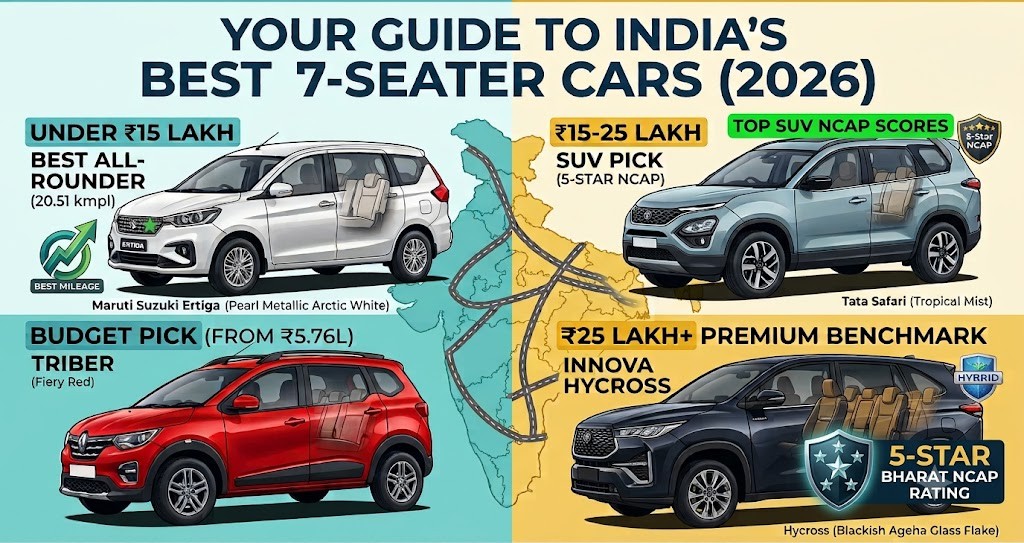
Quick answer: For most Indian families, the Maruti Suzuki Ertiga (₹8.85-12.99 lakh, 20.51 kmpl petrol ARAI) is the best all-round pick under ₹15 lakh. On a tight budget, the Renault Triber (from ₹5.76 lakh) is the cheapest genuine 7-seater. If budget stretches past ₹19 lakh, the Toyota Innova Hycross is the benchmark for a third row adults can actually use.
Best 7-Seater Cars in India (2026): Quick Ranked Shortlist
All prices below are ex-showroom, cross-checked across multiple market listings (July 2026) — figures vary slightly by source and city, so treat each as a band rather than a fixed number.
| Model | Price Range (ex-showroom) | Budget Band | Why It’s Here |
|---|---|---|---|
| Renault Triber | ₹5.76-8.69 lakh | Under ₹10L | Cheapest way into 7 seats; clever sub-4m packaging |
| Nissan Gravite | ₹5.73-9.09 lakh | Under ₹10L | Newest entrant (Feb 2026), flexible 2-7 seat layout |
| Mahindra Bolero | ₹8.49-9.99 lakh | Under ₹10L | Rugged, body-on-frame alternative to hatchback-based MPVs |
| Maruti Suzuki Ertiga | ₹8.85-12.99 lakh | ₹10-15L | Best-mileage petrol/CNG all-rounder, strong resale |
| Kia Carens | ₹11.02-12.88 lakh | ₹10-15L | More premium cabin and features than the Ertiga |
| Toyota Rumion | ₹9.79-14.21 lakh | ₹10-15L | Toyota reliability and service network on an Ertiga-based platform |
| Mahindra XUV700 / XUV 7XO | ₹13.99-25.79 lakh | ₹15-25L | ADAS + 5-star Global NCAP adult rating, feature-loaded |
| Tata Safari | ₹13.39L onwards (official) | ₹15-25L | 5-star Global & Bharat NCAP, commanding road presence |
| Hyundai Alcazar | ₹14.50-21.20 lakh | ₹15-25L | Most premium cabin in this band, 6- or 7-seat choice |
| Mahindra Scorpio N | ₹13.49-24.95 lakh | ₹15-25L | Body-on-frame toughness, strong value at the top end |
| Toyota Innova Hycross | ₹18.70-31.84 lakh | ₹25L+ (spans both bands) | The genuinely usable-adult-third-row benchmark; 5-star Bharat NCAP |
| Toyota Innova Crysta | ~₹19.72 lakh | ₹25L+ | Diesel workhorse for those who want the old formula |
| Jeep Meridian | ₹23.33-38.17 lakh | ₹25L+ | European road manners, premium positioning |
| Toyota Fortuner | ₹34.76-50.46 lakh | ₹25L+ | Body-on-frame flagship, strongest resale in its class |
Best 7-Seater Cars Under ₹10 Lakh
This band is genuinely for occasional third-row use — none of these three give adults a comfortable long-distance third row, but they’re the only way into 7 seats without a loan payment that hurts.
The Renault Triber remains the cheapest route to 7 seats, priced ₹5.76-8.69 lakh across current listings; Renault’s own configurator shows a narrower ₹5,80,875-8,00,350 ex-showroom band, so expect some city/dealer variation. It seats 5 to 7 with a removable third row that Renault markets around “over 100” seating and cargo combinations — genuinely clever packaging for a sub-4-metre car, but the third row itself is snug, best for children on short trips. See our Renault Triber facelift coverage for what’s changing on the next-generation model.
The Nissan Gravite is the newest name here — Nissan launched it in India in February 2026 at an introductory ₹5.65 lakh, and by July 2026 aggregators list the range at ₹5.73-9.09 lakh. It’s Nissan’s first real 7-seater push in years, with seating flexible “from 2 to 7 occupants.” Worth a test drive precisely because it’s unproven in the used/resale market yet — go in with that caveat.
The Mahindra Bolero (₹8.49-9.99 lakh on Mahindra’s official site) is the odd one out: a body-on-frame, diesel-only workhorse rather than a car-based MPV. It trades cabin polish for genuine ruggedness and a mHawk75 diesel with a reputation for shrugging off bad roads — a sensible pick for rural/semi-urban buyers over city-first families. Renault’s Duster is separately expected to gain a 7-seat variant; that’s a testing-stage vehicle, not yet on sale, so it isn’t part of this ranked shortlist — see our Renault Duster 7-seater spy report if you’re willing to wait rather than buy today.
Best 7-Seater Cars ₹10-15 Lakh
This is the segment’s genuine sweet spot — where mileage, cabin space and running cost line up best for a family that uses all 7 seats reasonably often.
The Maruti Suzuki Ertiga starts at ₹8,85,000 ex-showroom (confirmed on Maruti Suzuki’s own Ertiga page) and runs to ₹12.99 lakh across variants. It’s the segment’s default recommendation for good reason: strong resale, Maruti’s dealer/service reach, and a genuine CNG option most rivals don’t offer. That reputation holds up in long-term ownership: Autocar India’s Ertiga owner-reviews page (rated 3.7/5 across 11 owner ratings as of July 2026) is full of high-kilometre CNG stories — one owner, Shankar, writes, “I am using the Ertiga CNG since 2017 and have enjoyed it a lot. It has covered 126,000 km,” while another, Gaurav Agarwal, singles out the real-world seating edge over rivals: “The Ertiga is the only one that actually seats six when parents join.” See the dedicated mileage section below for a correction on the “26.1 kmpl” figure widely quoted for this car.
The Kia Carens (from ₹11,01,900 per Kia’s official price page, running to about ₹12.88 lakh) undercuts the Ertiga on cabin features and design flair while sitting slightly above it on price — a reasonable upgrade pick if you want a more premium-feeling interior and don’t need CNG.
The Toyota Rumion (₹9.79-14.21 lakh, ARAI-rated 20.51 kmpl) is mechanically related to the Ertiga but sold through Toyota’s network — pick it if you specifically value Toyota’s service reputation over Maruti’s, since the underlying hardware is close to identical.
Best 7-Seater SUVs ₹15-25 Lakh
Genuine caveat before this section: most vehicles here are “5+2” layouts — two occasional-use rear jump seats behind a proper 5-seat cabin, not a true 3-row MPV. They’re fine for children on trips under a couple of hours; adults will find the last row tight for anything longer.
The Mahindra XUV700 is priced ₹13.99-25.79 lakh and remains the ADAS and safety benchmark in this band — it was crash-tested by Global NCAP at 5 stars for adult occupant protection and 4 stars for child occupant protection. One accuracy note worth knowing before you shop: Mahindra facelifted and renamed this SUV to the XUV 7XO in January 2026. It is the same vehicle underneath — no mechanical changes, same engines — just a cosmetic and feature update with a new name, so don’t treat “XUV700” and “XUV 7XO” listings as two different cars. Our XUV700 on-road price breakdown has the full variant-wise numbers.
The Tata Safari‘s official ex-showroom price starts at ₹13.39 lakh (per Tata Motors’ own price page), with aggregator listings showing a range up to roughly ₹26.76 lakh across top variants. Safari and its Harrier sibling were the first SUVs to earn a 5-star Bharat NCAP rating for both adult and child occupant protection, and the Safari separately holds a 5-star Global NCAP rating — genuinely class-leading safety credentials for this price band.
The Hyundai Alcazar starts at ₹14,50,700 ex-showroom on Hyundai’s own site and runs to about ₹21.20 lakh, offered in both 6-seater (captain seats) and 7-seater (bench) configurations — the most premium-feeling cabin in this group, though it trails the Safari and XUV700 on outright road presence.
The Mahindra Scorpio N (₹13.49-24.95 lakh) is the value pick for buyers who want body-on-frame toughness without the Safari’s extra premium — less overtly urban than its rivals here but strong for those prioritising ground clearance and a rugged image.
Best Premium 7-Seaters Above ₹25 Lakh
The Toyota Innova Hycross is the benchmark for genuine adult-usable third-row seating and straddles this band and the one below — priced ₹18.70-31.84 lakh across variants, with the strong-hybrid trims specifically running ₹26.76-31.84 lakh. It’s ARAI-rated at 23.24 kmpl on the hybrid powertrain (some secondary sources quote a lower approximate ~21 kmpl figure — treat the ARAI-certified 23.24 kmpl as the reference number). It also holds a 5-star Bharat NCAP rating for both adult and child occupant protection. That adult-third-row claim is backed by testing rather than brochure copy: in Autocar India’s road test the reviewers found the third row “quite bright and airy, so even adults will be comfortable on long drives without feeling worse for wear,” and rated its “flat and composed ride” among the car’s real strengths; their instrumented test returned 13.10 kmpl in the city and 16.10 kmpl on the highway on the hybrid — well short of the 23.24 kmpl ARAI figure, as lab numbers always are, but strong for a three-row vehicle this size. If your budget clears ₹19-20 lakh and third-row comfort for adults genuinely matters, this is the car to beat.
The Toyota Innova Crysta (reported around ₹19.72 lakh) is the older diesel formula still sold alongside the Hycross for buyers who prefer a conventional diesel to the hybrid’s petrol-only setup.
The Jeep Meridian (₹23.33-38.17 lakh) brings European ride and handling manners with genuinely usable third-row space, positioned as a premium alternative for buyers who want something less common on Indian roads than a Fortuner or XUV700.
The Toyota Fortuner (₹34.76-50.46 lakh, confirmed independently across market listings) sits at the top as the segment’s body-on-frame flagship — buyers here are typically less price-sensitive and more focused on road presence, off-road capability and Toyota’s exceptional resale value.
Electric buyers should note the Mahindra XEV 9S, reported at roughly ₹20.65-30.70 lakh, as an emerging option — treat this figure as provisional pending wider price confirmation as the electric 7-seat segment is still new.
Best Mileage & CNG 7-Seater Options
Two very different efficiency stories dominate this segment, and one popular claim needs correcting.
Maruti’s own site rates the Ertiga’s petrol engine at 20.51 kmpl ARAI, and its CNG variant at 26.11 km/kg. Several price-comparison sites report the Ertiga’s “best mileage” as “26.1 kmpl” — that figure is real, but it’s the CNG variant’s km/kg rating, not a petrol kmpl number; km/kg and kmpl aren’t directly comparable units (CNG has different energy density and per-kg pricing to petrol). If you’re cross-shopping on efficiency, use 20.51 kmpl for petrol and 26.11 km/kg for CNG, not “26.1 kmpl” as a blanket figure.
At the premium end, the Toyota Innova Hycross‘s strong-hybrid powertrain is ARAI-rated at 23.24 kmpl — remarkable for a 3-row vehicle this size, and it runs on regular petrol with none of the CNG refuelling-station hunting. The trade-off is upfront cost: the Hycross costs roughly double an Ertiga. For high-mileage owners (daily long commutes, ride-hailing, frequent highway runs), the Ertiga CNG’s per-km running cost is hard to beat on pure fuel spend; for owners prioritising refinement and resale with less obsessive attention to fuel cost, the Hycross hybrid wins on comfort per rupee spent on fuel over a longer ownership period.
MPV vs SUV: Which Third Row Actually Works for Your Family
This is the distinction most competing roundups gloss over, and it’s the single most useful thing to understand before shortlisting: true 3-row MPVs (Ertiga, Carens, Rumion, Triber, Innova Hycross/Crysta) are engineered from the floor up for three real rows — the second row usually slides, and the third row, while tightest in the Triber, is a genuine seat rather than an afterthought. Most 5+2 SUVs (XUV700/7XO, Safari, Scorpio N, Alcazar, Fortuner, Meridian) bolt a folding two-seat bench onto what is fundamentally a 5-seat cabin — legroom, headroom and entry/exit are compromised for row three, and adults will feel it within an hour on the road.
The practical rule: if the third row is for your own kids on regular family trips, an MPV serves them better and costs less to run. If the third row is mostly for occasional guests, school-run overflow, or short local trips, a 5+2 SUV’s other advantages — road presence, safety kit, ground clearance — become the more relevant trade-off. Buying the wrong category for your actual usage pattern is the single biggest source of 7-seater buyer’s remorse.
Common Mistakes Buyers Make When Choosing a 7-Seater
Three mistakes account for most of the regretted 7-seater purchases we see discussed by buyers and dealers:
- Overestimating third-row usage frequency. Be honest about how often you’ll actually fill all 7 seats. If it’s occasional, a Triber or Ertiga saves you lakhs over a full-size SUV whose extra capability you’ll rarely use.
- Budgeting on EMI alone, ignoring running costs. Count the running cost, not just the EMI. The Ertiga (petrol/CNG) and Hycross (hybrid) are meaningfully cheaper to run day-to-day than a diesel SUV, even if the SUV’s EMI looks similar.
- Undervaluing safety ratings versus feature lists. It’s easy to be swept up by sunroof and infotainment specs while skipping the crash-test rating. Prioritise safety ratings — the XUV700/XUV 7XO and Safari both carry 5-star crash-test credentials, worth paying for with a family aboard, and the Innova Hycross’s 5-star Bharat NCAP score matters just as much at the premium end.
Related reading: our roundup of 5-star NCAP-rated cars in India is a useful cross-check regardless of which 7-seater you shortlist. If your real need is closer to a 9-to-17-seat people-mover for larger groups rather than a family car, our Tata Winger Plus review covers that adjacent, higher-capacity category.
Budget-to-Pick Cheat Sheet
For skimmers: here is the whole guide condensed to one pick per budget band.
| Budget | Best Pick | Why |
|---|---|---|
| Under ₹10 lakh | Renault Triber | Cheapest genuine 7-seater; fine for occasional third-row use |
| ₹10-15 lakh | Maruti Suzuki Ertiga | Best all-round mileage, resale and running cost balance |
| ₹15-25 lakh | Tata Safari or Mahindra XUV700/7XO | Best safety credentials in the SUV band (both 5-star tested) |
| ₹25 lakh+ | Toyota Innova Hycross | The only vehicle here with a genuinely usable adult third row plus 5-star safety |
Frequently Asked Questions
Which is the best 7 seater car in India?
There’s no single “best” — it depends on budget and how the third row will actually be used. The Ertiga (₹8.85-12.99 lakh) is the best all-rounder under ₹15 lakh, the Triber (from ₹5.76 lakh) is the cheapest genuine option, and the Innova Hycross (from ₹18.70 lakh) is the benchmark once budget allows for a truly adult-usable third row.
Which is the best 7 seater car under 10 lakh?
The Renault Triber (₹5.76-8.69 lakh) is the cheapest way into 7 seats. The Nissan Gravite (launched at ₹5.65 lakh, now ₹5.73-9.09 lakh) and the body-on-frame Mahindra Bolero (₹8.49-9.99 lakh) are the other two realistic options in this band.
Which 7 seater car has the best mileage?
Among petrol cars, the Maruti Ertiga‘s 20.51 kmpl ARAI rating leads mainstream MPVs; its CNG variant is rated 26.11 km/kg (a different unit, not directly comparable to kmpl, despite being widely misquoted as “26.1 kmpl”). Among premium hybrids, the Toyota Innova Hycross’s 23.24 kmpl ARAI rating is exceptional for a 3-row vehicle of its size.
Are 7 seater cars available with a CNG option?
Yes — the Maruti Suzuki Ertiga is the main mainstream 7-seater sold with a factory CNG option in India, rated 26.11 km/kg, making it the go-to choice for high-mileage or cost-conscious buyers who still want three rows.
Which 7 seater car is best for a family with a sunroof?
Within ₹10-15 lakh, the Kia Carens offers a more feature-rich cabin (including sunroof options on higher trims) than the Ertiga. Above ₹15 lakh, the Hyundai Alcazar and Mahindra XUV700/XUV 7XO both offer sunroof-equipped top trims alongside stronger safety kit.
Is a 5+2 SUV as good as a true 7-seater MPV for a family?
Not for regular adult use of the third row. 5+2 SUVs like the XUV700/7XO, Safari and Scorpio N are fine for children on short trips, but true 3-row MPVs and the Innova Hycross give noticeably better third-row legroom and access for adults on longer journeys. Choose based on how the third row will actually be used, not just on badge or road presence.