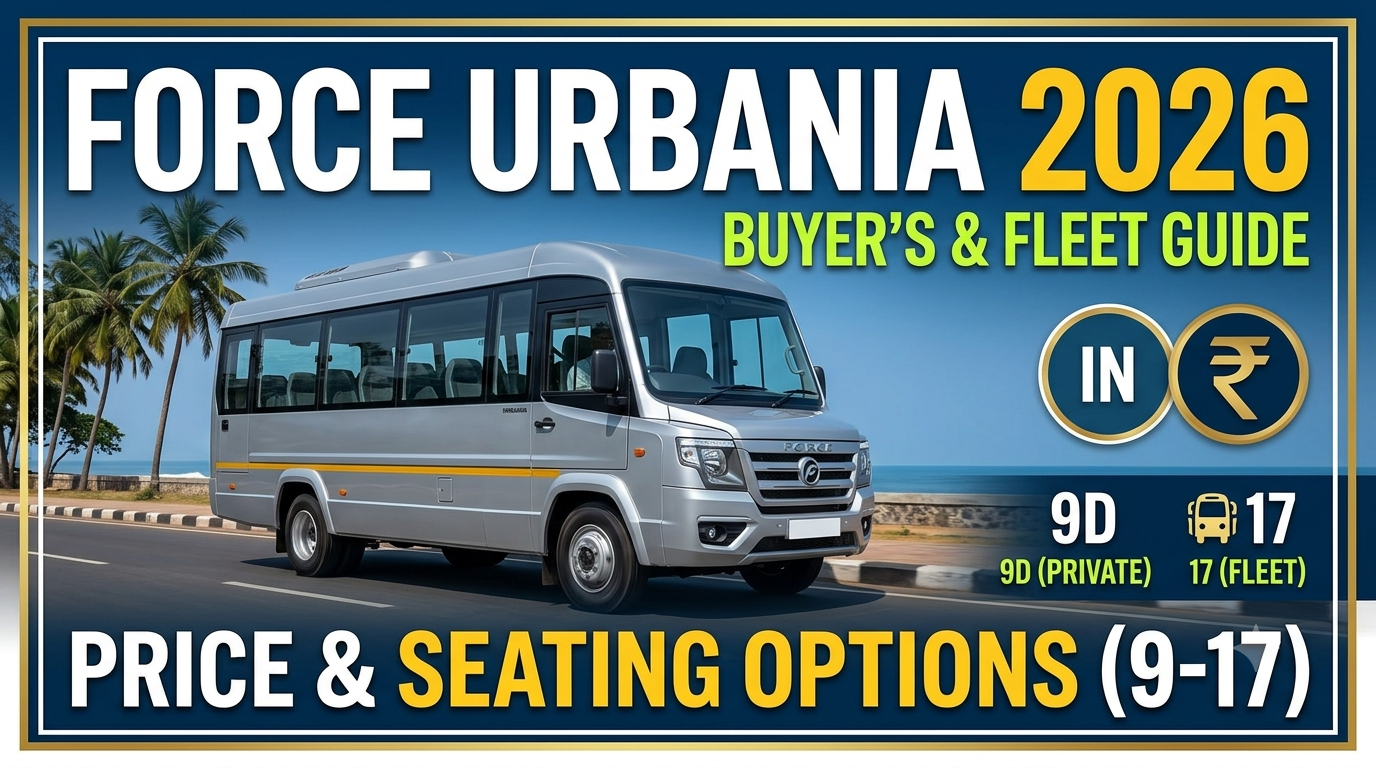
Walk into a school transport committee meeting, a corporate admin’s office, or a tour operator’s fleet yard anywhere in urban India, and one name keeps coming up for premium group transport: the Force Urbania. It isn’t a car and it isn’t quite a “tempo traveller” in the old sense either — it’s a purpose-built institutional minibus, seating anywhere from 9 (in its private-registration-friendly trims) to 17, that has quietly become the default upgrade from the ageing Tata Winger and the generic 12-seater vans parked outside every corporate park in the country.
This guide is built for the people who actually buy these vehicles — fleet managers, school transport committees, tour and hotel operators, and a growing number of large families who’ve simply outgrown their MPV. Below: the full 8-variant price list, what each seating configuration is actually good for, real-world mileage (not just the ARAI number), a worked EMI example, and a straight comparison against the Tata Winger, the generic Tempo Traveller class, and the Mercedes-Benz Sprinter.
What is the price of Force Urbania in India?
Force Urbania ex-showroom prices are quoted in two different ranges depending on the source: auto-classifieds like CarDekho and ZigWheels list ₹26.34 lakh to ₹31.83 lakh, while Force Motors’ own official price list shows ₹28.68 lakh to ₹34.04 lakh. Across 8 variants and three wheelbases, seating runs 9 to 17. On-road prices run roughly 10-15% higher — confirm the current figure with your dealer.
Force Urbania Price in India (2026) — All 8 Variants
Force Motors does publish an official price list (see the reconciliation note below the table), but auto-classifieds remain the more commonly cited source for this segment because they break prices down by the exact variant/seating combination buyers search for. The table below cross-checks two independent classifieds sources (CarDekho and ZigWheels), which agree on both variant structure and pricing within a few thousand rupees of each other.
| Variant | Wheelbase | Seating | Ex-Showroom Price |
|---|---|---|---|
| 3350WB 10-Str | 3350mm | 10 | ₹26.34 lakh |
| 3350WB 11-Str | 3350mm | 11 | ₹26.34 lakh |
| 3615WB 14-Str | 3615mm | 14 | ₹28.89 lakh |
| 3615WB 10-Str | 3615mm | 10 | ₹29.01 lakh |
| 3615WB 13-Str | 3615mm | 13 | ₹29.11 lakh |
| 4400WB 14-Str | 4400mm | 14 | ₹31.61 lakh |
| 4400WB 17-Str | 4400mm | 17 | ₹31.68 lakh |
| 4400WB 13-Str | 4400mm | 13 | ₹31.83 lakh |
A few things stand out. First, seating count doesn’t rise in a straight line with price — the 3615WB 14-seater (₹28.89 lakh) is actually cheaper than the 3615WB 10-seater (₹29.01 lakh) on the same wheelbase, because the difference comes down to seat spacing and trim rather than raw capacity. Second, on-road price adds a further 10-15% on top of ex-showroom, depending on your state’s RTO tax slab, insurance (institutional/commercial insurance is costlier than private), and registration category — always get a state-specific on-road quote before budgeting.
A price discrepancy worth flagging, not hiding: Force Motors’ own official price list shows a noticeably higher range for the same 8-variant lineup — ₹28.68 lakh to ₹34.04 lakh ex-showroom. Auto-classifieds (CarDekho, ZigWheels) consistently show the lower ₹26.34L-₹31.83L range used in the table above, which may reflect an older price list, a different city’s ex-showroom base, or an AC-inclusive figure quoted against a different trim mix — the two sources don’t reconcile cleanly. Treat the table above as a reliable STRUCTURE and RELATIVE-pricing guide (which variant costs more than which), but get a dealer quote for the exact number before budgeting — don’t anchor on either figure as gospel.
Seating Configurations Explained: 9 to 17-Seater
The Urbania is built on three distinct wheelbases, and which one you need depends entirely on your use case, not just headcount. One nuance that trips up first-time buyers: seating counts are quoted two different ways across sources. Force Motors’ own official price list (forcemotors.com/prices) labels seating excluding the driver — a “9D” variant means 9 passenger seats plus the driver (10 people on board total) — and lists this 9-seat configuration on both the 3350WB and 3615WB wheelbases.
Some experts do count the driver as one of the total seats, so the same base 3350WB trim shows up as a “10-seater.” This matters most because the 9-passenger-plus-driver configuration is specifically the one relevant to private (“white plate”) registration in most states, not just a rounding difference.
- 3350WB (9-seater/9D or 10/11-seater depending on source): The shortest, most manoeuvrable option, and the one most commonly bought for private registration. Best for corporate shuttle routes in dense city traffic where turning radius matters more than capacity, or for the emerging private buyer segment — families or groups who’ve outgrown a 7-seat MPV but don’t need a full-size bus.
- 3615WB (9-seater/9D or 10/12/13/14-seater depending on source): The volume seller and, per CarDekho’s own notes, the “sweet spot” for most operators. This wheelbase balances capacity with everyday driveability, making it the default pick for school transport committees running fixed routes; it’s also the medium-wheelbase option that offers a 9-seat private-registration variant.
- 4400WB (12/13/14/16/17-seater depending on source): The long-wheelbase option, and the only one that gets you to the top-end capacity (16 or 17 seats, depending on whether the source counts the driver). This is the tour-operator and hotel-fleet configuration — long highway stints, more luggage room, and the lowest per-seat cost at full occupancy. No 9-seat private-registration option is offered on this wheelbase.
A common buyer question worth addressing directly: the Urbania is available only as a diesel with a 5-speed manual gearbox — there is no automatic or AMT variant at any seating configuration, and no CNG option either.
Engine, Performance & Real-World Mileage
Every Urbania variant shares the same drivetrain: a 2596cc diesel engine producing 114 bhp at 2,950 rpm and 350 Nm of torque between 1,400-2,200 rpm, paired exclusively with a 5-speed manual transmission. Ground clearance is rated at 200mm, which matters for the broken approach roads common outside tier-2 school campuses and hotel driveways.
ARAI’s certified figure is 11 kmpl — but that number is measured under a fixed test cycle, not how these vehicles are actually run. Fleet-cost breakdowns show a wider, load-dependent range: roughly 7-8 kmpl in city/stop-start traffic, climbing to 9-10 kmpl on the highway at full passenger load, and up to 11-12 kmpl on the highway when running near-empty.
If you’re budgeting fuel cost for a full-time school route (city driving, full load, twice a day), plan around the lower end of that band, not the ARAI number — the gap between claimed and real-world mileage here is genuinely wide enough to change your per-km cost.
Who Should Buy the Force Urbania? (Schools, Corporates, Tour Operators, Private Buyers)
The Urbania isn’t a one-size-fits-all purchase. Here’s how it maps to the four buyer profiles actually researching this vehicle:
- School transport committees: Per-seat cost and safety are the deciding factors. The 3615WB 13/14-seater variants offer the best balance — enough capacity to justify the per-child cost, with dual airbags, ABS, EBD and ESP as standard across the range, which matters for compliance-conscious school boards.
- Corporate fleet managers: Comfort and a professional look for client pickups and daily staff shuttles matter more than outright capacity. The compact 3350WB variants suit dense city routes, while the triple-AC cabin and reclining seats read as a genuine upgrade over a shared cab or an ageing Tata Winger.
- Tour and hotel operators: The 4400WB 17-seater is built for this job — maximum capacity per trip, more luggage space, and reclining seats with individual reading lamps and USB charging that guests actually notice on a multi-hour transfer.
- Private/large-family buyers: Families who’ve outgrown a 7-seat MPV have started opting for the smaller, hybrid buses for personal use. It’s a secondary segment, not the primary market, but it’s real: the specific configuration that qualifies for private (“white plate”) registration is the 9-seat (“9D”) variant on the 3350WB or 3615WB wheelbase.
The honest way to frame this decision: don’t buy by seat count alone. A school committee choosing the 17-seater purely to “maximise capacity per trip” without checking the 4400WB’s longer turning radius against its actual campus gate and drop-off lane width is a common, avoidable mistake. Similarly, a tour operator buying the compact 3350WB to save on ex-showroom price will find the shorter wheelbase noticeably less comfortable on multi-hour highway stretches than the 4400WB. Match the wheelbase to the route, not just the invoice.
Force Urbania vs Tempo Traveller vs Tata Winger vs Mercedes Sprinter — Which Should You Choose?
This is where most price-aggregator pages stop short — they list specs but don’t actually tell you which vehicle fits which job. Here’s the honest comparison:
| Vehicle | Approx. Price Range | Seating | Engine | Best For |
|---|---|---|---|---|
| Force Urbania | ₹26.34L-31.83L (classifieds) / ₹28.68L-34.04L (OEM) | 9-17 | 2596cc diesel, 114bhp | Premium institutional transport — schools, corporate, tour |
| Tata Winger (Staff/Cargo/Tourist/School range) | ~₹13L – ₹16L (Staff variant); up to ~₹25L+ across ambulance/other body styles | 9-15 (Staff); up to 20+ across body styles | 2200cc diesel, 98bhp | Budget-conscious fleets prioritising lower upfront cost over cabin premium |
| “Tempo Traveller” (generic class) | Varies widely by brand/seating (~₹10L-₹35L+) | 9-26 depending on model | Varies by manufacturer | A market category name, not a single product — see note below |
| Mercedes-Benz Sprinter | ~₹51.7 lakh (resale-market listing) | Up to 15-19 (global spec) | 2.0L diesel (global spec) | Ultra-premium/import buyers only — not a mainstream India option |
A genuinely useful fact competitors skip: “Tempo Traveller” is often searched as if it’s a specific model, but it’s actually a generic category name in India — originally the name of a Force-built van manufactured under licence from Daimler-Benz (Mercedes-Benz’s parent). Force has since retired that specific Daimler-Benz-licensed lineage — though Force still sells a current, differently-badged “Traveller N” van range alongside the Urbania — and the Urbania is effectively the modern, more premium tier above it.
When people search “Force Urbania vs Tempo Traveller,” they’re really asking Urbania-vs-generic-budget-van — vehicles closer in spirit to the Tata Ace Passenger (Tata Magic) or the smaller vans covered in our Mahindra mini-truck and van comparison, not a direct current Force product.
On the Mercedes-Benz Sprinter: it is not officially retailed through Mercedes-Benz India’s dealer network as a passenger minibus. Listings that surface in India (reported around ₹51.7 lakh as of July 2026) are resale/import-market vehicles, not new-vehicle purchases backed by factory warranty or an authorised India service network.
What’s genuinely new vs the outgoing lineup: Nothing structural has changed — the 8-variant spread, the 2596cc/114bhp engine, and the 5-speed-manual-only gearbox are the same as when the Urbania first went on sale. What has moved is context: the Winger and generic tempo-traveller options around it have gotten pricier too, which is why the Urbania’s premium over them has narrowed slightly in relative terms even though its own sticker price hasn’t dropped.
| Item | Status |
|---|---|
| 2026 facelift / generation change | Not confirmed — no dealer or OEM signal of an imminent update |
| Automatic/AMT variant | Not available; no confirmed plan to add one |
| CNG variant | Not available on any current variant |
| 8-variant price/seating structure | Confirmed unchanged in variant COUNT, but sources disagree on exact seat-count labels and price: Force Motors’ own price list uses “excluding driver” counts (9D/12D/13D/16D-style) at ₹28.68L-₹34.04L, while CarDekho/ZigWheels use driver-inclusive counts (10/13/14/17-style) at ₹26.34L-₹31.83L — confirm both seat count and price with a dealer before ordering |
| Colour lineup (White, Grey) | Confirmed unchanged |
Should you wait? verdict: No update or facelift is currently expected for the Urbania — this is a mature, stable product line (on sale in India since 2023) with no signal of an imminent refresh. If the price and spec sheet above work for your use case at the moment, there’s no reason to delay a purchase decision waiting for a “2026 model”.
EMI, Down Payment & Running Costs
Here’s a worked out, illustrative financing example based on a mid-range 4400WB variant:
- Ex-showroom price: ₹30,50,000
- Estimated on-road price (Ludhiana): ₹34,00,000
- Down payment (20%): ₹6,80,000
- Loan amount (80%): ₹27,20,000
- Tenure: 5 years (60 months)
- Interest rate: 9.5% – 10.5%
- Estimated monthly EMI: ₹57,000 – ₹59,000
These numbers will shift with your city (registration/insurance costs vary by state), your lender’s commercial-vehicle interest slab, and your down payment percentage — treat this as a planning anchor, not a quote.
Commercial/passenger-carrying insurance on a vehicle in this class runs meaningfully higher than a private car policy of similar value, since it’s rated on seating capacity and commercial usage rather than private ownership — get an actual premium quote for your registration category before finalising a monthly budget.
If your fleet also runs smaller support vehicles alongside the Urbania — a maintenance van or a light cargo run — it’s worth cross-checking options like the Mahindra Supro for that lighter-duty leg of the operation rather than over-specifying a second Urbania.
On the operating side, annual routine maintenance (engine servicing, suspension greasing, tyre rotation, brake checks, electrical work across 10,000-15,000 km service intervals) is estimated at ₹26,000 to ₹42,000 per year. Combined with fuel, per-km running cost works out to roughly ₹9-12.50 per km depending on load and driving conditions — city/full-load routes sit at the higher end, empty highway running at the lower end.
Key Features & Safety
Across the range, the Urbania is fitted with:
- Triple-zone AC (a genuine differentiator for full-bus cooling on long routes)
- 7-inch touchscreen infotainment with wired Android Auto and Apple CarPlay
- Reclining seats with individual reading lamps, USB charging points and bottle holders at every seat
- Power windows
- Dual airbags, ABS, EBD and Electronic Stability Program (ESP)
- Hill-hold assist and all-wheel disc brakes
- 200mm ground clearance for uneven campus/hotel driveways
Colour options are limited to two: White and Grey — a deliberately fleet-friendly choice rather than a retail-car palette, which tracks with the vehicle’s institutional-first positioning.
It’s worth noting what’s absent too: there’s no factory CNG kit, no automatic gearbox, and no all-wheel-drive variant at any trim — buyers coming from a private-car mindset sometimes assume these will be available as a higher-spec option, and they simply aren’t on this platform today.
Before you end your research, make sure to check out the Force Motor’s Official Page listing for all the latest data.
Frequently Asked Questions
Is the Force Urbania available with CNG or an automatic transmission?
No. Every Urbania variant is diesel-only with a 5-speed manual gearbox — there is no CNG option and no automatic/AMT variant currently offered.
Can the Force Urbania be registered as a private vehicle?
Yes — specifically the 9-seat (“9D”) configuration on the 3350WB or 3615WB wheelbase (9 passenger seats plus the driver, per Force Motors’ own official price list), which is the trim commonly used for private (“white plate”) registration since a 9-passenger-plus-driver cap is the threshold many RTOs apply. Confirm the exact registration category (private vs commercial/LMV) and current RTO rule with your local RTO, since rules can vary by state.
What is the real-world mileage of the Force Urbania, not just the ARAI figure?
ARAI’s certified figure is 11 kmpl, but real-world fleet data shows a range of roughly 7-8 kmpl in city traffic, 9-10 kmpl on the highway at full load, and 9-12 kmpl on the highway when lightly loaded. Budget on the lower end for daily school-route usage.
How much is the booking amount and what’s the waiting period for a Force Urbania?
Booking amounts and waiting periods vary by dealership and city stock availability; since Force Motors does not publish this centrally, confirm current figures directly with your nearest Force Motors dealer before budgeting a delivery timeline.
What colours does the Force Urbania come in?
Two colour options are offered: White and Grey, in line with its institutional/fleet positioning rather than a retail-car colour palette.
How does the Force Urbania compare with the Tata Winger on running cost?
The Winger’s smaller 2200cc/98bhp engine and lower price make it the cheaper upfront and likely cheaper-to-run option per trip, but the Urbania’s larger cabin, triple AC and reclining seats justify its premium for operators where passenger comfort (school comfort standards, corporate image, tourist satisfaction) is part of the value proposition, not just per-km cost.