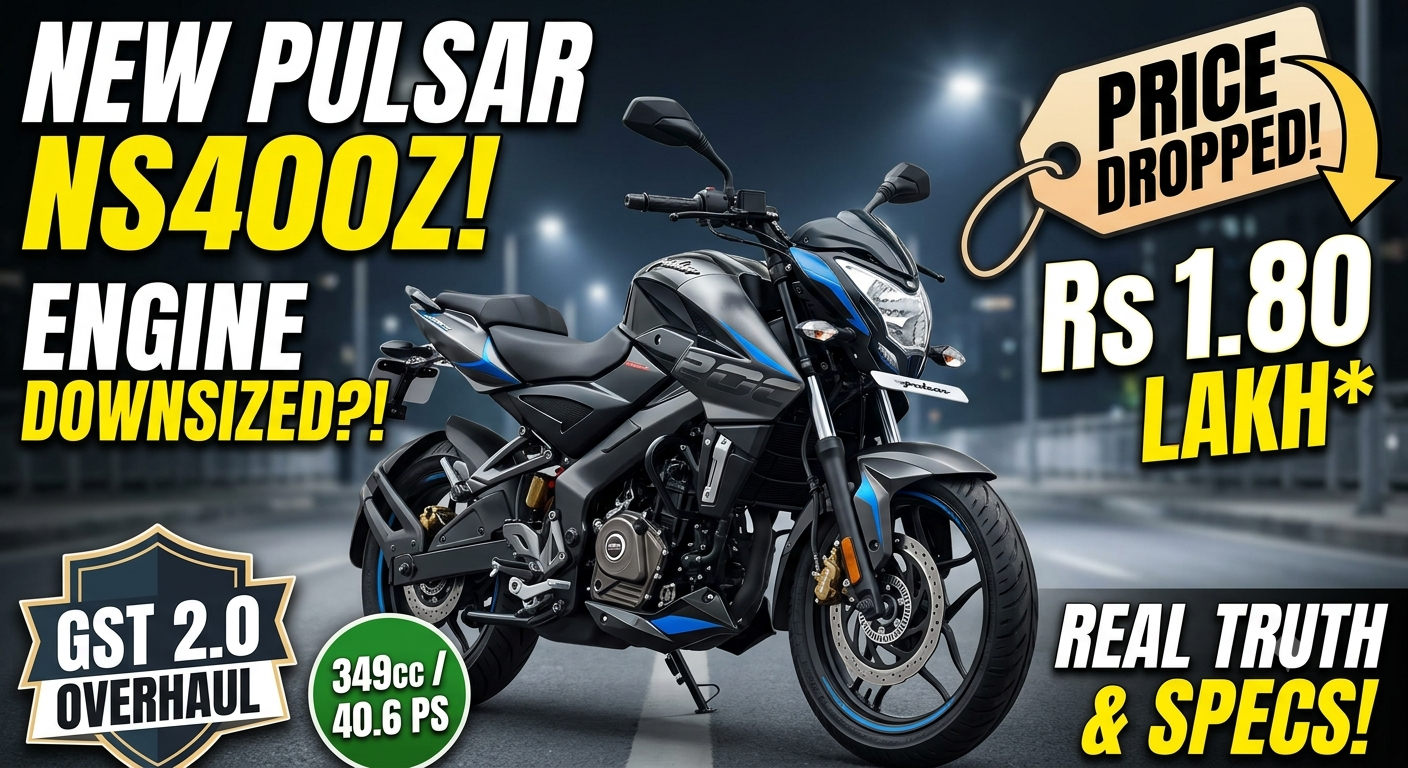
Bajaj just did something Indian two-wheeler buyers rarely see: it made an engine smaller on purpose. The Bajaj Pulsar NS400Z price has dropped by roughly Rs 24,500 to around Rs 1.80 lakh ex-showroom — not through a discount, but because Bajaj re-engineered the motorcycle’s engine from 373.27cc down to 349.13cc specifically to land it in a lower GST tax bracket.
This piece breaks down exactly how that GST math works, verifies the real spec changes with numbers (not marketing lines), and answers the question every shopper actually has: how much performance did you really lose, and is this cheaper Pulsar still worth buying?
The timing matters too. India’s GST overhaul on two-wheelers, effective September 2025, redrew the line between “affordable” and “premium” motorcycles at exactly 350cc — and the Pulsar NS400Z sat right on the wrong side of it. But what Bajaj did next is the real story here.
Bajaj Pulsar NS400Z 2026: What Changed and Why
To understand why Bajaj shrank an engine, you first need the tax backdrop. Before September 2025, all two-wheelers above 350cc attracted 28% GST plus a 3% cess — a combined 31% tax incidence. India’s GST 2.0 overhaul replaced that with a simpler two-slab system: motorcycles up to 350cc now attract 18% GST, while anything above 350cc jumps to a steep 40%, according to 91Wheels’ coverage of the GST 2.0 rollout.
At launch of the new tax structure, Bajaj’s first move was simply to eat the cost: the company confirmed it would absorb the GST hike on the Pulsar NS400Z and Dominar 400, keeping ex-showroom prices unchanged at around Rs 1.93 lakh despite the 373cc engine now falling in the 40% bracket.
That was the stopgap. The real fix came later: The company re-engineered the Bajaj Pulsar NS400Z with a new 349.13cc engine, deliberately sized to slip under the 350cc line and qualify for the 18% slab instead, as reported by ETV Bharat.
The result isn’t just a price hold — it’s an actual price cut, down to roughly Rs 1.80-1.82 lakh ex-showroom, a saving of about Rs 24,500 once reduced insurance and registration costs are factored in.
Engine & Performance: The 373cc to 349cc Story Explained
The outgoing Pulsar NS400Z used a 373.27cc, liquid-cooled, DOHC 4-valve single that made up to 43 PS in Sport mode and 35 Nm of torque, following a 2025 update that bumped power from an earlier 40 PS. That’s the engine you’ll still see quoted on some bike-listing pages that haven’t been refreshed for 2026 — treat any Bajaj Pulsar NS400Z spec sheet citing 373cc/43PS as the previous model, not the current one.
The current 2026 engine is a smaller 349.13cc unit, still liquid-cooled with DOHC and 4 valves, producing 40.6 PS (40.04 bhp) at 9,000 rpm and 33.2 Nm of torque at 7,500 rpm, paired with a 6-speed gearbox that retains an assist-and-slipper clutch and Bajaj’s software-based Sport-Shift clutchless quickshifter.
Do the maths and the loss is small: about 2.4 PS and under 2 Nm compared with the outgoing Sport-mode figures — a gap most riders won’t notice outside a drag strip, especially since peak torque now arrives slightly earlier in the rev range.
Full Specifications: Bajaj Pulsar NS400Z (2026, 349cc)
| Specification | Detail |
|---|---|
| Engine | 349.13cc, liquid-cooled, DOHC, 4-valve, single-cylinder |
| Max Power | 40.6 PS (40.04 bhp) @ 9,000 rpm |
| Max Torque | 33.2 Nm @ 7,500 rpm |
| Transmission | 6-speed, assist & slipper clutch, Sport-Shift quickshifter |
| Front Suspension | 43mm USD forks |
| Rear Suspension | Monoshock |
| Front Brake | 320mm disc |
| Rear Brake | 230mm disc, sintered pads |
| ABS | Dual-channel, mode-specific tuning |
| Tyres | 110/70-17 (front), 150/60-17 (rear), radial |
| Wheelbase | 1,346mm |
| Ground Clearance | 165mm |
| Seat Height | 807mm |
| Fuel Tank | 12 litres |
| Kerb Weight | ~176 kg |
| Mileage (ARAI-claimed) | ~35 kmpl |
Source: Bajaj Auto’s official Pulsar NS400Z product page and BikeDekho’s specification listing. Note: kerb weight is confirmed at 176 kg by BikeDekho; a small number of listings cite a slightly higher figure with fuel and fluids topped up — treat 176 kg (dry/base) as the reference figure.
The claimed mileage figure itself varies by listing — BikeDekho cites ~35 kmpl while 91Wheels lists a lower 28.5 kmpl ARAI-adjacent figure for the platform — so treat ~35 kmpl as the higher-end claimed figure, not a settled number. See the Real-World Ride Quality section below for the fuller mileage picture and what owners actually report.
Bajaj Pulsar NS400Z Price & Variants in India: How Cheaper Is It, Really?
Here’s the before-and-after that matters to buyers: the outgoing 373cc Bajaj Pulsar NS400Z was priced at Rs 1.93 lakh ex-showroom.
The new 349cc model is priced between Rs 1,80,092 and Rs 1,82,174 ex-showroom Delhi depending on the source and exact billing date, which works out to a saving of roughly Rs 24,500 once the knock-on reduction in insurance and RTO registration costs (both calculated as a percentage of ex-showroom price) is included.
On-road prices in major cities range from about Rs 1.96 lakh (Delhi, per Autocar India) to Rs 2.14-2.20 lakh in cities with higher RTO charges such as Mumbai, Pune, and Chennai.
The Pulsar NS400Z is sold in a single variant with no trim hierarchy to navigate, offered in four colour options: Brooklyn Black, Pearl Metallic White, Glossy Racing Red, and Pewter Grey. EMI options start from roughly Rs 2,900-6,200 per month depending on the down payment and tenure selected.
Chassis, Suspension & Braking
The hardware underneath carries over largely unchanged from the outgoing model. Up front, 43mm upside-down forks (finished in a champagne-gold tone) handle damping duties, paired with a rear monoshock.
Braking comes from a 320mm front disc and a 230mm rear disc with sintered pads, backed by dual-channel ABS that Bajaj tunes differently depending on the selected ride mode — a more relaxed intervention threshold in Off-Road mode, tighter in Sport. Radial tyres front and rear (a 150-section rear tyre) give the NS400Z meaningfully more grip than most bikes in its price bracket, which still run cross-ply rubber.
Features & Technology
Four ride modes — Road, Rain, Sport, and Off-Road — each retune throttle response, ABS intervention, and traction control behaviour. Traction control itself is switchable in Sport and Off-Road modes for riders who want to disable it.
The Bluetooth-enabled colour LCD console handles turn-by-turn navigation, call and music alerts, and even a lap timer for track days, while an LED projector headlamp with a signature lightning-bolt DRL rounds out the styling. The Sport-Shift quickshifter — a clutchless up/down-shift system — remains one of the most talked-about features at this price point, since it’s rarely offered on bikes under Rs 2 lakh.
Real-World Ride Quality & Ownership Feedback
Spec sheets only tell half the story. In practical terms, the gap between the outgoing 43 PS/35 Nm Sport-mode tune and the current 40.6 PS/33.2 Nm figures is small enough — about 2.4 PS and under 2 Nm — that most riders are unlikely to notice it outside back-to-back testing or a drag strip, especially in everyday city and highway riding where the bike rarely holds peak revs for long stretches.
Owner-reported mileage tells a more mixed story than the ARAI-claimed ~35 kmpl figure suggests — and even the “official” figure itself isn’t fully settled across listings: 91Wheels lists a lower ARAI-adjacent figure of 28.5 kmpl for the platform (not a real-world average, despite how some aggregators present it — 91Wheels’ own owner-mileage data for this bike is still too thin to draw a real-world conclusion from).
What real owners actually report, is that real-world experience clusters around 25-28 kmpl in city riding and climbs to roughly 32-39 kmpl on steady highway runs at 70-100 km/h, with sport-mode city riding dropping as low as 20 kmpl — a wide, riding-style-dependent spread that’s fairly typical for performance-oriented naked motorcycles in this class, but worth setting expectations around before you buy.
Running the numbers on cost: at a illustrative reference fuel price of around Rs 95/litre (check your local pump price, as this varies by state and month), a realistic mixed-use average of ~27 kmpl works out to roughly Rs 3.5 per km in fuel alone — closer to Rs 3 per km if you mostly ride highway stretches at 35+ kmpl, and closer to Rs 4.75 per km in stop-start city sport-mode riding at ~20 kmpl.
Add routine service costs (Bajaj’s authorised network typically prices basic services for this segment in the Rs 1,500-2,500 per visit range), and the NS400Z’s real running cost sits comfortably in line with other 300-400cc naked motorcycles — the smaller 349cc engine does not meaningfully change the ownership-cost picture versus the outgoing 373cc bike.
On refinement, feedback is more encouraging on the newer engine than it was on earlier Bajaj Pulsar NS400 iterations. Reviewers note a noticeable improvement in NVH (noise, vibration, harshness) at highway cruising speeds of 80-100 km/h compared with earlier versions of the platform, though some owners still flag mild vibrations creeping in at high RPM — consistent with the long-standing criticism of “high-rpm engine vibrations” and a “firm seat”.
Bajaj Pulsar NS400Z vs TVS Apache RTR 310 vs KTM 250 Duke
The NS400Z’s new price positions it in an interesting gap between two very different rivals: the more powerful, pricier TVS Apache RTR 310-class naked bikes, and the smaller-capacity, cheaper KTM 250 Duke.
It’s worth noting the Bajaj Pulsar NS400Z now competes on price with sub-300cc bikes while matching displacement closer to premium naked streetfighters like the Aprilia Tuono 457 Special Edition we reviewed recently — a useful reference point if you’re curious how far up the segment ladder the extra spend actually buys you. Here’s how the numbers stack up against its two closest direct rivals.
| Model | Ex-showroom Price | Engine | Power / Torque | Kerb Weight | Claimed Mileage |
|---|---|---|---|---|---|
| Bajaj Pulsar NS400Z (2026) | ~Rs 1.80-1.82 lakh | 349.13cc | 40.6 PS / 33.2 Nm | ~176 kg | ~35 kmpl (ARAI) |
| TVS Apache RTR 310 | ~Rs 2.25-2.90 lakh | 312.12cc | 35.08 bhp / 28.7 Nm | 169 kg | ~32 kmpl |
| KTM 250 Duke (2026) | ~Rs 2.13 lakh | 249.07cc | 30.57 bhp / 25 Nm | 162.8 kg | ~30 kmpl (ARAI) |
On paper, the Bajaj Pulsar NS400Z undercuts the TVS Apache RTR 310 by nearly Rs 45,000-1 lakh depending on variant while still out-powering and out-torquing it — a genuinely strong value proposition if outright numbers are what you’re shopping on.
Buyers cross-shopping faired sports bikes around this budget should also look at the Hero Karizma XMR 250, which competes on price if not outright naked-bike styling. Against the KTM 250 Duke — a close relative given Bajaj and KTM’s manufacturing partnership, and closely related to the smaller KTM Duke 160 further down the lineup.
Here the story flips: the Duke is cheaper on ex-showroom price but gives away nearly 10 PS and 8 Nm to the Bajaj, along with KTM’s sharper, more track-focused chassis tuning that some riders will prefer over the NS400Z’s more relaxed street setup.
Neither rival has gone through a similar GST-driven engine change, so the NS400Z remains the only bike in this trio whose spec sheet changed specifically because of tax policy rather than a model-year refresh.
Should You Buy the Bajaj Pulsar NS400Z? Verdict
The Bajaj Pulsar NS400Z 2026 makes a strong case for buyers who want big-bike looks, a proper USD fork and dual-channel ABS, and a quickshifter — features usually reserved for bikes well above Rs 2 lakh — without actually spending Rs 2 lakh.
The GST-driven downsize genuinely worked in the buyer’s favour here: you’re paying Rs 24,500 less than the outgoing bike for a real-world performance difference that’s close to imperceptible on the street. If your budget tops out around Rs 1.8-1.9 lakh and you want the most engine and equipment for the money, this is currently one of the strongest options in the segment.
It’s a harder recommendation for two kinds of buyers. If peak power and a sharper handling character matter more to you than outright value, the TVS Apache RTR 310’s higher state of tune and more track-oriented chassis are worth the extra spend.
And if real-world fuel efficiency is your primary concern, the gap between the claimed 35 kmpl and the realistic 24-29 kmpl owners are actually reporting is worth sitting with before you commit — this remains a performance-first naked bike, not a mileage champion.
Our take: this is a rare case of a manufacturer’s tax-driven engineering decision genuinely benefiting the buyer rather than being a marketing spin on a cost-cutting measure. The 349cc Bajaj Pulsar NS400Z gives up very little and gains a meaningfully lower price — for value-focused buyers in the 350cc naked-bike bracket, it’s currently hard to beat.
Frequently Asked Questions
Why did Bajaj reduce the Pulsar NS400Z’s engine size to 349cc?
India’s GST 2.0 reform, effective September 2025, set 350cc as the dividing line for motorcycle taxation: bikes up to 350cc attract 18% GST, while anything larger is taxed at 40%. Bajaj initially absorbed the higher tax on the outgoing 373cc Pulsar NS400Z to keep prices unchanged, then re-engineered the bike with a smaller 349.13cc engine to actually qualify for the lower 18% slab, cutting the price by about Rs 24,500.
What is the on-road price of the Bajaj Pulsar NS400Z in major cities?
Ex-showroom price is around Rs 1,80,092-1,82,174 depending on source and billing date. On-road price varies by city due to differing RTO and insurance costs: expect roughly Rs 1.96 lakh in Delhi and up to Rs 2.14-2.20 lakh in cities like Mumbai, Pune, and Chennai. Confirm the exact figure with your local Bajaj dealership.
How much performance did buyers actually lose with the smaller engine?
Not much. The outgoing 373cc engine made up to 43 PS and 35 Nm in Sport mode; the new 349cc engine makes 40.6 PS and 33.2 Nm — a drop of about 2.4 PS and under 2 Nm. That gap is small enough that most riders are unlikely to notice it in everyday or even spirited street riding.
How does the Bajaj Pulsar NS400Z compare to the TVS Apache RTR 310?
The Bajaj Pulsar NS400Z is significantly cheaper (~Rs 1.80-1.82 lakh vs ~Rs 2.25-2.90 lakh for the Apache RTR 310) while offering more displacement, power, and torque. The Apache RTR 310 counters with a more track-focused chassis tune and TVS’s established performance-bike reputation. For buyers prioritising value and outright numbers, the NS400Z has the edge; for a sharper handling character, the Apache RTR 310 is worth the extra spend.
Is the older 373cc Bajaj Pulsar NS400Z still available anywhere?
Bajaj has moved production to the 349cc engine, so new stock of the 373cc version is largely unavailable through official dealerships. A small amount of old, pre-transition dealer stock may still exist in some markets, but Bajaj’s official listings and current advertising exclusively reference the 349cc, 40.6 PS specification going forward.