Search “best scooty under ₹1 lakh” on any listing site and you’ll hit a wall of 60-70+ models sorted by price alone, with no indication of which one actually fits your life. A college student commuting 15 km a day, a parent doing the school run with a full boot of groceries, and someone weighing an electric scooter for the first time are shopping for three different scooters — even though they’re all technically browsing the same budget band.
This guide skips the flat price list. It’s organised by use-case — best overall, best mileage, best for families, best sporty pick, and best electric — with a clear petrol-vs-electric verdict for this specific ₹1 lakh budget, because that’s the decision most buyers actually get stuck on. If two-wheelers rather than scooters are on your radar too, our Best Bike Under ₹1 Lakh in India guide covers the motorcycle side of this exact budget band.
Which Is the Best Scooty Under ₹1 Lakh in India?
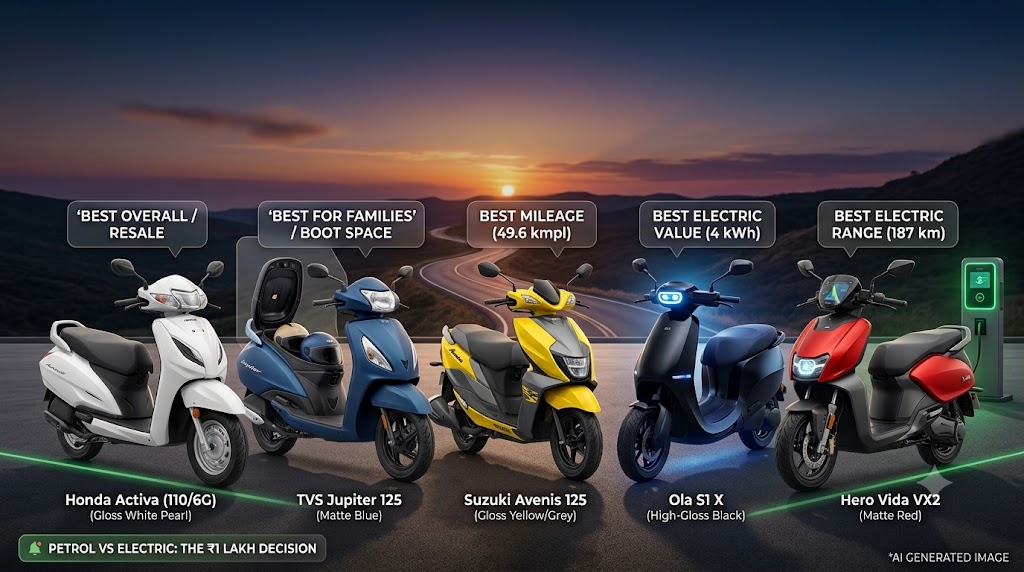
The Honda Activa is the best overall pick under ₹1 lakh for reliability and resale value. The TVS Jupiter 125 and Suzuki Avenis 125 lead on mileage (49.6-50 kmpl claimed), and the Ola S1 X is the strongest electric pick if you can charge at home. Figures are ex-showroom, as of July 2026.
Best Scooty Under ₹1 Lakh: Quick Ranked Shortlist
A fast, at-a-glance view across both petrol and electric options. Prices are approximate ex-showroom (Delhi) ranges — they vary a little by source and city, so treat them as a band, not a fixed number.
| Model | Type | Price Range (ex-showroom) | Mileage / Range | Best For |
|---|---|---|---|---|
| Honda Activa (110/6G) | Petrol, 109.51cc | ₹75,958 – ₹92,470 | ~47 kmpl | Best overall / resale |
| TVS Jupiter 125 | Petrol, 124.8cc | ₹86,000 – ₹95,370 | 50 kmpl (claimed) | Best for families |
| Suzuki Avenis 125 | Petrol, 124cc | ₹88,093 – ₹93,030 | 49.6 kmpl (ARAI) | Best mileage |
| TVS Ntorq 125 | Petrol, 124.8cc | ₹82,500 – ₹1.01 lakh | 48.5 kmpl claimed (~41 real-world) | Best sporty / youth pick |
| Suzuki Access 125 | Petrol, 124cc | ₹81,585 – ₹1.02 lakh | ~47 kmpl | All-rounder alternative |
| Ola S1 X | Electric, 2-5.2 kWh | ₹69,999 – ₹1.49 lakh* | 108 – 320 km (IDC) | Best electric value |
| Hero Vida VX2 | Electric, 2.2-4.4 kWh | ₹79,490 – ₹1.5 lakh* | 92 – 187 km (IDC) | Best electric range |
*Electric scooter pricing varies more than petrol between sources because it depends heavily on battery variant, state EV subsidy and ongoing offers — treat the electric price bands as directional, not final, and check the OEM’s booking page for your city.
Best Overall Scooty Under ₹1 Lakh
The Honda Activa, badged Activa 110 on Honda’s official site for current-generation models, is still the default answer for “which scooter should I buy” in India, and for good reason rather than habit. It uses a 109.51cc engine and returns around 47 kmpl in owner-reported real-world use per aggregated dealer and owner data, with ex-showroom pricing spanning roughly ₹75,958 to ₹92,470 depending on variant and city. It isn’t the most powerful or the most feature-loaded scooter here — it wins on the things that matter after year three: parts availability at literally every mechanic in the country, predictable resale value, and a service network that doesn’t require planning around a single authorised dealer.
The TVS Jupiter 125, per TVS Motor’s official product page, is the strongest challenger to Activa’s default status. At roughly ₹86,000-95,370 ex-showroom, it undercuts the top Activa variants slightly while offering a bigger 124.8cc engine, TVS-claimed 50 kmpl mileage, and — as covered below — genuinely useful practicality touches the Activa doesn’t match. If you’re cross-shopping strictly on riding refinement and features rather than brand-loyalty resale, Jupiter 125 is the one to test-ride before signing.
Best Mileage Scooty Under ₹1 Lakh
If fuel cost per kilometre is your primary filter, two models lead the segment: the TVS Jupiter 125 at a TVS-claimed 50 kmpl, and the Suzuki Avenis 125 at an ARAI-certified 49.6 kmpl. Both figures are close enough that the practical difference in your monthly fuel bill is marginal — pick based on which one you prefer to ride and which service network is closer to home.
The Avenis 125 is priced a touch higher, roughly ₹88,093-93,030 ex-showroom, and pitches itself as the more design-forward, youth-oriented option in Suzuki’s 125cc lineup, while carrying the same reliable Suzuki drivetrain as the Access 125.
One honest caveat: claimed mileage and real-world mileage are not the same number. The TVS Ntorq 125 is rated at 48.5 kmpl claimed, but owner and instrumented real-world figures commonly land closer to 41 kmpl — a reminder that sportier, higher-revving scooters (and aggressive city riding in general) eat into the claimed figure more than sedate commuters do. Budget your fuel costs against real-world numbers, not the number on the spec sheet — you can sanity-check any claimed figure against your own riding with our Mileage Calculator.
Best Scooty Under ₹1 Lakh for Families
For a scooter that does daily-errand duty — groceries, a child on the back, an unpredictable schedule — storage and low-effort ergonomics matter more than outright mileage. The TVS Jupiter is the strongest pick here: it packs a 33-litre underseat storage bin large enough to fit two helmets, and its fuel-filler cap sits externally at the front rather than under the seat, so you can top up fuel without unloading whatever’s stored underneath — a small detail that matters a lot when you’re using the boot daily.
Honda’s answer for this use-case is the Activa 125 (the larger-engine sibling of the standard Activa), which trades a little of the base Activa’s fuel efficiency for extra pulling power when riding two-up or carrying a loaded boot — useful if your typical ride involves a pillion rider more often than not. TVS Jupiter also has a comparatively low seat height, which matters if the primary rider is petite or if multiple household members of different heights will be sharing the scooter.
Best Sporty / Youth-Focused Scooty Under ₹1 Lakh
The TVS Ntorq 125 is the segment’s style-and-performance pick — sharper design, a full digital console with Bluetooth connectivity via TVS SmartXonnect, and the quickest-feeling acceleration among the models in this guide. Ex-showroom pricing runs approximately ₹82,500 to ₹1.01 lakh depending on variant (Disc, Race Edition, Race XP, Super Squad Edition, XT), using the same 124.8cc engine platform as the Jupiter 125 but tuned for punchier response rather than outright efficiency — which is exactly why its real-world mileage runs a few kmpl below the Jupiter’s despite the shared engine family.
If you want a scooter that looks and feels quicker off the line and you’re not chasing the last kmpl of fuel efficiency, Ntorq is the pick in this budget band.
Best Electric Scooter Under ₹1 Lakh
Electric pricing is genuinely messier to pin down than petrol in this budget band — the number you see depends heavily on which battery variant, which state’s EV subsidy, and which day’s promotional offer you’re looking at. With that caveat upfront, two models stand out.
The Ola S1 X is the most accessible entry point: Ola Electric’s own site lists the 4 kWh S1 X from ₹69,999 (introductory pricing), while the range-topping S1 X+ 5.2 kWh variant carries a claimed IDC range of 320 km and starts around ₹1.02-1.49 lakh depending on source and offers. The base 2 kWh variant is rated for roughly 108 km of IDC range — comfortably enough for most short daily commutes, though real-world range on any electric scooter typically runs 15-25% below the IDC figure once you factor in city traffic, AC usage of accessories, and aggressive throttle.
The Hero Vida VX2 is the other serious contender, spanning the entry Go 2.2 kWh (~92 km IDC range) up to the Plus 4.4 kWh (IDC-certified 187 km range), with ex-showroom pricing across sources running roughly ₹79,490 to ₹1.5 lakh depending on variant and city. The VX2 Plus 4.4 kWh in particular is worth cross-shopping against the S1 X+ if range anxiety is your main hesitation about going electric.
Two models worth flagging by way of context: the TVS iQube, a strong electric scooter in its own right, starts at roughly ₹1,13,753 ex-showroom for its entry 2.2 kWh variant — just over this guide’s ₹1 lakh ceiling, which is why it isn’t in the core picks above even though it’s a common cross-shop. And if a family-oriented electric scooter with a bigger boot is more your priority than raw price, it’s worth reading our Ather Rizta 2026 buyer’s guide and our head-to-head Honda Activa e vs Bajaj Chetak vs TVS iQube comparison — both sit just outside this budget but are common cross-shops for the same buyer.
Petrol vs Electric Under ₹1 Lakh: Which Should You Buy
This is the decision most buyers in this budget actually get stuck on, and the honest answer is: it depends on your charging access and daily distance, not on which technology is objectively “better.”
Petrol wins if: you don’t have reliable access to home or workplace charging, your daily distance is unpredictable or occasionally long (highway stretches, inter-city trips), you value the widest possible resale market and the fastest possible “refuel,” or you want the lowest-hassle ownership experience with the largest service network. Every petrol model in this guide can be refuelled in under two minutes at any of the thousands of pumps nationwide.
Electric wins if: you have home or society charging available, your daily commute is a predictable under-40 km round trip well within any of these scooters’ real-world range, and you want a materially lower running cost per kilometre plus near-zero scheduled maintenance (no engine oil, no clutch, far fewer moving parts to service). The catch is charging infrastructure away from home is still thin in most Indian cities compared to petrol pumps, and resale value data for electric scooters is less mature than for petrol models with a decade-plus track record. For a sense of how fast this segment is shifting, see our coverage of India’s electric scooter war and how TVS and Bajaj have reshaped the market.
For most first-time buyers in this exact budget band who are unsure, the safe default is still petrol — the Activa or Jupiter 125 — unless you can say with confidence that home charging will always be available. If that’s true for you, the Ola S1 X or Vida VX2 will very likely cost less to run over a 3-5 year ownership period.
On-Road Price & Running Cost: What to Budget Beyond the Sticker
Every price quoted above is ex-showroom — it does not include what you’ll actually pay at the dealership. On-road price = ex-showroom price + road tax + registration + mandatory insurance + a Tax Collected at Source (TCS) charge. Road tax on two-wheelers is calculated as a percentage of the ex-showroom price and typically ranges from 3% to 20% depending on the state, with an additional 1% TCS charge from the dealer, plus a mandatory third-party (or comprehensive) insurance premium. In practice, budget roughly 10-15% over the ex-showroom figure for most states, though it can run higher in states with steeper road tax slabs — work out an exact city-specific figure with our On-Road Price Calculator, or ask your dealer for the full on-road break-up before finalising a budget.
Running cost, worked example (illustrative, your actual costs will vary):
| Scenario | Assumption | Approx. Cost / km |
|---|---|---|
| Petrol (Activa, ~47 kmpl) | Petrol at ₹102.12/litre (Delhi, 18 July 2026) | ~₹2.17/km |
| Petrol (Jupiter 125, 50 kmpl claimed) | Same petrol price; real-world likely 5-15% below claimed | ~₹2.04-2.30/km |
| Electric (home charging) | Domestic tariff ₹3-14/unit (state-dependent); ₹8/unit mid-range assumption, ~2.5 kWh/100km | ~₹0.20-0.35/km |
The electric running-cost figure above is an estimate built on a mid-range domestic tariff assumption, not a fixed number — your actual per-unit rate depends entirely on your state and consumption slab, so treat it as directional. Even at the high end of the domestic tariff range, electric running cost per km stays well below petrol; the real question for most buyers isn’t running cost, it’s whether reliable home charging is actually available. To model your own monthly spend on any of these petrol picks, plug your distance and mileage into our Fuel Cost Calculator.
Common Mistakes Buyers Make Choosing a Scooty Under ₹1 Lakh
- Sorting by price alone and ignoring fit. The cheapest variant of any model often strips out features (like a fuel gauge, alloy wheels, or a bigger boot) that matter more day-to-day than the ₹3,000-5,000 you saved. Check boot space and seat height against your actual use-case before locking in on price.
- Going electric without confirming home-charging access first. An electric scooter’s low running cost only materialises if you can charge conveniently and consistently. If you live in a flat without a dedicated parking point near a socket, or you can’t guarantee overnight charging, the “savings” evaporate into range anxiety and inconvenient public charging.
- Underweighting resale value differences between brands. Petrol models from Honda and TVS generally hold resale value better than newer or lower-volume brands simply because used-scooter buyers trust what’s common and easy to get serviced. If you plan to sell in 3-4 years, factor this in — it can matter more than a few thousand rupees of difference in on-road price today.
Frequently Asked Questions
Which is the best scooty under 1 lakh in India?
For most buyers, the Honda Activa is the best all-round pick under ₹1 lakh thanks to its reliability and resale value, while the TVS Jupiter 125 and Suzuki Avenis 125 lead on mileage (49.6-50 kmpl claimed), and the Ola S1 X is the strongest electric option if you have reliable home charging.
Which is the best electric scooter under 1 lakh?
The Ola S1 X and Hero Vida VX2 are the two strongest electric options whose entry variants price under or close to ₹1 lakh, with IDC-rated ranges from roughly 92 km (VX2 Go) up to 320 km (S1 X+ 5.2 kWh). The TVS iQube is a strong alternative but its entry variant starts just above ₹1 lakh ex-showroom.
Which is the best mileage scooty under 1 lakh?
The TVS Jupiter 125 (50 kmpl claimed) and Suzuki Avenis 125 (49.6 kmpl ARAI-certified) currently lead the segment on claimed fuel efficiency among the models covered here. Real-world mileage typically runs a few kmpl below the claimed figure depending on riding style and traffic.
Does the on-road price for a scooty under 1 lakh vary a lot by city?
Yes — road tax on two-wheelers is state-specific and typically ranges from 3% to 20% of the ex-showroom price, plus a 1% TCS charge and mandatory insurance. As a rough rule of thumb, budget 10-15% over the ex-showroom figure for on-road price, but always confirm the exact break-up with your local dealer since it varies meaningfully by state.
Is it better to buy a petrol or electric scooter under 1 lakh?
If you have reliable home or workplace charging and a predictable daily commute under roughly 40 km, an electric scooter like the Ola S1 X or Hero Vida VX2 will likely cost less to run over a 3-5 year period. If your charging access is uncertain or you need flexibility for longer, unplanned rides, a petrol scooter like the Activa or Jupiter 125 remains the safer default.