
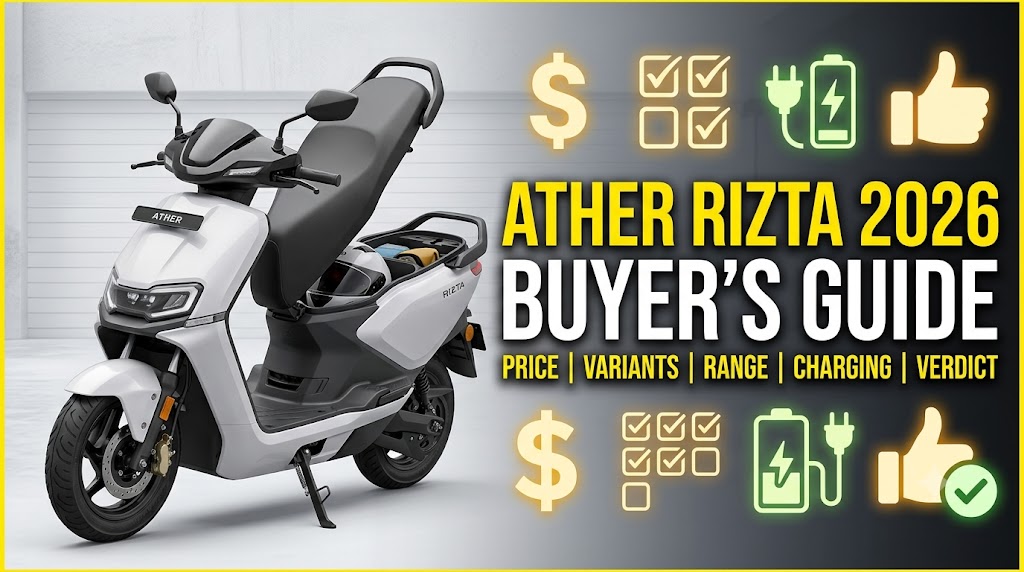
The Ather Rizta has crossed 3 lakh units sold since its April 2024 launch, establishing itself as India’s best-selling family electric scooter. But with four core variants across two trims and two battery sizes, choosing the right one can feel overwhelming. This Ather Rizta buyer guide 2026 cuts through the confusion — breaking down every variant, real-world range data, true charging times, running costs versus petrol scooters, maintenance expenses, and warranty options. Whether you are a daily office commuter, a family rider, or simply exploring the electric switch, this guide gives you the data-backed clarity to make the smartest purchase decision.
Ather Rizta 2026: Overview and What’s New
Positioned as Ather Energy’s family-focused electric scooter alongside the performance-oriented 450 series, the Rizta is built on an underbone chassis derived from the 450-series platform. Its defining traits are practicality and comfort: 56 litres of total storage (34L under-seat boot that fits a full-face helmet, plus a 22L optional frunk), the longest seat in the segment at 900 mm, and a flat floorboard for everyday convenience.
For 2026, Ather has introduced several notable updates. The new ParkSafe Alerts warn riders if the scooter is parked unsafely, while Crash Alert automatically notifies emergency contacts with the rider’s location in case of an accident. Voice on Ather enables natural voice interaction without wake words on the Z variant’s touchscreen. Additionally, Ather has expanded its fast-charging network to over 5,900 Ather Grid points across 370+ cities, significantly improving long-distance usability.
A price revision effective 1 June 2026 added approximately Rs 3,000-4,000 across the variant lineup. All prices mentioned in this guide are post-revision and include the PM e-Drive subsidy (formerly FAME-II), though the exact subsidy amount varies by state. As of June 2026, the Rizta remains eligible for central and most state-level EV subsidies, making it one of the most affordably priced family electric scooters in India.
Variants and Pricing: S vs Z, 2.9 kWh vs 3.7 kWh Explained
The Ather Rizta lineup is built around two trims (S and Z) and two battery sizes (2.9 kWh and 3.7 kWh), creating four core variants. Here is a clear breakdown of what you get at each price point (all prices ex-showroom, post PM e-Drive subsidy):
| Variant | Ex-Showroom Price* | Battery | IDC Range | Display | Key Feature Differences |
|---|---|---|---|---|---|
| S 2.9 kWh | Rs 1.20 lakh | 2.9 kWh Li-ion | 123 km | 7-inch DeepView LCD | Basic connectivity, Eco & Zip modes, CBS, reverse mode |
| S 3.7 kWh | Rs 1.43 lakh | 3.7 kWh Li-ion | 159 km | 7-inch DeepView LCD | Larger battery, same S-trim features, longer range |
| Z 2.9 kWh | Rs 1.37 lakh | 2.9 kWh Li-ion | 123 km | 7-inch TFT Touchscreen | Google Maps navigation, Magic Twist regen, SkidControl, Smart Eco mode, dual-tone seat, pillion backrest, WhatsApp previews, Alexa, Voice on Ather |
Z 3.7 kWh |
Rs 1.58 lakh |
3.7 kWh Li-ion |
159 km |
7-inch TFT Touchscreen |
All Z features + largest battery + best range |
*Prices shown are base Mono colour ex-showroom. Duo finishes add Rs 500; Super Matte finishes add Rs 1,000. Prices vary by city and state subsidy. As of June 2026.
On-road price estimates (Z 3.7 kWh variant): Delhi — approximately Rs 1.72 lakh | Mumbai — approximately Rs 1.75 lakh | Bengaluru — approximately Rs 1.70 lakh | Chennai — approximately Rs 1.73 lakh. On-road costs include registration, insurance, and road tax, which vary by state.
Feature gap between S and Z: The Z variant is worth the premium for most buyers. It adds the full TFT touchscreen with Google Maps turn-by-turn navigation, WhatsApp message previews, call and SMS alerts, Alexa integration, Magic Twist regenerative braking (which lets you control regen intensity via the throttle), SkidControl traction control for wet or sandy roads, Smart Eco mode, a dual-tone seat, pillion backrest, ParkSafe Alerts, Crash Alert, and Voice on Ather. If you plan to use the scooter for daily commuting with navigation, the Z is the clear choice.
Battery and Real-World Range: What to Actually Expect
Range anxiety remains the biggest concern for electric scooter buyers. Here is an honest breakdown comparing Ather’s IDC-claimed figures with real-world data gathered from owner reviews, media road tests, and long-term ownership reports.
| Condition | 2.9 kWh (IDC: 123 km) | 3.7 kWh (IDC: 159 km) |
|---|---|---|
| Eco mode, solo rider, flat terrain | 95-110 km | 120-140 km |
| Zip mode, solo rider, mixed terrain | 70-85 km | 90-110 km |
| Eco mode, with pillion, city traffic | 80-95 km | 105-125 km |
| Zip mode, with pillion, hilly terrain | 55-70 km | 75-90 km |
| Aggressive riding / hot weather (>40°C) | 50-65 km | 65-80 km |
According to Autocar India’s real-world range test, the 2.9 kWh variant delivered approximately 105 km under typical urban riding conditions — roughly 85% of the IDC claim. Owners on forums and review platforms consistently report 90-105 km from the smaller battery and 110-125 km from the 3.7 kWh pack under normal city commuting.
Why the gap between IDC and real-world? The IDC (Indian Driving Cycle) test is conducted at a steady 25 kmph with no stops, inclines, or pillion weight. Real-world riding involves acceleration, braking, hills, traffic, air conditioning weather, and passenger weight — all of which consume more energy. That said, the Rizta’s real-world efficiency is among the best in its class, partly because the heavier battery pack and smooth PMSM motor deliver consistent discharge curves.
Practical takeaway: If your daily commute is under 30 km (which covers over 80% of Indian urban commuters), even the 2.9 kWh variant offers 3-4 days of riding on a single charge. The 3.7 kWh variant is worth the premium if your daily run exceeds 40 km or if you frequently ride with a pillion.
Charging: Home Charging Times, Fast Charging and Ather Grid
Understanding charging is critical before buying any electric scooter. The Ather Rizta supports three charging methods:
| Charging Method | 2.9 kWh (0-80%) | 2.9 kWh (0-100%) | 3.7 kWh (0-80%) | 3.7 kWh (0-100%) |
|---|---|---|---|---|
| Portable charger (included, standard 15A socket) | 5 hrs 27 min | 8 hrs 18 min | — | — |
| Ather Duo charger (optional home charger) | 3 hrs 30 min | 5 hrs 30 min | 4 hrs 18 min | 6 hrs 6 min |
| Ather Grid fast charger (public) | 30 km range in 10 minutes (DC fast charge) | |||
Home charging is simpler than you think. The included portable charger plugs into any standard 15A household socket — no special wiring, no electrician visit required. For most buyers, the overnight charging strategy works perfectly: plug in before bed, wake up to a full battery. The optional Ather Duo charger (available separately) cuts charging time significantly and is recommended for the 3.7 kWh variants.
Ather’s fast-charging network, Ather Grid, has expanded to over 5,900 points across 370+ cities as of June 2026. While you will primarily charge at home, the Grid provides peace of mind for longer trips and top-ups during the day. You can locate the nearest charger via the Ather app or directly on the Z variant’s dashboard navigation.
Compared to rivals, the Honda Activa e uses swappable batteries that can be exchanged in under a minute at Honda swap stations — a fundamentally different approach. The TVS iQube charges in 2.5-4.2 hours depending on variant but has a smaller network of fast chargers. Each approach has trade-offs: Ather’s home charging is more convenient for daily use, while Honda’s swapping is faster but requires proximity to swap stations.
Performance and Ride Quality
The Ather Rizta is powered by a 4.3 kW permanent magnet synchronous motor (PMSM) producing 22 Nm of peak torque. Performance is identical across all four variants — the battery size affects range, not power output.
- Top speed: 80 kmph (electronically limited)
- 0-40 kmph: 4.7 seconds
- Riding modes: Eco and Zip (S variants); Eco, Zip, and Smart Eco (Z variants)
- Braking: 200 mm front disc + 130 mm rear drum with CBS (Combined Braking System)
- Suspension: Telescopic front forks + rear monoshock
On-road feel: In Eco mode, the Rizta is calm and efficient — ideal for relaxed city commuting but noticeably underpowered on steep inclines or when carrying a pillion. Switch to Zip mode for adequate acceleration that handles traffic gaps and mild gradients confidently. The throttle response is smooth and linear, making it beginner-friendly.
Two features stand out. Magic Twist (Z variants only) turns the throttle into a regenerative braking controller — twist it backward to increase regen intensity, feeding energy back into the battery. It is genuinely useful in stop-and-go traffic and becomes second nature within a week. SkidControl (also Z-only) provides traction control on wet or sandy roads, reducing wheel spin during acceleration — a practical safety feature during monsoon months.
The suspension setup — telescopic forks up front and a monoshock at the rear — handles typical Indian urban roads well. It absorbs speed bumps and potholes without drama, though riders coming from heavier ICE scooters may find the ride slightly firmer. The 150 mm ground clearance is adequate for most conditions but can scrape on aggressive speed bumps when loaded with a pillion.
Storage, Comfort and Practicality
This is where the Rizta genuinely differentiates itself from every other electric scooter in India.
- Total storage: 56 litres (34L under-seat boot + 22L optional frunk) — the most in any electric scooter sold in India
- Under-seat boot: 34 litres, large enough for a full-face helmet with room to spare
- Seat length: 900 mm — the longest seat in any scooter (electric or petrol) currently on sale in India
- Seat height: 780 mm — accessible for most riders
- Flat floorboard: Accommodates bags, groceries, or a child standing during short rides
- Kerb weight: 119 kg (2.9 kWh) to 125 kg (3.7 kWh)
- IP67 rated battery: Fully waterproof — safe to ride through waterlogged roads during monsoons
For families, the Rizta is purpose-built. The 900 mm seat comfortably accommodates rider and pillion without either feeling cramped. The Z variants include a pillion backrest for added comfort on longer rides. The flat floorboard makes it easy to carry shopping bags or position a child between rider and handlebar — a common use case in India that most electric scooters handle poorly due to battery placement.
The Rizta also supports the Ather Halo smart helmet with wireless charging — place the helmet on the seat and it charges via induction. While the Halo is a separate purchase, the integration is a thoughtful touch for the Ather ecosystem.
Technology and Smart Features
The technology gap between the S and Z variants is significant and should factor heavily into your buying decision.
Z variant (7-inch TFT touchscreen):
- Google Maps Platform integration with turn-by-turn navigation
- WhatsApp message previews and push navigation from WhatsApp (share a location on WhatsApp, navigate to it directly)
- Call and SMS alerts on dashboard
- Alexa Skills integration for voice commands
- Voice on Ather — natural voice interaction without wake words (new for 2026)
- Ping My Scooter — locate your parked scooter from the app
- Inter-city trip planner
- Auto-reply to incoming calls while riding
- Auto-brightness dashboard
- Digital document storage (license, RC)
- ParkSafe Alerts and Crash Alert (new for 2026)
- Live cricket scores on dashboard
S variant (7-inch DeepView LCD):
- Basic connectivity via Ather app
- Ride analytics and battery status
- Theft notifications
- OTA (over-the-air) software updates
- Reverse mode
Both variants receive OTA updates, which means Ather can add features and fix bugs remotely — something petrol scooters simply cannot do. The Ather app (available on Android and iOS) provides battery status, live location, ride analytics, and theft alerts for all variants.
Compared to the TVS electric scooter range with SmartXonnect and the Honda Activa e with RoadSync Duo, the Ather Z variant offers the most comprehensive connected experience in the segment. The S variant, however, lags behind even the TVS iQube’s base connectivity — something to consider if smart features matter to you.
Running Cost: Ather Rizta vs Petrol Scooters
This is the section most buyer guides skip — and it is arguably the most important factor in your purchase decision. Let us calculate the actual cost of ownership with transparent assumptions.
Assumptions: Electricity rate: Rs 8 per unit (kWh) — national average for domestic tariff. Petrol price: Rs 105 per litre (Delhi, June 2026). Daily commute: 30 km. Annual distance: approximately 9,000 km.
| Cost Component | Ather Rizta Z 3.7 kWh | Honda Activa 6G (petrol, 110cc) |
|---|---|---|
| Running cost per km | Rs 0.25 | Rs 2.63 |
| Annual fuel/electricity cost (9,000 km) | Rs 2,250 | Rs 23,625 |
| Annual maintenance | Rs 1,500-2,000 | Rs 3,500-4,500 |
| Annual insurance (comprehensive) | Rs 2,500 | Rs 3,000 |
| Total annual running cost | Rs 6,250-6,750 | Rs 30,125-31,125 |
| Annual savings with Ather | Rs 23,875-24,375 | |
5-Year Total Cost of Ownership (TCO) comparison:
| TCO Component | Ather Rizta Z 3.7 kWh | Honda Activa 6G (petrol) |
|---|---|---|
| Purchase price (on-road Delhi) | Rs 1.72 lakh | Rs 0.85 lakh |
| 5-year running costs | Rs 0.33 lakh | Rs 1.53 lakh |
| 5-year TCO | Rs 2.05 lakh | Rs 2.38 lakh |
| Resale value (estimated) | Rs 0.55 lakh | Rs 0.40 lakh |
| Net 5-year cost | Rs 1.50 lakh | Rs 1.98 lakh |
Bottom line: Despite a significantly higher purchase price, the Ather Rizta Z 3.7 kWh costs approximately Rs 48,000 less to own over five years compared to a petrol Honda Activa 6G, thanks to dramatically lower fuel and maintenance costs. The crossover point — where savings offset the higher purchase price — occurs at approximately 18-20 months for a daily 30 km commuter. If you ride more, the payback is even faster.
One rider on the Ecozaar long-term ownership review reported spending just Rs 30 to charge for 126 km of riding — a figure that makes petrol costs look almost absurd in comparison.
Maintenance, Warranty and After-Sales
Electric scooters have fundamentally fewer moving parts than petrol scooters, which translates directly into lower maintenance costs and simpler service requirements.
What you do NOT need to worry about: Oil changes, valve adjustments, clutch cables, air filters, spark plugs, carburettor cleaning. None of these exist on the Rizta.
What you DO need: Periodic brake pad replacement, tyre replacement (roughly every 15,000-20,000 km), software updates (delivered OTA at no cost), and an annual general inspection.
Estimated service cost: Rs 500-800 per service visit, with one or two visits recommended annually. This compares favourably to petrol scooters that typically cost Rs 1,500-2,500 per service with 2-3 visits per year.
Warranty Options
| Warranty Plan | Battery Coverage | Motor Coverage | Charger Coverage | Cost |
|---|---|---|---|---|
| Standard | 3 years / 30,000 km | 3 years / 30,000 km | 3 years | Included |
| Eight70 Extended | 8 years / 80,000 km | 3 years / 30,000 km | 3 years | Rs 4,999 |
The Eight70 warranty is Ather’s standout after-sales proposition. For a one-time payment of Rs 4,999, it extends battery coverage to 8 years or 80,000 km (whichever comes first). The critical clause: if battery health drops below 70% at any point during the warranty period, Ather replaces the battery free of charge. According to Ather’s official warranty documentation, this is one of the most comprehensive battery guarantees in the Indian electric two-wheeler market.
Our recommendation: The Eight70 warranty is a no-brainer at Rs 4,999. Battery replacement costs Rs 35,000-50,000 outside warranty — the Eight70 eliminates this risk entirely. Purchase it at the time of buying the scooter.
Service network: As of June 2026, Ather operates service centres across 150+ cities in India. While this is smaller than TVS (500+ touchpoints) and Honda (5,000+ service centres), Ather’s network has been expanding aggressively. Check Ather’s official website for service centre availability in your city before purchasing.
Ather Rizta vs TVS iQube vs Honda Activa e: Quick Comparison
Here is how the Ather Rizta stacks up against its two closest rivals in the electric scooter segment, along with the Bajaj Chetak as a secondary comparison. For a detailed look at Honda’s electric offering, read our Honda Activa e comparison.
| Parameter | Ather Rizta Z 3.7 kWh | TVS iQube ST 5.1 kWh | Honda Activa e | Bajaj Chetak 3501 |
|---|---|---|---|---|
| Price (ex-showroom) | Rs 1.58 lakh | Rs 1.70 lakh | Rs 1.17-1.52 lakh | Rs 1.50 lakh |
| Battery | 3.7 kWh (fixed) | 5.1 kWh (fixed) | 2 x 1.5 kWh (swappable) | 3.2 kWh (fixed) |
| IDC Range | 159 km | 212 km | 102 km | 137 km |
| Real-World Range (est.) | 110-125 km | 120-140 km | 75-90 km | 95-110 km |
| Motor Power | 4.3 kW | 4.4 kW | 6 kW | 4.08 kW |
| Torque | 22 Nm | 33 Nm | 22 Nm | 16 Nm |
| Top Speed | 80 kmph | 78 kmph | 80 kmph | 73 kmph |
| Charging (0-80%) | 4 hrs 18 min | 2 hrs 45 min | Battery swap (<1 min) | 3 hrs 25 min |
| Kerb Weight | 125 kg | 129 kg | 118 kg | 126 kg |
| Under-seat Storage | 34 litres | 32 litres | 18 litres | 14 litres |
| Display | 7-inch TFT touch | 7-inch TFT | 7-inch TFT | 5-inch TFT |
| Battery Warranty | 3 yr (8 yr with Eight70) | 5 years | 3 years | 5 years |
| User Rating | 4.5/5 | 3.7/5 | 4.6/5 | 4.0/5 |
Ather Rizta advantages: Best-in-class storage (56L total), longest seat (900 mm), best real-world range in its price bracket, Magic Twist regenerative braking, most advanced connected features (Z variant), OTA updates, Eight70 battery warranty option.
TVS iQube advantages: Highest range with 5.1 kWh battery, higher torque (33 Nm), fastest charging, largest service network (500+ touchpoints), 5-year battery warranty as standard. The iQube ST is the range champion but costs more. Also consider reading about the TVS Orbiter, TVS’s newest electric offering.
Honda Activa e advantages: Honda brand reliability and trust, swappable batteries for instant “refuelling,” lightest weight (118 kg), 6 kW motor (most powerful in this comparison). The swap model eliminates charging wait times entirely but depends on swap station proximity.
Bajaj Chetak advantages: Metal body construction (most durable build), lowest service costs (Rs 300-500 per visit), premium retro styling, Bajaj’s proven reliability. However, it has the least storage and lowest top speed in this group.
Expert Verdict: Which Ather Rizta Variant Should You Buy?
After analysing the specs, real-world data, ownership costs, and rival offerings, here is our clear recommendation broken down by buyer profile:
Budget buyer with a short commute (under 20 km daily): Buy the S 2.9 kWh (Rs 1.20 lakh). This is the most affordable entry point into the Ather ecosystem. The 2.9 kWh battery provides 3-5 days of riding on a single charge for a 15-20 km daily commute. You miss out on the fancy touchscreen and connected features, but the core scooter — motor, chassis, storage, comfort — is identical to the Z. If you simply want a reliable, affordable electric scooter for local errands, this is it.
Daily commuter riding 20-40 km: Buy the Z 2.9 kWh (Rs 1.37 lakh). This is our best-value pick. The Z trim’s Google Maps navigation, Magic Twist regen, and SkidControl traction control genuinely improve the daily riding experience. The 2.9 kWh battery handles a 30 km daily commute comfortably with 2-3 day charging intervals. The Rs 17,000 premium over the S variant is easily justified by the feature uplift.
Family use or longer range needs: Buy the Z 3.7 kWh (Rs 1.58 lakh). If you frequently ride with a pillion, make longer weekend trips, or simply want the peace of mind of a 110-125 km real-world range, the 3.7 kWh battery is worth the investment. Combined with the Z trim’s full feature set, this is the most complete Rizta you can buy. Add the Eight70 warranty (Rs 4,999) for 8-year battery peace of mind.
Who should NOT buy the Ather Rizta:
- Highway riders: The 80 kmph top speed limit makes it unsuitable for highway or expressway use. If you need highway capability, consider the Ather 450X or a petrol scooter.
- Buyers without home charging access: If you live in a rented apartment without a dedicated parking spot with a power socket, daily charging becomes impractical. The Ather Grid network is growing but is not yet a substitute for home charging.
- Buyers in areas without Ather service centres: Check Ather’s service network before purchasing. In cities without service centres, warranty claims and maintenance become difficult.
The electric two-wheeler market in India is evolving rapidly. For context on the broader EV landscape, our coverage of the Hero VIDA VX2 launch and the 2026 Tata Tiago EV update highlight how quickly this space is maturing across two-wheelers and four-wheelers alike.
Frequently Asked Questions
What is the real-world range of the Ather Rizta?
In typical city riding conditions (Eco mode, solo rider, flat roads), the 2.9 kWh variant delivers 90-105 km and the 3.7 kWh variant delivers 110-125 km. Autocar India’s independent test confirmed approximately 105 km from the 2.9 kWh battery. Range drops significantly in Zip mode, with a pillion, or in extreme heat — expect 55-80 km under aggressive conditions.
How much does it cost to charge the Ather Rizta at home?
At India’s average domestic electricity rate of Rs 8 per unit (kWh), a full charge costs approximately Rs 23 for the 2.9 kWh battery and Rs 30 for the 3.7 kWh battery. This translates to a running cost of roughly Rs 0.20-0.25 per km — about 10 times cheaper than a petrol scooter.
Which Ather Rizta variant is the best value for money?
The Z 2.9 kWh variant at Rs 1.37 lakh offers the best balance of features and price. It includes the full TFT touchscreen, Google Maps navigation, Magic Twist regenerative braking, and SkidControl traction control — features that genuinely enhance daily commuting. The 2.9 kWh battery is sufficient for commutes under 40 km per day.
Is the Ather Rizta suitable for family use with a pillion?
Yes, the Rizta is specifically designed as a family scooter. Its 900 mm seat (longest in any scooter in India), flat floorboard, 56 litres of total storage, and optional pillion backrest (standard on Z variants) make it one of the most pillion-friendly electric scooters available. The 4.3 kW motor handles pillion weight adequately in Zip mode, though expect a 15-20% reduction in range.
What is the Ather Eight70 warranty and is it worth buying?
The Eight70 warranty extends battery coverage from the standard 3 years / 30,000 km to 8 years / 80,000 km for a one-time payment of Rs 4,999. If battery health drops below 70% during this period, Ather replaces the battery free of charge. Given that a battery replacement costs Rs 35,000-50,000 outside warranty, the Eight70 is highly recommended — it eliminates the single biggest long-term cost risk of electric scooter ownership.
How does the Ather Rizta compare to the TVS iQube?
The Ather Rizta offers better storage (56L vs 32L), a longer seat, superior connected features (Z variant), and the Eight70 battery warranty option. The TVS iQube counters with higher torque (33 Nm vs 22 Nm), faster charging, longer range with the 5.1 kWh variant (212 km IDC), a larger service network, and a standard 5-year battery warranty. The Rizta suits family buyers who prioritise comfort and tech; the iQube suits performance-oriented riders who want maximum range.
Can I ride the Ather Rizta in rain and through waterlogged roads?
Yes. The Ather Rizta’s battery pack carries an IP67 rating, meaning it is fully protected against dust ingress and can withstand immersion in up to 1 metre of water for 30 minutes. Ather has tested the scooter extensively for monsoon conditions. The Z variant’s SkidControl traction control provides additional safety on wet roads.
2 thoughts on “Ather Rizta 2026 Buyer’s Guide: Price, Variants, Range, Charging & Verdict”