
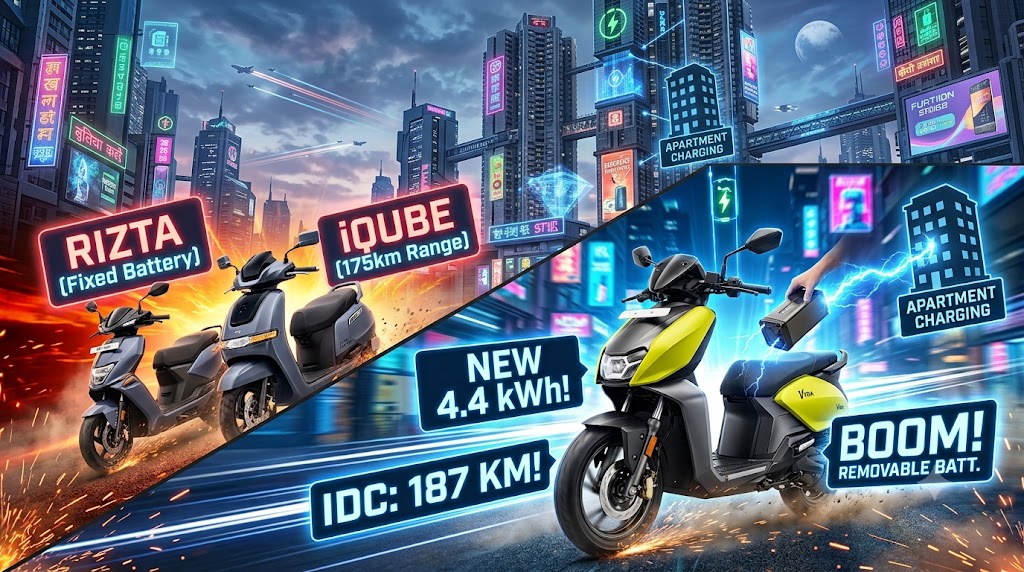
Hero Vida has doubled the storage-friendly, apartment-charging pitch of its VX2 Plus scooter with a second, bigger battery option. On 11 July 2026, the company launched the Hero Vida VX2 Plus 4.4 kWh at an ex-showroom price of roughly Rs 1.44 lakh, pushing the IDC-certified range from 146 km to a claimed 187 km — a jump that puts it squarely in the sights of the Ather Rizta and TVS iQube. This piece covers the confirmed Hero Vida VX2 Plus 4.4 kWh price, the two different ways Hero lets you buy it, the full spec sheet, and how it stacks up against the class’s biggest names.
The timing matters. India’s electric scooter segment is in an active range-and-price war, and Hero Vida quietly slotting a longer-range VX2 Plus above its existing 3.4 kWh version — without touching the design — is a direct answer to rivals that have spent the last year one-upping each other on claimed range. Deliveries begin end of July 2026.
What’s New: Hero Vida VX2 Plus 4.4 kWh Explained
The core change is the battery. Where the standard VX2 Plus uses a single 3.4 kWh removable pack, the new variant carries two removable 2.2 kWh lithium-ion battery packs that combine for 4.4 kWh of total capacity, according to Hero Vida’s official VX2 Plus product page. Nothing else about the scooter’s design, chassis, or motor mounting has changed — Hero has simply slotted a longer-range option above the existing VX2 Plus in the lineup, similar to how it introduced the 3.4 kWh Plus above the base VX2 Go.
Both batteries remain individually removable, which is the same practical pitch Hero has made since the original Vida VX2: owners without dedicated home charging can pull the packs out and charge them indoors on a regular wall socket, one at a time or together.
Hero Vida VX2 Plus 4.4 kWh Price & Variants in India
According to Hero Vida’s launch communication, the VX2 Plus 4.4 kWh carries an effective ex-showroom price of Rs 1,43,990 in Delhi (reported as roughly Rs 1.44 lakh ex-showroom Mumbai by other outlets, with the gap coming down to state-level EV incentives). That figure is corroborated by Autocar India‘s, Rushlane’s, AckoDrive’s, and Autopunditz’s launch-day coverage. For context, the outgoing single-battery 3.4 kWh VX2 Plus is priced meaningfully lower — reported anywhere between roughly Rs 93,000 and Rs 1.20 lakh ex-showroom depending on city and applicable state subsidy.
A quick word on the two price figures you’ll see floating around. Some coverage of this launch cites a lower figure of around Rs 1.14 lakh for the VX2 Plus 4.4 kWh. This is not a rival price for the same outright purchase — it appears to reflect Hero’s separate Battery-as-a-Service (BaaS) financing route, where the vehicle is billed differently because the buyer isn’t paying for the battery pack outright. Based on how Hero has structured BaaS on the existing VX2 line (confirmed via AckoDrive’s BaaS breakdown and BikeDekho’s coverage of the scheme), the mechanic works like this: the customer pays a sharply reduced upfront amount for the scooter body — historically around Rs 45,000 on the standard VX2 — and then pays a monthly subscription for battery use instead of owning the pack. On the VX2 Plus BaaS plans, a 2-year tenure with a 2,400 km/month allowance has been quoted at roughly Rs 2,160/month, working out to about Rs 0.90 per km, among the cheapest per-km rates in the VX2 range.
Exactly how the ~Rs 1.14 lakh figure maps onto the 4.4 kWh BaaS plan specifically is not consistently confirmed across sources at the time of writing — treat it as an indicative BaaS-adjusted number rather than a fixed on-paper price, and confirm the exact upfront amount and subscription slab for the 4.4 kWh variant with your local Vida showroom before booking. What is consistent across every source: Rs 1.44 lakh (ex-showroom) is the confirmed outright purchase price if you’re buying the battery outright with the scooter.
Battery, Range & Charging
Hero claims 187 km on the IDC (Indian Driving Cycle) test for the 4.4 kWh pack, up from 146 km on the 3.4 kWh version. It’s worth being upfront about what an IDC figure actually represents: it’s a standardised lab test run under controlled conditions, not a real-world commute with traffic signals, pillion load, AC-less summer heat, and throttle-happy riding. As a rule of thumb across the EV scooter segment, real-world range typically lands at 60–70% of the claimed IDC figure.
Owners of the outgoing 3.4 kWh VX2 Plus (146 km claimed on that variant’s own rating) have reported real-world figures of roughly 80–90 km in mixed city riding, including in Team-BHP’s ride observations and independent range tests — a ratio of almost exactly 60%. Applying that same ratio to the 4.4 kWh pack’s 187 km claim suggests owners should realistically plan for somewhere around 110–125 km per charge in everyday commuting, more in Eco mode, less if you’re regularly riding in Sport with a pillion.
Charging is where the dual-battery layout pays off. Using the 1 kW portable charger, both packs together go from 0–80% in about 3 hours 17 minutes, with a full 0–100% charge taking roughly 5 hours 8 minutes. Where the scooter is near a DC fast charger — Hero cites a network of over 6,000 fast-charging stations across India — a 0–80% top-up takes just 65 minutes. Because the packs are individually removable, owners can also pull one battery indoors to charge on a standard socket while the scooter sits parked, which is the whole point of the design for apartment dwellers without dedicated EV charging points.
Performance & Ride Specs
Power comes from a permanent-magnet synchronous motor rated at 6 kW (about 8.16 PS) peak power and 26 Nm of torque, sent to the rear wheel. Hero quotes a 0–40 km/h time of 3.1 seconds and a claimed top speed of 90 km/h in Sport mode — a full 10 km/h quicker than the 80 km/h ceiling of the 3.4 kWh variant, thanks largely to the extra battery capacity supporting sustained higher output.
Three ride modes are on offer: Eco (capped around 45 km/h for maximum range), Ride (up to 70 km/h), and Sport (up to 90 km/h), plus a Boost function for short bursts of extra acceleration when overtaking. Seat height sits at 777 mm — friendly for most Indian riders — and kerb weight is in the region of 118–120 kg with both battery packs fitted, according to Vida’s specification sheet. Braking duties are handled by a front disc with combined braking (CBS), and there’s a regenerative braking system that feeds some energy back into the pack under deceleration.
Features & Technology
The VX2 Plus 4.4 kWh carries over the 4.3-inch TFT instrument cluster from the rest of the range, with a display theme that shifts colour depending on the selected ride mode. It supports smartphone connectivity through the Vida app, turn-by-turn navigation, and over-the-air (OTA) software updates for compatible vehicle systems. Under the seat, Hero has managed to fit 27.2 litres of storage despite housing two battery packs — useful for a half-face helmet and a bit more, though noticeably less than the 33-litre boot on the single-battery VX2 Go.
Specifications: Hero Vida VX2 Plus 4.4 kWh Full Spec Sheet
Here’s the complete specification sheet for the VX2 Plus 4.4 kWh, sourced from Hero Vida’s official product page and cross-checked against launch-day coverage from Autocar India and Rushlane.
| Specification | Hero Vida VX2 Plus 4.4 kWh |
|---|---|
| Battery capacity | 4.4 kWh (two removable 2.2 kWh packs) |
| Claimed range (IDC) | 187 km |
| Estimated real-world range | ~110–125 km (mixed city riding) |
| Motor type & power | Permanent-magnet synchronous motor, 6 kW (8.16 PS) peak |
| Torque | 26 Nm |
| Top speed | 90 km/h (Sport mode) |
| 0–40 km/h | 3.1 seconds |
| Ride modes | Eco (0–45 km/h), Ride (0–70 km/h), Sport (0–90 km/h), plus Boost |
| DC fast charging (0–80%) | 65 minutes |
| DC fast charging (0–100%) | 2 hours 30 minutes |
| Portable/AC charging (0–80%) | 3 hours 17 minutes |
| Portable/AC charging (0–100%) | 5 hours 8 minutes |
| Display | 4.3-inch TFT, mode-based colour theme, app connectivity, turn-by-turn navigation, OTA updates |
| Braking | Front disc, combined braking system (CBS), regenerative braking |
| Seat height | 777 mm |
| Kerb weight | ~118–120 kg (both packs fitted) |
| Under-seat storage | 27.2 litres |
| Incline capability | 18 degrees |
| Colour options | Matte Giallo Lime, Nexus Blue, Matt Inspired White, Pearl Red, Pearl Black, Autumn Orange, Metallic Matt Gun Metal Grey |
| Ex-showroom price | ~Rs 1.44 lakh (outright) / BaaS option available, see Price & Variants section |
Hero Vida VX2 Plus vs Ather Rizta vs TVS iQube vs Bajaj Chetak
None of the launch-day coverage of this scooter carried a proper rival comparison table, so here’s how the VX2 Plus 4.4 kWh’s numbers stack up against its closest competition — the family-focused Ather Rizta, the segment’s long-running favourite the TVS iQube, and the value-oriented Bajaj Chetak.
| Model (top comparable variant) | Ex-showroom Price (Delhi, approx.) | Battery | Claimed Range (IDC) | Peak Power / Torque | Top Speed | Battery Warranty |
|---|---|---|---|---|---|---|
| Hero Vida VX2 Plus 4.4 kWh | ~Rs 1.44 lakh (ex-showroom Delhi) | 4.4 kWh (2x removable) | 187 km | 6 kW / 26 Nm | 90 km/h | Not officially detailed at launch |
| Ather Rizta Z 3.7 kWh | ~Rs 1.57 lakh (ex-showroom Delhi) | 3.7 kWh (fixed) | 159–160 km | 4.3 kW / 22 Nm | 80 km/h | 8 years (advertised) |
| TVS iQube S 4.7 kWh | ~Rs 1.37 lakh (ex-showroom Delhi) | 4.7 kWh (fixed) | 175 km | 4.4 kW / — | ~82 km/h | 3 yrs/50,000 km standard; reported extendable to 5 yrs/70,000 km (promotional offer, not confirmed as BaaS-specific) |
| Bajaj Chetak 3501 | ~Rs 1.47 lakh (ex-showroom Delhi) | 3.5 kWh (fixed) | 153 km | — | 73 km/h | 3 yrs/50,000 km standard |
On paper, the VX2 Plus 4.4 kWh has the longest claimed range and the highest top speed in this set, and it’s the only one here with a removable, apartment-charge-friendly battery — the Rizta, iQube, and Chetak in these configurations all use fixed packs. Where it’s less competitive is documented battery warranty: Ather and TVS are both explicit about multi-year coverage in their marketing, while Hero Vida had not published a specific battery warranty figure for the 4.4 kWh variant at the time of this article. Prospective buyers should ask their dealer for this in writing before booking. For a broader look at how the segment has shifted, see our coverage of India’s electric scooter war in 2026.
Availability, Delivery & Service Network
Hero Vida says deliveries of the VX2 Plus 4.4 kWh will begin across India by the end of July 2026, roughly three weeks after the launch announcement. The company is leaning on its existing infrastructure to support the extended-range pitch: over 700 service touchpoints and a claimed 6,000+ fast-charging station network nationally, figures cited in Hero Vida’s own launch communication and repeated across Autocar India and Rushlane’s coverage. Hero also used the 4.4 kWh variant to set an Asia Book of Records entry for the “Longest Journey by an Electric Scooter” — a continuous 12,111 km ride across India completed in 52 days — a marketing exercise, but one that at least demonstrates real-world durability over an extended period.
Should You Buy the Vida VX2 Plus 4.4 kWh? Verdict
The VX2 Plus 4.4 kWh makes the most sense for riders who genuinely rack up distance — long daily commutes, occasional weekend runs beyond city limits, or households without reliable access to a charging point where the scooter is parked overnight. The realistic 110–125 km per charge is enough to comfortably cover a 40–50 km round-trip commute for several days between charges, and the removable-battery format remains this scooter’s genuine point of difference against the Rizta, iQube, and Chetak, none of which let you pull the pack out and carry it upstairs.
It’s a harder sell for two kinds of buyers. If your daily riding is genuinely under 30–40 km, the outgoing 3.4 kWh VX2 Plus does the job at a meaningfully lower price and the extra battery capacity here is money you won’t use. And if outright performance and brand ecosystem matter more than range — faster charging infrastructure, a more premium fit-and-finish, tighter software — the Ather 450 series or a Rizta with Ather’s advertised 8-year battery warranty is worth cross-shopping before you commit to the VX2 Plus.
Our take: on paper, this is currently the longest-range scooter under Rs 1.5 lakh with a removable battery, and that combination is genuinely hard to find elsewhere in the segment right now. The one thing holding back a stronger recommendation is the lack of a clearly published battery warranty at launch and some inconsistency in how the BaaS pricing has been reported — both are worth nailing down with your dealer in writing before you book one.
Frequently Asked Questions
What is the on-road price of the Hero Vida VX2 Plus 4.4 kWh in major cities?
The ex-showroom price is around Rs 1.44 lakh (Rs 1,43,990 in Delhi, per Hero Vida’s launch pricing). On-road price will typically add RTO registration and insurance, which for EVs in most states is lower than for petrol scooters due to road-tax exemptions — expect the on-road figure to land somewhere between Rs 1.48 lakh and Rs 1.55 lakh depending on your city and insurance plan. Confirm the exact figure with your local Vida dealership.
How does the claimed 187 km IDC range compare to real-world range?
The IDC (Indian Driving Cycle) figure is a lab-tested claim, not a real-world guarantee. Based on how the outgoing 3.4 kWh VX2 Plus has performed for owners (roughly 60% of its own claimed figure in daily use), a realistic real-world expectation for the 4.4 kWh variant is approximately 110–125 km per full charge in mixed city riding, with Eco mode pushing that figure higher and Sport mode with a pillion bringing it down.
What is the battery warranty on the Hero Vida VX2 Plus 4.4 kWh?
Hero Vida had not published a specific battery warranty figure for the 4.4 kWh variant at the time of this article’s publication. This is worth asking about directly, since rivals like the Ather Rizta advertise up to 8 years of battery coverage and the TVS iQube offers 3 years/50,000 km standard, reportedly extendable to 5 years/70,000 km via a promotional extended-warranty purchase (not confirmed as tied to BaaS specifically). Get this in writing from your dealer before booking.
Is the Battery-as-a-Service (BaaS) option worth it for the VX2 Plus 4.4 kWh?
BaaS makes sense if you want a lower upfront cost and ride enough distance for the per-km subscription rate to work in your favour — Hero has quoted plans as low as roughly Rs 0.90/km on a 2-year, 2,400 km/month tenure for the VX2 Plus range. It makes less sense if you ride very little each month, since you’re paying a recurring fee regardless of usage, or if you plan to keep the scooter long-term, where outright ownership usually works out cheaper over 5+ years. Run the numbers against your actual monthly mileage before choosing.
How does the Hero Vida VX2 Plus 4.4 kWh compare to the Ather Rizta on range?
On claimed figures, the VX2 Plus 4.4 kWh’s 187 km IDC rating beats the Ather Rizta Z 3.7 kWh’s claimed 159–160 km by a solid margin, and the VX2 Plus also has a higher claimed top speed (90 km/h vs 80 km/h). The Rizta counters with a fixed but well-proven battery pack, an 8-year advertised battery warranty, and Ather’s charging network and software ecosystem, which many owners rate highly. If maximum range and removable-battery flexibility matter most, the VX2 Plus 4.4 kWh has the edge; if warranty peace of mind and ecosystem maturity matter more, the Rizta remains a strong alternative.
One thought on “Hero Vida VX2 Plus 4.4 kWh Launched at Rs 1.44 Lakh: Price, Range, Specs & How It Compares to Ather Rizta”