
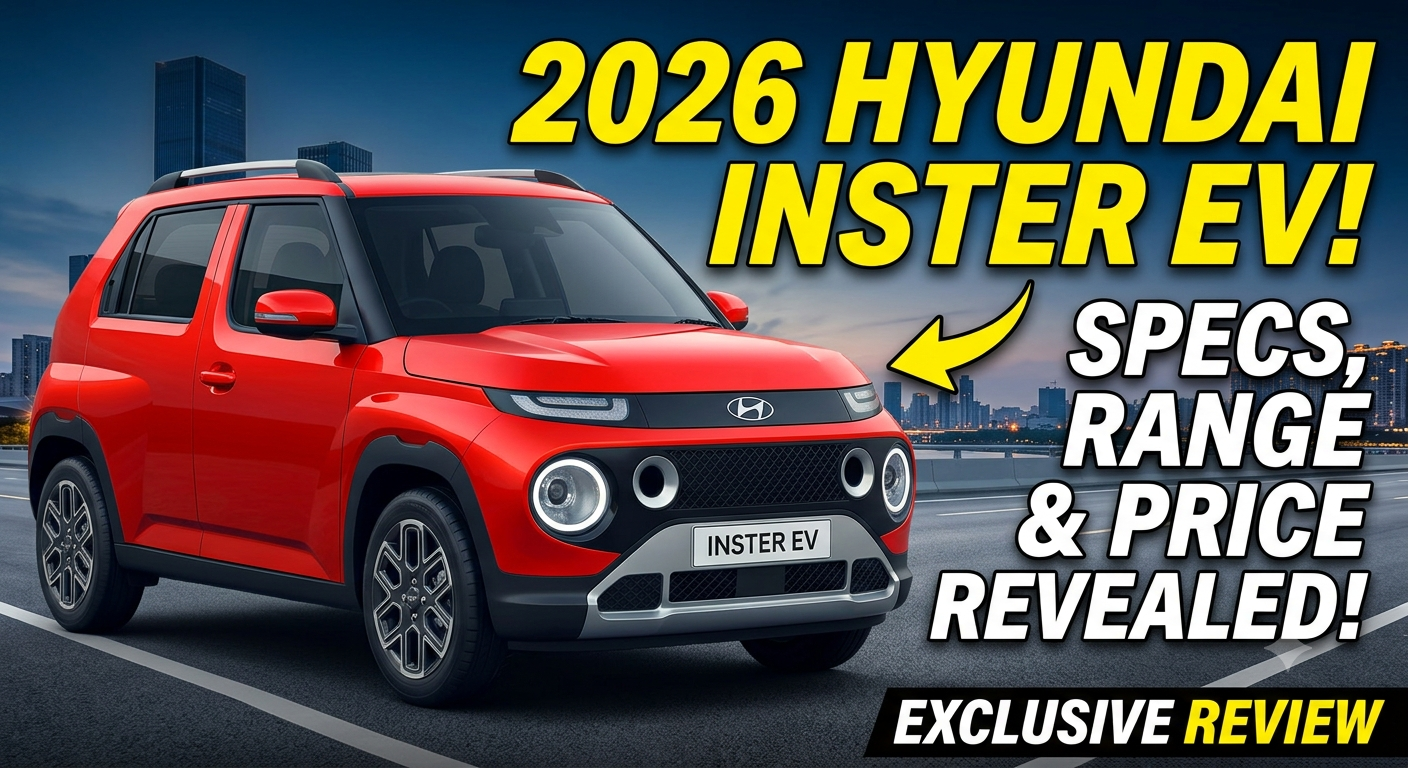
With a 120 kW DC fast-charging capability that outpaces the Tata Punch EV’s 65 kW, two battery options offering up to 355 km of WLTP range, and a Vehicle-to-Load (V2L) feature that no rival in this price bracket can match, this sub-4-metre electric micro-SUV is generating serious anticipation.
According to Hyundai’s official press release, the Inster brings the brand’s global EV expertise to its most compact and affordable platform yet. With an expected price of Rs 10-15 lakh (ex-showroom) and manufacturing confirmed at Hyundai’s Sriperumbudur plant in Tamil Nadu, the Hyundai Inster EV specifications India story is one every prospective EV buyer needs to read.
This comprehensive spec review covers both battery variants, real-world range estimates, charging infrastructure compatibility, the full ADAS suite, and a head-to-head comparison with the Tata Punch EV to help you decide whether to wait for the Inster or buy what’s available today.
Hyundai Inster EV: Overview & Positioning
The Hyundai Inster EV is based on the Casper platform, re-engineered from the ground up as a fully electric vehicle. It is Hyundai’s smallest and most affordable global EV, designed specifically for urban mobility in markets like India, South Korea, and Europe. At 3,825 mm in length, it comfortably qualifies as a sub-4-metre vehicle, which means it will attract lower GST rates in India — a significant pricing advantage that Hyundai can pass on to buyers.
Hyundai’s India strategy for the Inster is built on localisation. The vehicle will be manufactured at the company’s Sriperumbudur facility near Chennai, and battery sourcing is expected to involve Exide Energy Solutions, further reducing costs. This positions the Inster squarely against the Tata Punch EV, Citroen eC3, and MG Comet EV in India’s fastest-growing automotive segment.
What sets the Inster apart from its rivals is its global platform pedigree. Unlike some India-specific EVs built on retrofitted ICE platforms, the Inster was conceived as an EV from day one. This means optimised battery placement for a low centre of gravity, a flat floor for maximum cabin space, and an electrical architecture that supports advanced features like V2L and 120 kW DC fast charging.
Battery Options & Electric Range
The Hyundai Inster EV offers two battery configurations, both using lithium-ion chemistry:
| Parameter | Standard Range | Long Range |
|---|---|---|
| Battery Capacity (Gross) | 42 kWh | 49 kWh |
| Battery Capacity (Usable) | ~39.3 kWh (est.) | 46.0 kWh |
| WLTP Range | 300+ km | 355 km (with 15-inch wheels) |
| Energy Consumption (WLTP) | ~15.3 kWh/100 km | 15.3 kWh/100 km (15-inch wheels) |
| Real-World Range (India est.) | 220–260 km | 260–320 km |
The WLTP-rated range of up to 355 km for the Long Range variant places the Inster competitively in the affordable EV segment. However, Indian driving conditions — heavy city traffic with frequent stop-and-go, AC usage in summer months (April–September), and highway speeds above 100 km/h — typically reduce rated range by 15–25%. Based on international real-world testing data from EV Database, which estimates approximately 300 km of real-world combined range for the Long Range variant in temperate conditions, we project 260–320 km for Indian conditions, depending on usage patterns.
For comparison, the Tata Punch EV’s updated 2026 variant offers an ARAI-certified range of 468 km on the 40 kWh battery, though its real-world C75 range is estimated at 335–355 km. Note that ARAI and WLTP use different testing methodologies, so direct range number comparisons require context.
Performance & Driving Dynamics
Both Inster variants use a single front-mounted electric motor driving the front wheels. Here’s how they compare:
| Performance Metric | Standard Range | Long Range |
|---|---|---|
| Motor Power | 71.1 kW (97 PS) | 84.5 kW (115 PS) |
| Peak Torque | 147 Nm | 147 Nm |
| 0–100 km/h | 11.7 seconds | 10.6 seconds |
| Top Speed | 140 km/h | 150 km/h |
| Drive Type | Front-Wheel Drive | Front-Wheel Drive |
The 0–100 km/h times of 10.6–11.7 seconds may not set hearts racing on paper, but they are a game changer for Indian roads. In typical city traffic, where most acceleration happens between 0–60 km/h, the Inster’s instant electric torque delivery of 147 Nm makes it feel punchy and responsive.
The lack of gear shifts means seamless acceleration through stop-and-go traffic — a genuine everyday advantage over petrol-powered sub-4-metre SUVs.
For comparison, the Tata Punch EV Long Range (40 kWh) produces 129 PS (127 bhp) and 154 Nm (source: CarDekho, as of June 2026), with a 0–100 km/h time of under 9 seconds. The Punch EV has the edge in outright acceleration, but the Inster’s lighter kerb weight and efficient powertrain offer competitive real-world performance for urban commuting.
Charging Infrastructure & Times
This is where the Hyundai Inster EV delivers its most compelling advantage over every rival in this segment.
| Charging Parameter | Hyundai Inster EV | Tata Punch EV |
|---|---|---|
| Max DC Fast Charging | 120 kW | 65 kW (1.5C on 40 kWh) |
| DC Fast Charge Time | 10–80% in ~30 min | 20–80% in 26 min (official, both variants; source: Tata EV) |
| AC Onboard Charger | 11 kW | 7.2 kW |
| AC Full Charge Time | 4 hrs (42 kWh) / 4 hrs 35 min (49 kWh) | 3.6 hrs (30 kWh) / 5.3 hrs (40 kWh) |
| Battery Architecture | 400V | 400V |
| Connector Type | CCS2 | CCS2 |
The Inster’s 120 kW DC fast-charging capability is nearly double the Punch EV’s 65 kW rate (updated 40 kWh variant; source: CarDekho). Note that Tata officially quotes 20–80% in 26 minutes for the Punch EV (source: Tata EV official site), while Hyundai quotes 10–80% in approximately 30 minutes for the Inster — these are slightly different measurement windows, so direct comparison requires context.
In practical terms, a 30-minute highway stop can replenish up to 70% of the Inster’s battery — enough for an additional 200+ km of range on the Long Range variant. For India’s expanding network of DC fast chargers along national highways (Tata Power, Ather Grid, ChargeZone), this means the Inster is genuinely viable for inter-city trips, not just urban commuting.
V2L: Vehicle-to-Load — The Inster’s Secret Weapon
The V2L feature is arguably the Inster’s most underappreciated differentiator. It allows the car to function as a mobile power bank, delivering up to 3.6 kW (15A) of power through two channels:
- External V2L port: Located near the charging socket, it uses an adaptor to provide a standard power outlet. You can power camping equipment, outdoor lighting, portable coolers, or even charge another EV in an emergency.
- Internal 3-pin outlet: Positioned at the rear of the centre console, it powers laptops, CPAP machines, small appliances, or a portable electric cooker during road trips.
At 3.6 kW, the V2L output can handle most household appliances rated under 3,500 watts. During a power outage, the Inster’s 49 kWh battery could theoretically power essential home appliances (lights, fans, router, phone chargers) for over 10 hours.
Previously, V2L was exclusive to premium EVs like the Hyundai Ioniq 5 and Kia EV6, making its inclusion in the Inster a significant value addition. No other EV in the sub-Rs 15 lakh segment offers this capability.
Exterior Design & Dimensions
The Hyundai Inster’s design language is distinctly modern and compact, with pixel-themed lighting elements that echo the larger Ioniq 5. As of June 2026, the confirmed dimensions are:
| Dimension | Hyundai Inster EV | Tata Punch EV |
|---|---|---|
| Length | 3,825 mm | 3,857 mm |
| Width | 1,610 mm | 1,742 mm |
| Height | 1,575 mm | 1,633 mm |
| Wheelbase | 2,580 mm | 2,445 mm |
| Sub-4m Status | Yes | Yes |
The Inster is notably narrower and shorter than the Punch EV, but its 135 mm longer wheelbase is the standout figure. A longer wheelbase generally translates to better ride comfort, more cabin space between the axles, and improved straight-line stability. The compact 3,825 mm length makes it ideal for navigating tight city streets, crowded parking lots, and narrow bylanes — a genuine everyday advantage in Indian metro cities.
Wheel options range from 15-inch steel wheels with covers to 17-inch alloys (205/45 R17). Note that the WLTP range of 355 km is achieved with the more efficient 15-inch wheels; choosing 17-inch alloys will reduce range somewhat.
Internationally, the Inster is available in nine colours including Atlas White, Tomboy Khaki, Sienna Orange Metallic, and Buttercream Yellow Pearl, with select shades offered in a two-tone configuration with a black roof.
Interior, Cabin & Boot Space
The Inster is configured as a 4-seater, similar to the MG Comet EV. While the absence of a fifth seat may concern some buyers, Hyundai has compensated with class-leading space utilisation and clever packaging.
Key cabin dimensions include front headroom of 1,028 mm (987 mm with the optional sunroof), front legroom of 1,050 mm, rear headroom of 982 mm, and rear legroom of 885 mm. The flat floor — a benefit of the dedicated EV platform — means no transmission tunnel intrudes into the cabin.
The standout cabin feature is the sliding rear seats with 16 cm of travel. In their rearmost position, they offer generous legroom for rear passengers. Slide them forward, and boot space expands from 280 litres to 351 litres. All seats, including the driver’s, can fold completely flat, creating a versatile cargo or even camping configuration. The 50/50 split rear seats also recline for added comfort on long journeys.
Additional comfort features include a wireless charging dock, 64-colour LED ambient lighting, walk-through front-row seating (no centre console obstruction), and customisable upper door trim garnishes with a pixel-themed design. Heated front seats and a heated steering wheel are available internationally, though availability for India remains to be confirmed.
Infotainment & Connected Features
The Inster’s tech package is surprisingly premium for its price point:
- Dual 10.25-inch screens: A fully digital instrument cluster paired with a 10.25-inch touchscreen infotainment system, mounted in a seamless dashboard layout
- Wireless connectivity: Both Android Auto and Apple CarPlay work wirelessly — no cables needed
- Hyundai Digital Key 2 Touch (NFC): Unlock and start the car using your smartphone via NFC. Share digital keys with family members remotely
- Connected car technology: Remote climate control, vehicle status monitoring, and charge scheduling via the Hyundai app
- Single-pane sunroof: Expected on higher variants
The dual 10.25-inch screen setup is identical in size to what you get on the Tata Punch EV, but the Inster adds the Digital Key feature and wireless phone connectivity as differentiators.
If you’re upgrading from a budget hatchback, the Inster’s tech suite will feel like a generational leap. For buyers exploring other new launches in India’s competitive SUV market, our coverage of the JSW Jetour T2 offers another perspective on how new entrants are raising the tech bar.
Safety & ADAS Features
The Hyundai Inster EV comes equipped with one of the most comprehensive safety suites in the affordable EV segment. According to Hyundai’s official specifications, the full Level 2 ADAS package includes:
- Forward Collision-Avoidance Assist 1.5 (FCA 1.5) — detects vehicles, pedestrians, and cyclists
- Lane Keeping Assist (LKA) and Lane Following Assist (LFA)
- Blind-Spot Collision-Avoidance Assist (BCA)
- Smart Cruise Control with Stop & Go (SCC)
- Highway Driving Assist 1.5 (HDA 1.5) — combines lane centring and adaptive cruise on highways
- Rear Cross-Traffic Collision-Avoidance Assist (RCCA)
- Surround View Monitor (SVM) — 360-degree camera view for parking
- Rear Occupant Alert (ROA) — alerts if a child or pet is left in the rear seat
- Driver Attention Warning (DAW)
- High Beam Assist (HBA)
- Parking Distance Warning (PDW) — front and rear
- Safe Exit Warning (SEW) — warns against opening doors into oncoming traffic
- Intelligent Speed Limit Assist (ISLA)
Standard passive safety includes 6 airbags, ABS with EBD, and electronic stability control. The Tata Punch EV also offers a solid safety package with 6 airbags and ESP, but the Inster’s ADAS suite is significantly more extensive.
Features like Highway Driving Assist 1.5 and Safe Exit Warning are typically found on vehicles costing Rs 20 lakh and above, making their inclusion in the Inster exceptional value. Note that ADAS feature availability may vary by variant for the Indian model — expect the full suite on the top-spec trim.
Expected Variants & Pricing in India
As of June 2026, the Hyundai Inster EV has not been officially priced for India. However, based on estimates from CarDekho, CARS24, and ZigWheels, the expected pricing structure is:
| Variant | Battery | Expected Price (Ex-Showroom) |
|---|---|---|
| Standard Range Base | 42 kWh | Rs 10–11 lakh |
| Standard Range Mid | 42 kWh | Rs 11–12 lakh |
| Long Range Mid | 49 kWh | Rs 12–13 lakh |
| Long Range Top | 49 kWh | Rs 14–15 lakh |
These prices are competitive when you consider the Tata Punch EV’s current range of Rs 9.69–12.59 lakh (ex-showroom, New Delhi; source: CarDekho, as of June 2026). Here is the full Punch EV variant-wise pricing for context: Smart 30 kWh at Rs 9.69 lakh, Smart Plus 30 kWh at Rs 10.29 lakh, Smart Plus 40 kWh at Rs 10.89 lakh, Adventure 40 kWh at Rs 11.59 lakh, Empowered 40 kWh at Rs 12.29 lakh, and Empowered Plus S 40 kWh at Rs 12.59 lakh.
The lower starting price compared to pre-2026 listings (which began at Rs 10.99 lakh for the earlier 25 kWh base variant) reflects Tata’s introduction of the more affordable Smart 30 kWh trim in the 2026 model year.
The Inster’s aggressive pricing is expected to be driven by local manufacturing at the Sriperumbudur plant and localised battery sourcing from Exide Energy Solutions. Sub-4-metre status also ensures the lower GST slab, which Hyundai can leverage to undercut imports.
The expected launch window is Q3–Q4 2026, with some reports pointing to a festive season debut (September–October). If you’re currently shopping for affordable EVs, our comparison of the 2026 Tata Tiago EV changes may help you evaluate what’s available right now.
Hyundai Inster EV Specifications India: Complete Table (Both Variants)
| Specification | Standard Range (42 kWh) | Long Range (49 kWh) |
|---|---|---|
| Motor Power | 71.1 kW (97 PS) | 84.5 kW (115 PS) |
| Peak Torque | 147 Nm | 147 Nm |
| Battery Capacity | 42 kWh | 49 kWh |
| WLTP Range | 300+ km | 355 km |
| Real-World Range (India est.) | 220–260 km | 260–320 km |
| 0–100 km/h | 11.7 sec | 10.6 sec |
| Top Speed | 140 km/h | 150 km/h |
| DC Fast Charging (Max) | 120 kW | 120 kW |
| DC 10–80% Time | ~30 min | ~30 min |
| AC Onboard Charger | 11 kW | 11 kW |
| AC Full Charge Time | 4 hrs | 4 hrs 35 min |
| V2L Output | 3.6 kW | 3.6 kW |
| Drive Type | FWD | FWD |
| Length | 3,825 mm | 3,825 mm |
| Width | 1,610 mm | 1,610 mm |
| Height | 1,575 mm | 1,575 mm |
| Wheelbase | 2,580 mm | 2,580 mm |
| Boot Space | 280–351 L | 280–351 L |
| Seating Capacity | 4 | 4 |
| Battery Architecture | 400V | 400V |
| Airbags | 6 | 6 |
| Infotainment | Dual 10.25-inch screens | Dual 10.25-inch screens |
| Battery Warranty | 8 years / 1,60,000 km (expected) | 8 years / 1,60,000 km (expected) |
Source: Specifications based on Hyundai’s official world premiere press release and EV Database. Indian-spec variant details may differ upon official launch.
Hyundai Inster EV vs Tata Punch EV: Quick Comparison
The Tata Punch EV has been the undisputed leader in India’s affordable electric SUV segment. Here’s how the Hyundai Inster EV stacks up against its primary rival, the updated 2026 Punch EV with 30 kWh and 40 kWh battery options:
| Parameter | Hyundai Inster EV (Long Range) | Tata Punch EV (40 kWh) |
|---|---|---|
| Battery Capacity | 49 kWh | 40 kWh |
| Rated Range | 355 km (WLTP) | 468 km (ARAI) |
| Real-World Range (est.) | 260–320 km | 335–355 km |
| Motor Power | 115 PS | 129 PS (127 bhp) |
| Peak Torque | 147 Nm | 154 Nm |
| 0–100 km/h | 10.6 sec | <9 sec |
| Max DC Charging | 120 kW | 65 kW (1.5C) |
| DC Fast Charge Time | 10–80% in ~30 min | 20–80% in 26 min (official; 10–80% not published) |
| AC Charger | 11 kW | 7.2 kW |
| V2L | Yes (3.6 kW) | No |
| Length | 3,825 mm | 3,857 mm |
| Wheelbase | 2,580 mm | 2,445 mm |
| Seating | 4 | 5 |
| Boot Space | 280–351 L | 366 L |
| ADAS Level | Level 2 (comprehensive) | Level 2 (basic) |
| Digital Key | Yes (NFC) | No |
| Expected Price (top) | ~Rs 14–15 lakh | Rs 12.59 lakh |
| Battery Warranty | 8 yrs / 1,60,000 km (expected) | Lifetime (40 kWh, 1st owner) |
Inster advantages: Faster DC charging speed (120 kW vs 65 kW), V2L capability, more comprehensive ADAS, Digital Key, longer wheelbase for ride comfort, and a more premium cabin feel with 64-colour ambient lighting.
Punch EV advantages: More power and torque for outright acceleration, 5-seat configuration, wider and taller body for family practicality, proven after-sales network across India, competitive 1.5C fast charging on the 40 kWh variant, lifetime battery warranty for the first owner, and an established track record in the Indian market.
If you’re interested in the Tata ecosystem, our Tata Punch Facelift 2025 review covers the ICE version’s updates in detail. Also consider equipping your new EV with the right gear — check our list of the best car accessories on Amazon India for practical add-ons.
Verdict: Should You Wait for the Hyundai Inster EV?
The Hyundai Inster EV is, on paper, one of the most compelling affordable EV propositions heading to India. Its combination of 120 kW fast charging, V2L capability, a comprehensive Level 2 ADAS suite, and Hyundai’s global EV platform expertise gives it genuine differentiators that no rival in the Rs 10–15 lakh segment currently matches.
The sub-4-metre dimensions, local manufacturing, and Exide battery sourcing suggest Hyundai is serious about pricing the Inster aggressively.
Wait for the Inster if: You are an urban commuter who values fast charging over outright range, want V2L for outdoor activities or power backup, prioritise ADAS and tech features, and are comfortable with a 4-seat configuration. The Inster is also the better pick if your daily commute is under 80 km and you want the confidence of a quick 30-minute top-up on longer trips.
Consider the Tata Punch EV instead if: You need a 5-seater for family use, want the security of Tata’s extensive service network and lifetime battery warranty, prefer the higher real-world range of the 40 kWh variant, or want to buy a tried-and-tested EV rather than a first-generation India launch.
The Punch EV’s updated 2026 model with the 40 kWh battery and 1.5C fast charging has significantly closed the charging speed gap.
Our verdict: if Hyundai delivers on the expected Rs 10–11 lakh starting price for the Standard Range variant, the Inster will be the most feature-rich affordable EV in India.
The V2L feature alone could be a deciding factor for buyers who camp, face frequent power outages, or simply want the versatility of a mobile power source. We recommend waiting for the official India launch and test drive reviews before making a final decision, but the Inster has earned a spot on every affordable EV buyer’s shortlist.
Frequently Asked Questions
What is the expected price of the Hyundai Inster EV in India?
The Hyundai Inster EV is expected to be priced between Rs 10 lakh and Rs 15 lakh (ex-showroom, Delhi) when it launches in India in Q3–Q4 2026. The Standard Range 42 kWh variant may start around Rs 10–11 lakh, while the Long Range 49 kWh variant could go up to Rs 14–15 lakh. Local manufacturing at Hyundai’s Sriperumbudur plant and localised Exide batteries should help keep prices competitive.
What is the real-world range of the Hyundai Inster EV in Indian conditions?
While the Hyundai Inster EV offers a WLTP-rated range of 300+ km (42 kWh) and up to 355 km (49 kWh), real-world range in Indian conditions is expected to be 220–260 km for the Standard Range and 260–320 km for the Long Range variant.
How fast can the Hyundai Inster EV charge?
The Hyundai Inster EV supports 120 kW DC fast charging, which can replenish both battery variants from 10% to 80% in approximately 30 minutes. For home charging, the 11 kW onboard AC charger takes about 4 hours for the 42 kWh battery and 4 hours 35 minutes for the 49 kWh battery. This DC charging speed is significantly faster than the Tata Punch EV’s 65 kW DC fast charging on the updated 40 kWh variant.
What is V2L in the Hyundai Inster EV and how does it work?
V2L (Vehicle-to-Load) is a feature that allows the Hyundai Inster EV to function as a portable power source delivering up to 3.6 kW. It works through both an external port (using an adaptor) and an internal 3-pin outlet at the rear of the centre console. You can power laptops, camping equipment, electric cookers, or even charge other EVs. This feature is unique to the Inster in the sub-Rs 15 lakh EV segment in India.
How does the Hyundai Inster EV compare with the Tata Punch EV?
The Hyundai Inster EV offers faster DC charging (120 kW vs 65 kW), V2L capability, and a more comprehensive ADAS suite with features like Highway Driving Assist 1.5. The Tata Punch EV counters with a 5-seat configuration, wider body, competitive ARAI-rated range of up to 468 km, a lifetime battery warranty on the 40 kWh variant, and an established after-sales network across India.
When is the Hyundai Inster EV launching in India?
The Hyundai Inster EV is expected to launch in India in Q3–Q4 2026, with some reports suggesting a festive season launch around September–October 2026. It will be manufactured at Hyundai’s Sriperumbudur plant in Tamil Nadu, with localised battery sourcing from Exide Energy Solutions to keep costs competitive against the Tata Punch EV.
Is the Hyundai Inster EV a 4-seater or 5-seater?
The Hyundai Inster EV is a 4-seater, similar to the MG Comet EV. However, it compensates with class-leading rear legroom (885 mm), sliding rear seats with 16 cm of travel, and a boot that expands from 280 litres to 351 litres when the rear seats are slid forward. All seats, including the driver’s, can fold completely flat for maximum cargo flexibility.
One thought on “Hyundai Inster EV 2026 India: Complete Specifications, Range, Charging, Price & Features Reviewed”