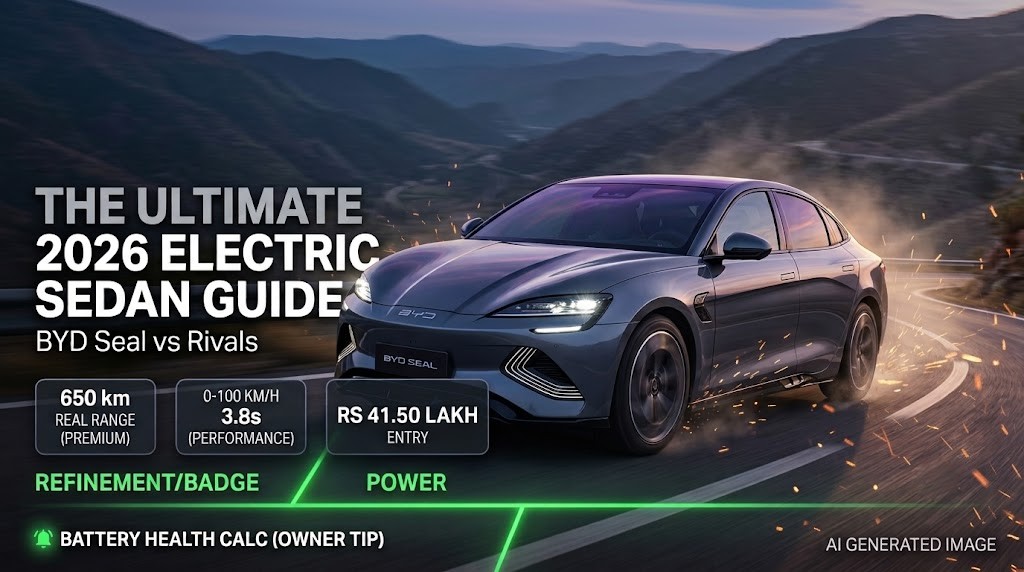
The BYD Seal is one of the very few electric sedans on sale in India that answers the two questions premium-EV buyers actually care about: how far will it really go, and does it drive like it costs this much. With an ARAI range that stretches to 650 km on the mid-spec car and a range-topping variant that fires off a 0-100 km/h sprint in a claimed 3.8 seconds, the Seal is less a science project and more a genuine long-distance tool. The catch, as always with an imported EV, is price and where it fits in your driveway logic.
This 2026 guide breaks the BYD Seal down the way a buyer thinks about it: price and variants first, then the battery-and-range trade-off that trips most people up, then performance, charging, real running cost, and finally a clear which-variant-to-buy verdict. All figures are dated to July 2026 and sourced to BYD India’s official Seal page and Autocar India, both checked this week.
What is the price and range of the BYD Seal in India?
As of July 2026, the BYD Seal is priced from Rs 41.50 lakh (ex-showroom) for the entry Dynamic and rises to roughly Rs 53.65 lakh for the range-topping Performance. Battery packs are 61.44 kWh or 82.56 kWh, and ARAI-certified range runs from 510 km to 650 km depending on variant. On-road Delhi pricing spans roughly Rs 44.20 lakh to Rs 57.14 lakh.
BYD Seal 2026 Price & Variant Snapshot
The Seal is sold in three trims — EV Dynamic, EV Premium and EV Performance. The table below is the fastest way to see how battery, range, power and price move together. These are ex-showroom figures; the on-road number in Delhi is meaningfully higher once road tax and insurance are added.
| Variant | Battery | ARAI Range | Power | Ex-showroom Price |
|---|---|---|---|---|
| EV Dynamic (RWD) | 61.44 kWh | 510 km | 201 bhp / 310 Nm | Rs 41.50 lakh |
| EV Premium (RWD) | 82.56 kWh | 650 km (highest) | 308 bhp / 360 Nm | ~Rs 49 lakh (est.) |
| EV Performance (AWD) | 82.56 kWh | 580 km | 523 bhp / 670 Nm | ~Rs 53.15–53.65 lakh |
A note on the numbers: the Dynamic and Performance ex-showroom prices are confirmed against Autocar India’s current listing. The Premium sits between the two, and dealers quote it in the region of Rs 49 lakh — treat that as an estimate and confirm the exact figure locally. Prices for imported EVs are also revised periodically; industry reporting pointed to an up-to-3% increase during 2026, so the safest move is to lock the current on-road quote in writing. You can sanity-check the Delhi-to-your-city difference with our On-Road Price Calculator, and if you are financing it, our Vehicle EMI Calculator will turn that ex-showroom figure into a monthly number in a few seconds.
Battery & Range: Dynamic vs Premium vs Performance
Here is the counter-intuitive bit that confuses most first-time Seal shoppers: the most expensive variant is not the longest-range one. The mid-tier Premium, with its 82.56 kWh Blade battery driving a single rear motor, is the range champion at 650 km ARAI. The Performance uses the same 82.56 kWh pack but adds a second motor on the front axle for all-wheel drive — and that extra motor and the higher power draw pull its rated range down to 580 km.
The entry Dynamic runs a smaller 61.44 kWh pack and a 510 km ARAI figure. That is still a lot of EV for the money, but it is the one variant where range-anxious buyers who do frequent highway runs should think twice.
Real-world vs ARAI reality check: ARAI figures come from a controlled test cycle, not from Indian highways at 100-plus km/h with the AC on. As a realistic planning rule, expect roughly 20-30% less than the ARAI number in mixed real-world use — so budget around 480-520 km from a full charge on the 650 km Premium, and closer to 380-400 km on the Dynamic. These are estimates, not measured figures, and your mileage will swing with speed, climate and how hard you use the accelerator. To keep tabs on how the pack ages over the years, our EV Battery Health Calculator is a useful ownership tool.
Performance & Driving: Power, Torque and the 3.8s Sprint
The Seal is built on BYD’s e-Platform 3.0 with the battery integrated into the floor using Cell-to-Body (CTB) technology, which BYD says stiffens the structure and lowers the centre of gravity — exactly what you want in a driver’s sedan. All three variants use BYD’s lithium-iron-phosphate (LFP) Blade Battery, chosen for its thermal stability rather than outright energy density.
Outputs climb steeply across the range. The Dynamic makes 201 bhp and 310 Nm through the rear wheels; the Premium steps up to 308 bhp and 360 Nm, still rear-driven. The headline act is the Performance: a dual-motor all-wheel-drive setup producing 523 bhp and 670 Nm, enough for a claimed 0-100 km/h in 3.8 seconds, per Autocar India. That puts the top Seal in genuine performance-car territory for the price. The single-motor Premium is no slouch either — independent testing has clocked it doing sub-six-second sprints. An intelligent torque control system (iTAC) manages grip across the range.
Charging: AC & DC Times and Real-World Planning
Charging is where you need to read the fine print, because two different DC figures are quoted. BYD India’s official page states that on the 82.56 kWh cars, “in 26 minutes, the battery can be charged from 30 per cent to 80 per cent” on a 150 kW DC fast charger. Autocar India, testing a 0-80% top-up, reports roughly 45 minutes. Both can be true — they simply measure different charge windows (30-80% versus 0-80%), and the first chunk of charge is always the fastest. For trip planning, assume a realistic 40-45 minute coffee stop to get from low to 80% on a fast charger.
On alternating current, the Seal takes a standard 7 kW AC connection, which BYD lists at roughly 12-16 hours for a full 0-100% charge on the larger pack — a comfortable overnight top-up at home. If you have a wall box and mostly charge overnight, DC speed will rarely matter to you; if you road-trip often, the 150 kW peak on the big-battery cars is the one to have.
Running Cost: Charging Cost Per Km vs a Petrol Rival
This is where an EV like the Seal claws back some of its premium sticker price. The table below is an illustrative estimate for the 82.56 kWh Premium, assuming a realistic 500 km per full charge. Figures are approximate and depend entirely on your electricity tariff and driving.
| How you fuel it | Cost assumption | Approx. cost/km |
|---|---|---|
| Home AC charging | ~Rs 8/kWh (~Rs 660 full charge) | ~Rs 1.3/km |
| Public DC fast charging | ~Rs 20/kWh (~Rs 1,650 full charge) | ~Rs 3.3/km |
| Comparable petrol luxury sedan | ~11 kmpl at ~Rs 95/litre | ~Rs 8.6/km |
Even on pricey public charging, the Seal costs roughly a third of a petrol equivalent to run; charge at home overnight and the gap becomes enormous. Over 15,000 km a year, home charging saves on the order of Rs 1 lakh in fuel versus a petrol luxury sedan. Plug your own tariff and distances into our Fuel Cost Calculator to see the number for your usage. That running-cost saving is a big part of the long-term case for a car with a high up-front price.
Features, Space & Safety
Inside, the BYD Seal leans hard on its “tech-forward” positioning. The centrepiece is a 15.6-inch multimedia touchscreen with a rotation function that swivels between landscape and portrait, backed by a 10.25-inch digital instrument cluster. BYD fits a 12-speaker Dynaudio premium audio system and an oversized panoramic glass roof, so the cabin feels appropriately special for the money.
Practicality is better than a swoopy sedan silhouette suggests: there is a 400-litre boot at the rear plus a 53-litre frunk under the bonnet — handy for charging cables so they never clutter the main boot. On safety, BYD Seal is offered with an advanced driver-assistance (ADAS) suite; buyers should confirm the exact feature list and any crash-test rating for the India-spec car with their dealer, as ADAS content can vary by variant.
BYD Seal vs Rivals: Where It Sits
In India, the Seal occupies an unusual gap. It is priced above mainstream electric SUVs yet undercuts established premium EVs, and it is one of the few electric sedans at this price point at all. Against the Hyundai Ioniq 5 and Kia EV6 — both crossovers — the Seal counters with a lower entry price and, in Premium form, a longer rated range, while giving up some SUV practicality and ground clearance. Against the Tesla Model 3, which is arriving through Tesla’s India rollout, the Seal’s pitch is more equipment and, on paper, a longer range for the money, though Tesla’s charging network and software are its own draw.
If you are cross-shopping the electric-crossover route instead, it is worth reading how the segment is shaping up in our coverage of the Hyundai Inster EV and the Kia Syros EV vs Hyundai Creta Electric comparison, and how homegrown options like the Tata Sierra EV are attacking a lower price band. For context on why a CBU-imported EV like the Seal carries the price it does, our explainer on import duty on luxury cars is a useful read. Buyers weighing whether to wait for Tesla should also see our note on the Tesla India launch.
Which BYD Seal Variant Should You Buy?
Here is the honest, no-hedging verdict after mapping range, price and use-case.
- Best all-rounder / best range-per-rupee — EV Premium. The 650 km ARAI range, 82.56 kWh Blade pack, 150 kW fast charging and 308 bhp make this the variant that best justifies the Seal’s premium. For most buyers this is the one to get.
- Budget entry — EV Dynamic. At Rs 41.50 lakh it is the cheapest way into the Seal, and 510 km is plenty for city-plus-occasional-highway life. Skip it only if you regularly do long, fast highway stints where the smaller pack will have you charging more often.
- For the performance seeker — EV Performance. The 523 bhp AWD, 670 Nm and 3.8-second sprint are the draw. You accept ~70 km less range and a higher price for that pace — a fair trade only if straight-line thrill genuinely matters to you.
Buy or skip? Buy the Seal if you want a long-range, quick, tech-loaded electric sedan and you can charge at home — the running-cost maths and the Premium’s range make a strong case. Approach with caution if you live outside a metro where BYD’s service and dealer network is still thin, or if you need SUV-style ground clearance and boot space. Battery warranties on EVs in this class typically run around eight years or 1.5 lakh km; confirm the exact Seal terms and your nearest service point before you sign, because service reach matters more on an imported EV than on a mass-market car.
Frequently Asked Questions
What is the on-road price of the BYD Seal in India?
On-road pricing in Delhi runs roughly Rs 44.20 lakh to Rs 57.14 lakh depending on variant, versus the Rs 41.50 lakh to ~Rs 53.65 lakh ex-showroom band (as of July 2026, per Autocar India). Your city’s road tax will shift the figure — use our On-Road Price Calculator for an exact number.
What is the real-world range of the BYD Seal?
ARAI figures are 510 km (Dynamic), 650 km (Premium) and 580 km (Performance). In real mixed driving expect roughly 20-30% less — realistically around 480-520 km on the Premium and 380-400 km on the Dynamic. These are estimates and vary with speed, AC use and terrain.
How long does the BYD Seal take to charge?
On a 150 kW DC fast charger, BYD India states 30-80% in 26 minutes on the 82.56 kWh cars; Autocar India reports about 45 minutes for a fuller 0-80% top-up. On a 7 kW home AC charger, a full charge takes roughly 12-16 hours — ideal overnight.
Which BYD Seal variant should you buy?
For most buyers, the EV Premium — it has the longest range (650 km ARAI), the big battery and fast charging at a mid-range price. Pick the Dynamic to save money, or the Performance only if you specifically want the 3.8-second AWD pace.
Is the BYD Seal a good car?
For a home-charging, metro-based buyer who wants a long-range, quick electric sedan, it is one of the strongest value propositions in its price band. The main reservations are service-network reach outside big cities and sedan-versus-SUV practicality.
Does the BYD Seal have ADAS?
Yes, the Seal is offered with an advanced driver-assistance suite, along with features like a rotating 15.6-inch touchscreen, 12-speaker Dynaudio audio and a panoramic glass roof. Confirm the exact ADAS feature list per variant with your dealer.
Sources: BYD India official Seal page (byd.com/in/car/seal) and Autocar India (autocarindia.com/cars/byd/seal), both accessed July 2026. Prices are ex-showroom/on-road Delhi as noted and are subject to periodic revision — confirm the latest figure with an authorised BYD dealer. Running-cost and real-world range figures are illustrative estimates. Published by Motoautiv.