
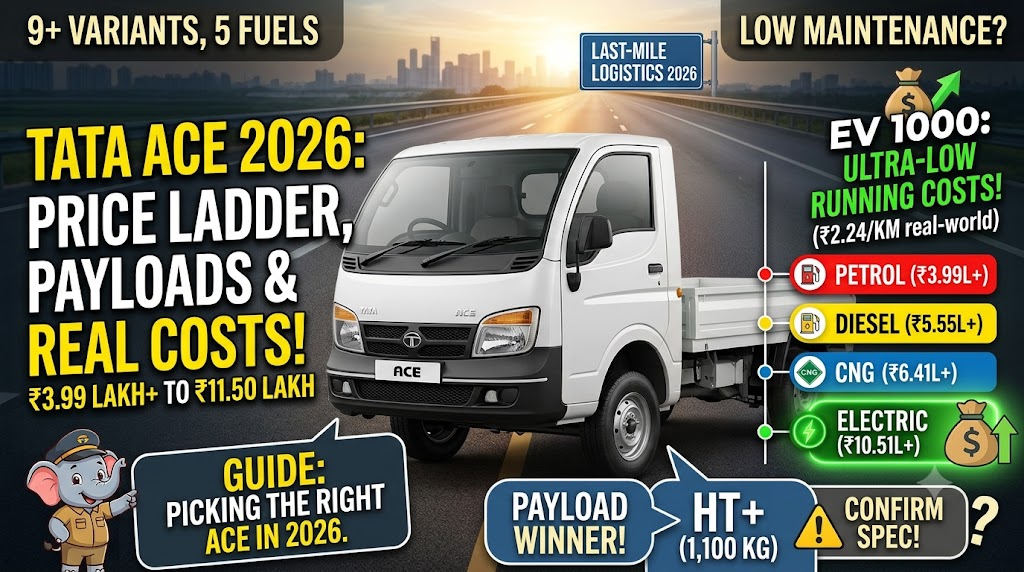
The Tata Ace — India’s original “Chhota Hathi” — is the vehicle most small-business owners picture the moment someone says “mini-truck.” But search “Tata Ace price” today and you’ll hit a wall most buyers don’t expect: it isn’t one price. It’s a ladder of nine-plus variants spanning petrol, diesel, CNG, bi-fuel and electric powertrains, stretching from roughly ₹3.99 lakh to ₹11.50 lakh ex-showroom. Picking the wrong rung on that ladder means overpaying for payload you don’t need, or under-buying and bottlenecking your own delivery runs. This guide lays out every variant, its real price, its payload, and — the part most price pages skip — what it actually costs you per kilometre to run.
Quick answer: Tata Ace ex-showroom prices range from about ₹3.99 lakh (Ace Pro petrol) to ₹11.30–11.50 lakh (Ace EV 1000), across nine main variants and five fuel types — petrol, diesel, CNG, bi-fuel and electric. Payload spans 600kg to 1,100kg depending on variant. Full ladder below.
Tata Ace Price in India (2026) — Every Variant Compared
| Variant | Fuel | Ex-showroom Price | Payload | Engine |
|---|---|---|---|---|
| Ace Pro | Petrol | ₹3.99 lakh | 750 kg | 694cc, 30HP |
| Ace Gold (Petrol/CX) | Petrol | ₹4.50–4.99 lakh | 900 kg | 694cc, 30HP |
| Ace Pro Bi-Fuel | CNG+Petrol | ₹4.99 lakh | 750 kg | 694cc, 25HP (CNG) |
| Ace Gold Plus | Petrol | ₹5.52 lakh | 900 kg | 702cc, 22HP |
| Ace Gold Diesel/Diesel Plus | Diesel | ₹5.55–6.34 lakh | 750–900 kg | 700–702cc, 19–22HP |
| Ace Gold CNG/CNG Plus | CNG | ₹6.41–6.86 lakh | 615–660 kg | 694cc, 26HP |
| Ace CNG 2.0 (Bi-Fuel) | CNG+Petrol | ₹6.50 lakh | 800 kg | 694cc twin-cyl, 25HP CNG/30HP petrol |
| Ace Pro EV | Electric | ₹6.50 lakh | 750 kg | 39HP motor, ~155km range |
| Ace Diesel | Diesel | ₹7.00 lakh | 750 kg | 702cc, 22HP |
| Ace HT+ | Diesel | ₹6.80–7.19 lakh* | 1,100 kg | disputed (see note) |
| Ace EV | Electric | ₹10.51 lakh+ | 600 kg | 21.3kWh battery, 36HP, 154km range |
| Ace EV 1000 | Electric | ₹11.30–11.50 lakh | 1,000 kg | 21.3kWh battery, 36HP, 161km range |
Tata’s own official small-trucks microsite lists the Ace range’s engine and fuel options in detail but, notably, carries no ex-showroom price anywhere — every variant page ends in a “Book Now” or “Enquire Now” form. That’s standard practice for Indian commercial-vehicle OEMs (dealers quote the final number after state RTO and body-type add-ons), so the table above triangulates prices across three independent commercial-vehicle aggregators — CarDekho, CMV360 and 91Trucks — that agree within a few thousand rupees on most variants. Treat every figure as a well-corroborated starting point, not a final on-road quote: real prices vary roughly 5–10% by city.
*Ace HT+ is the one variant where our three sources genuinely disagree — on both price (₹6.80 lakh vs ₹7.19 lakh) and engine displacement (694cc vs 798cc). This is exactly the kind of gap a single-source price page would hide. If HT+’s 1,100kg payload is what you need, get a written quote before booking — don’t assume either aggregator figure is final.
Which Tata Ace Variant Should You Buy? (Payload & Use-Case Guide)
Payload, not price, should drive the decision — an underpowered Ace on a fishery run costs more in wasted trips than the extra lakh a bigger variant would have cost upfront.
- FMCG & beverage distribution (900kg+ loads): Ace Gold Diesel or Ace Gold Plus — the 900kg payload class handles crated goods without constant reloading.
- Fishery & perishables: Ace HT+ (1,100kg) is the highest-payload Ace for insulated/reefer-body conversions, though confirm the price/spec discrepancy above with your dealer first.
- Last-mile e-commerce, fixed city routes: Ace Pro EV or Ace EV — low running cost per km (see below) makes sense only if your daily distance stays comfortably inside the real-world range and you have depot charging.
- Long-haul intercity or mixed loads: Ace Diesel or Ace CNG 2.0 — diesel/CNG don’t carry EV’s range anxiety on longer routes.
- Passenger transport instead of goods: the goods-carrier Ace reviewed here isn’t the right pick — see our dedicated Tata Ace Passenger (Tata Magic) guide for the people-mover variant.
Engine, Fuel Options & Mileage — Petrol vs Diesel vs CNG vs EV
Across the combustion range, Tata uses variations of a compact 694–702cc engine, tuned differently per fuel: roughly 25–30HP on petrol/CNG, 19–22HP on the lighter diesel units, and up to 35HP claimed on the diesel-tuned HT+. Claimed mileage clusters around 22 km/l for petrol and diesel Gold variants, and 21.4 km/kg for CNG Gold variants, per CMV360’s spec sheet. The CNG 2.0 Bi-Fuel reports a slightly wider 21–24 kmpl band.
On the electric side, both EV variants share a 21.3kWh battery: the Ace EV (600kg payload) is ARAI-rated for 154km and a 6–7 hour full charge, while the higher-payload Ace EV 1000 (1,000kg) is rated for 161km with a 105-minute 10-80% fast charge or 7-hour full charge, using a 36HP/130Nm AC induction motor topping out at 60kmph. For a deeper look at the Ace’s electric line specifically, see our Tata Ace Electric coverage.
Running Cost Per Km: Diesel vs CNG vs EV Compared
Here’s the calculation most Tata Ace price pages skip. Using Delhi fuel rates as of mid-July 2026 — petrol ₹102.12/litre and diesel ₹95.2/litre (ParkPlus, 10 July 2026), CNG ₹83.09/kg (CarDekho, 15 July 2026), and a commercial electricity tariff of roughly ₹12.5–15.6/unit (BridgewayPower, midpoint ₹14/unit used below) — here is what each fuel type actually costs to run, at claimed mileage and at a more realistic loaded, commercial-duty-cycle mileage (estimated 15–20% lower than claimed figures, our own working, not a third-party number):
| Fuel type | Claimed mileage | Cost/km (claimed) | Real-world estimate | Cost/km (real-world, est.) |
|---|---|---|---|---|
| Petrol (Ace Pro/Gold) | 22 km/l | ₹4.64 | ~17.5 km/l | ₹5.84 |
| Diesel (Ace Gold/Diesel) | 22 km/l | ₹4.33 | ~17 km/l | ₹5.60 |
| CNG (Ace Gold CNG) | 21.4 km/kg | ₹3.88 | ~17.1 km/kg | ₹4.86 |
| Electric (Ace EV 1000, 21.3kWh/161km) | 0.132 kWh/km | ₹1.85 | ~0.16 kWh/km | ₹2.24 |
The pattern holds regardless of which end of the mileage range you use: EV is cheapest to run per km by a wide margin, CNG is the cheapest combustion option, and petrol is the priciest fuel to run daily — even though it’s the cheapest variant to buy.
3-year fuel/energy cost estimate (our calculation, assuming a common last-mile duty cycle of ~30,000km/year — adjust proportionally for your own route volume):
| Fuel type | 90,000km over 3 years (real-world cost/km) |
|---|---|
| Petrol | ₹5.26 lakh |
| Diesel | ₹5.04 lakh |
| CNG | ₹4.37 lakh |
| Electric | ₹2.02 lakh |
On top of fuel/energy, Tata positions the whole Ace range as low-maintenance, backed by over 1,400 authorised service centres nationwide and an optional Freedom Platinum AMC (on the Gold Diesel+ variant) priced from roughly ₹40/month. We haven’t found a reliable per-variant annual service-cost figure beyond that AMC data point, so budget routine servicing conservatively rather than assuming a fixed number — combustion variants typically need more frequent oil/filter changes than the EV, which has far fewer moving parts.
Real-World vs Claimed Mileage
Every mileage figure above — 22 km/l petrol/diesel, 21.4–24 km/kg CNG, 154–161km EV range — is a manufacturer/aggregator-claimed number, typically measured on ARAI’s test cycle at part-load. A loaded commercial mini-truck making frequent stop-start city deliveries will not match it. Tata’s own aggregator data for the diesel-heavy HT+ variant already shows this gap in action: its claimed mileage sits at 16–18 kmpl, noticeably below the 22 km/l claimed for the lighter Gold Diesel, purely because of its higher-payload tune. Expect a similar 15–25% real-world discount on every other variant once you load it near its rated payload and factor in city traffic — treat the running-cost table above as directional, not a guarantee.
Tata Ace vs Rivals: Ashok Leyland Dost and Mahindra Jeeto
The Ace isn’t the only mini-truck fighting for this budget. Two direct rivals worth cross-shopping:
| Model | Price | Payload | Engine |
|---|---|---|---|
| Ashok Leyland Dost XL | ₹7.80 lakh | ~1.4 tonnes | 1478cc 3-cyl turbo-diesel, 70HP |
| Mahindra Jeeto (range) | ₹4.46–5.27 lakh | 715–815 kg | petrol/diesel/CNG, 16–23HP |
| Tata Ace (range) | ₹3.99–11.50 lakh | 600–1,100 kg | petrol/diesel/CNG/bi-fuel/EV, 25–39HP |
The Dost undercuts the Ace on power-per-rupee at the diesel end but doesn’t offer a CNG or EV option, and its 70HP comes from a much larger 1478cc engine built for higher GVW routes. The Jeeto is the budget play — cheaper to buy across the board, though its payload ceiling (815kg) can’t match the Ace HT+ or EV 1000. Neither rival matches the Ace’s five-fuel-type spread, which is really the Ace’s core pitch: whichever powertrain your route economics favour, there’s an Ace variant for it. If you’re specifically weighing the Ace Gold against Tata’s own Intra V30 (a common cross-shop within Tata’s own range), we’ve covered that exact match-up separately in Tata Intra V30 vs Tata Ace Gold: Which One Should You Buy? — worth reading before you finalise between Tata’s own two mini-truck lines.
EMI, Financing & Warranty
Commercial-vehicle financiers typically quote Ace EMIs starting around ₹11,490/month for the CNG Gold variant, per 91Trucks’ own dealer-sourced figure — actual EMI depends on down payment, tenure and your CIBIL/business profile, so treat this as an indicative starting point rather than a quote. Warranty terms vary meaningfully by variant: the Gold range carries 2 years/72,000km, the CNG 2.0 Bi-Fuel and HT+ step up to 3 years/1,00,000km, and the EV range goes furthest — a 3-year/1,25,000km vehicle warranty plus a separate 7-year/1,75,000km high-voltage battery warranty on the EV 1000 (6 years on the standard EV). Always confirm which warranty tier applies to your specific variant before signing — commercial-vehicle warranties are usually shorter than passenger-car norms and vary more by trim.
Verdict: Which Tata Ace Is Worth Buying in 2026?
For most small operators running mixed loads under 900kg, the Ace Gold Diesel Plus (₹5.55 lakh) is the sweet spot: diesel’s lower real-world running cost than petrol, a sensible payload, and the reassurance of the widest service network in the segment. Buy if your daily distance is high and fuel cost per km matters more than upfront price.
The Ace CNG 2.0 Bi-Fuel (₹6.50 lakh) is worth the premium over Gold CNG if you want the flexibility of switching to petrol when a CNG station isn’t nearby — genuinely useful outside dense CNG-network cities. Buy for CNG-corridor routes; skip if you operate somewhere CNG infrastructure is thin.
The Ace EV / EV 1000 only make sense on short, fixed urban routes with dependable depot charging — the running-cost math is dramatically in their favour (under ₹2.25/km even at conservative real-world energy use), but range under 160km rules out anything beyond city and near-suburb work. Buy only if your daily route is well within range and you can charge overnight; otherwise skip.
The Ace HT+ is the one variant we can’t fully endorse without a caveat — the price and engine-spec disagreement between aggregators (documented above) means you should get every number reconfirmed with a dealer before booking, even though its 1,100kg payload is genuinely the highest in the Ace range.
On resale, the Ace range holds up reasonably well versus most commercial vehicles: OrangeBookValue’s tool prices a 2023 Tata Ace Mega with 20,000km on it, in good Delhi condition, at roughly ₹3.00–3.18 lakh today, projecting only a modest further drop to about ₹2.80 lakh by 2027 — a real, if single-example, data point suggesting the nameplate’s brand trust and huge used-market demand cushion depreciation better than most rivals. For a features-first look at the full range beyond just pricing, our Tata Ace Variants Comprehensive Guide and Tata Ace: The Ultimate Powerhouse of Small Business Mobility cover cabin, safety and body-style details this price-focused guide deliberately leaves out.
Frequently Asked Questions
What is the price of Tata Ace in India?
Tata Ace prices range from about ₹3.99 lakh (Ace Pro petrol) to ₹11.30–11.50 lakh (Ace EV 1000) ex-showroom, across petrol, diesel, CNG, bi-fuel and electric variants. Tata Motors doesn’t publish a fixed list price, so figures vary roughly 5–10% by city and dealer.
What is the Tata Ace Gold price on-road?
Ace Gold ex-showroom prices range roughly ₹4.50 lakh (base petrol) to ₹6.86 lakh (CNG Plus); on-road price adds RTO registration, insurance and body-fabrication cost on top, typically another 8–15% depending on your state.
How much does the Tata Ace EV cost in India?
The standard Ace EV starts from ₹10.51 lakh ex-showroom (600kg payload, 154km range), while the higher-payload Ace EV 1000 costs ₹11.30–11.50 lakh (1,000kg payload, 161km range) — both figures per CarDekho’s commercial-vehicle listings.
Which Tata Ace variant has the best mileage?
On claimed figures, CNG variants lead at 21.4–24 km/kg, followed by petrol/diesel at around 22 km/l claimed. In practice, expect all combustion variants to run 15–25% lower once loaded near their rated payload in city traffic.
Is the Tata Ace price list for 2026 different from 2025?
Yes — the CNG 2.0 Bi-Fuel variant and the expanded EV lineup (Ace EV and Ace EV 1000 as separate payload tiers) are 2026 additions not covered in earlier comprehensive guides to the range; see our 2025 Tata Ace variants guide for how the lineup has evolved.
Can I get an EMI calculator estimate for the Tata Ace?
Dealer-quoted EMIs start around ₹11,490/month for the CNG Gold variant per 91Trucks’ listings, though your actual EMI depends on down payment, loan tenure and your credit profile — always get a personalised quote from your financier rather than relying on an indicative starting figure.
Is a second-hand Tata Ace worth buying instead of new?
It can be, given the range’s relatively strong resale retention — OrangeBookValue’s valuation tool prices a 2023 Tata Ace Mega with 20,000km on it, in good Delhi condition, at roughly ₹3.00–3.18 lakh, projecting only a modest further drop to about ₹2.80 lakh by 2027. That said, second-hand pricing swings heavily with kilometres driven, accident history and number of previous owners, so always get an independent valuation rather than trusting a seller’s asking price alone.

One thought on “Tata Ace Price in India (2026): Full Price List, Payload & Mileage for Every Variant”