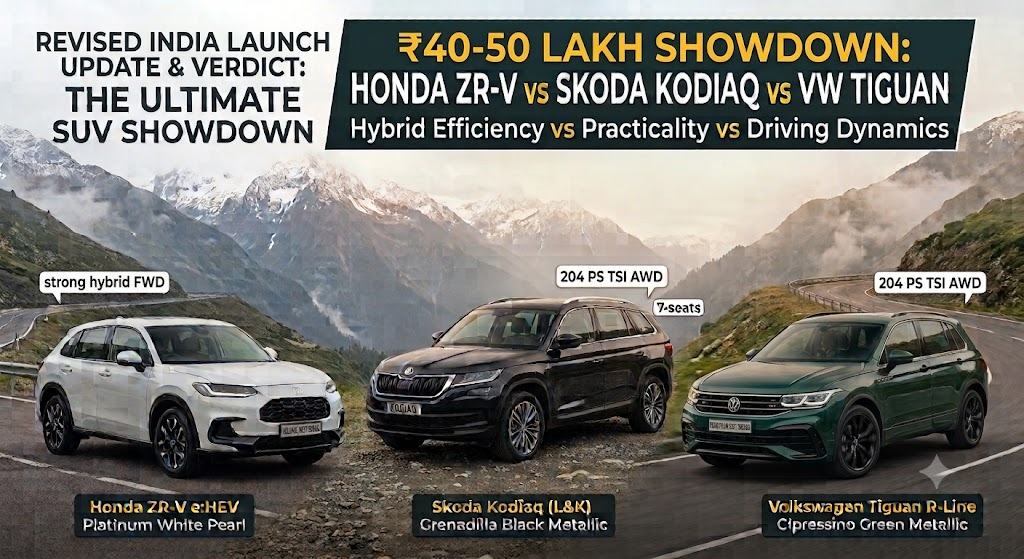
The Indian premium SUV segment has a genuinely fascinating new fight on its hands. When comparing the Honda ZR-V vs Skoda Kodiaq vs Volkswagen Tiguan, buyers in the ₹40–50 lakh bracket face a choice that goes far deeper than spec sheets — it is a battle of automotive philosophies. The Honda ZR-V enters with its game-changing 2.0L e:HEV strong-hybrid powertrain, promising city-slaying fuel efficiency and a whisper-quiet cabin.
The Skoda Kodiaq counters with sheer practicality — a larger body, available 7-seat layout, AWD, and the most space-per-rupee value of the three. The Volkswagen Tiguan R-Line throws down the gauntlet on driving dynamics, packing 204 PS, AWD, and a commanding 15-inch infotainment screen into a sportily styled package.
As of June 2026, all three SUVs are on sale in India, and buyers searching for this comparison are typically weeks away from making a ₹45+ lakh purchase decision. This article breaks down every dimension that matters — price, powertrain, fuel costs, space, features, safety, and real-world usability — so you can make the most informed call. No brand favouritism. Just data.
Price Comparison: Honda ZR-V vs Kodiaq vs Tiguan
Pricing in this segment is nuanced because of how each car reaches India. The Skoda Kodiaq and VW Tiguan are CKD (Completely Knocked Down) units assembled locally, keeping import duties in check. The Honda ZR-V arrives as a CBU (Completely Built-Up) import — a designation that adds import duty costs but also means tighter quality control and Honda’s global-spec build.
| Variant | Honda ZR-V | Skoda Kodiaq | Volkswagen Tiguan R-Line |
|---|---|---|---|
| Entry / Base | ~₹45.00 lakh* | ₹36.99 lakh (Lounge, 5-seat) | ₹47.11 lakh (single variant) |
| Mid | — | ₹44.99 lakh (Sportline, 7-seat) | — |
| Top | ~₹50.00 lakh* | ₹46.99 lakh (L&K, 7-seat) | — |
**Honda ZR-V price is estimated — Honda India’s official ex-showroom price has not yet been announced. Deliveries begin July 2026. All prices ex-showroom Delhi. Skoda Kodiaq prices reflect May 2026 relaunch.
The Kodiaq is the clear value leader at entry level — ₹5–7 lakh less than the competition. However, the Tiguan’s single fully-loaded variant at ₹47.11 lakh and the ZR-V’s expected pricing around ₹45–50 lakh make them comparable at mid-to-top range. On-road prices in Delhi add approximately 15–17% over ex-showroom, meaning real outgoings are ₹53–58 lakh for most of these SUVs. For context on how GST changes have affected car pricing in India, the current slabs continue to make CBU cars pricier.
Engine & Powertrain: Hybrid vs Turbo-Petrol
This is the core of the debate. The Honda ZR-V takes a fundamentally different engineering approach from its European rivals.
| Specification | Honda ZR-V e:HEV | Skoda Kodiaq 2.0 TSI | VW Tiguan R-Line 2.0 TSI |
|---|---|---|---|
| Engine Type | 2.0L Atkinson-cycle petrol + electric motor (strong hybrid) | 2.0L TSI EVO turbo-petrol | 2.0L TSI EVO turbo-petrol |
| System Power | 184 PS | 204 PS | 204 PS |
| Peak Torque | 315 Nm (electric motor) | 320 Nm | 320 Nm |
| Transmission | e-CVT (electric drive unit) | 7-speed DSG (dual-clutch) | 7-speed DSG (dual-clutch) |
| Drivetrain | FWD only | AWD standard | AWD (4MOTION) standard |
| 0–100 km/h | ~8.0 sec (est.) | 6.3 sec | 7.3 sec |
The Honda e:HEV system is technically the most sophisticated powertrain in this group. Rather than a conventional automatic, the petrol engine primarily acts as a generator for the electric motor in city conditions — meaning you are essentially driving an EV most of the time in slow traffic. The result is butter-smooth progress, zero turbo lag, and remarkable fuel savings. The electric motor delivers its 315 Nm of torque instantly, making the ZR-V feel deceptively quick in urban traffic despite its lower peak power figure.
The Kodiaq and Tiguan share the same 2.0L TSI EVO engine family, delivering 204 PS and 320 Nm through a 7-speed DSG. The Kodiaq’s additional mass (it is a considerably larger vehicle) slightly blunts outright pace, but the DSG’s lightning-fast shifts and AWD traction make both feel poised and confident at highway speeds. The Tiguan’s sport-tuned DCC Pro adaptive dampers sharpen this further into the most driver-focused SUV of the three.
The critical missing element for the ZR-V: no AWD option in India. For buyers in hilly regions or those who regularly drive on wet monsoon highways, the Kodiaq and Tiguan’s AWD systems offer a genuine safety and capability advantage that the ZR-V simply cannot match.
Fuel Efficiency & Running Costs
According to ARAI (Automotive Research Association of India) certified figures, the fuel efficiency gap between these three is enormous — and it translates directly to real money saved or spent over ownership.
| Model | ARAI Mileage | Fuel Cost Formula (15,000 km/yr @ ₹105/L) | Annual Fuel Cost | Savings vs Tiguan |
|---|---|---|---|---|
| Honda ZR-V e:HEV | 22.8 kmpl | 15,000 ÷ 22.8 × ₹105 | ₹69,079 | Save ₹86,710/yr |
| Skoda Kodiaq 2.0 TSI | 14.86 kmpl | 15,000 ÷ 14.86 × ₹105 | ₹1,05,986 | Save ₹49,803/yr |
| VW Tiguan R-Line | 12.58 kmpl | 15,000 ÷ 12.58 × ₹105 | ₹1,55,789 | Baseline |
The numbers speak plainly: at 15,000 km/year and petrol at ₹105/litre, the Honda ZR-V saves approximately ₹86,700 per year versus the Tiguan and ₹36,900 per year versus the Kodiaq. Over a 5-year ownership period, ZR-V owners save over ₹4.3 lakh in fuel alone compared to Tiguan owners. This meaningfully offsets the ZR-V’s higher initial purchase price.
Real-world figures from owners and publications including Autocar India and Overdrive suggest the ZR-V achieves 18–20 kmpl in mixed urban/highway use in Indian conditions. The Kodiaq typically returns 11–13 kmpl in city driving, while the Tiguan delivers 7–9 kmpl in heavy traffic — numbers that feel punishing at current fuel prices.
Dimensions, Space & Boot Capacity
The Skoda Kodiaq is clearly the space king in this trio, built on a longer wheelbase and substantially larger overall footprint.
| Dimension | Honda ZR-V | Skoda Kodiaq | VW Tiguan R-Line |
|---|---|---|---|
| Length | 4,567 mm | 4,758 mm | 4,539 mm |
| Width | 1,840 mm | 1,864 mm | 1,859 mm |
| Height | 1,621 mm | 1,679 mm | 1,656 mm |
| Wheelbase | 2,655 mm | 2,791 mm | 2,680 mm |
| Ground Clearance | ~180 mm | 155 mm | 176 mm |
| Boot Space (seats up) | 380 L | 340 L (7-seat) / 910 L (5-seat) | 652 L |
| Boot Space (max) | 1,312 L | 1,975 L | 1,650 L |
| Seating Capacity | 5 | 5 or 7 | 5 |
The Kodiaq’s 136 mm longer wheelbase versus the ZR-V translates to markedly better rear legroom across all rows. Even in 7-seat configuration, the third row is usable for children or occasional adult seating on short trips. The 5-seat Kodiaq Lounge offers a cavernous 910-litre boot — more than most estate cars and significantly ahead of both rivals. The Tiguan’s 652-litre boot comfortably beats the ZR-V’s 380 litres for airport runs or weekend luggage.
A critical note on ground clearance: the ZR-V’s approximately 180 mm clearance is a genuine advantage for Indian road conditions. The Kodiaq at just 155 mm is the most vulnerable to ground contact on bad surfaces — a notable weakness for a large family SUV on India’s potholed interior roads.
Features & Technology Comparison
| Feature | Honda ZR-V | Skoda Kodiaq | VW Tiguan R-Line |
|---|---|---|---|
| Infotainment Screen | 9-inch touchscreen | 13-inch free-standing display | 15-inch display |
| Digital Instrument Cluster | 10.25-inch digital display | Virtual Cockpit (digital) | Digital Cockpit Pro (10.25-inch) |
| Sunroof | Panoramic sunroof | Panoramic sunroof | Panoramic sunroof |
| Audio System | Bose 12-speaker | Canton 14-speaker | Standard system |
| Wireless Charging | Single pad | Dual pads | Dual pads |
| Wireless Apple CarPlay / Android Auto | Yes | Yes | Yes |
| Ventilated Front Seats | No | Yes (L&K variant) | No (massage seats instead) |
| Heated Front Seats | No | Yes | Yes |
| Climate Control | 2-zone auto AC | 3-zone Climatronic | 3-zone Climatronic |
| Head-Up Display | No | No | Yes |
| Ambient Lighting | Yes | Yes | Yes (30-colour) |
| Powered Tailgate | Yes | Yes | Yes |
| 360-Degree Camera | Yes | Yes | Yes (Park Assist Plus) |
| Adaptive Dampers | No | No | Yes (DCC Pro) |
The Tiguan’s 15-inch screen is a class leader in sheer scale and sets a new benchmark for this segment. The Kodiaq’s 13-inch free-standing unit paired with the Canton 14-speaker audio system is arguably the best audio-visual combination in the group. The ZR-V’s 9-inch infotainment unit feels somewhat dated against these European rivals, though the Bose audio and unique hybrid driving mode selector add their own character. Notably, the ZR-V lacks ventilated seats and a head-up display — conspicuous omissions at this price point.
The Tiguan’s DCC Pro adaptive dampers with multiple driving modes is a feature neither the ZR-V nor Kodiaq can match — a genuine differentiator for enthusiasts who want chassis character to change with a button press.
Safety & ADAS Comparison
All three SUVs deliver strong safety packages with Level 2 ADAS as standard. Here is a feature-by-feature breakdown:
| Safety Feature | Honda ZR-V | Skoda Kodiaq | VW Tiguan R-Line |
|---|---|---|---|
| Airbags | 8 airbags | 9 airbags | 9 airbags |
| NCAP Rating | India spec pending | Euro NCAP rated | 5-star Euro NCAP |
| ADAS Level | Level 2 (Honda SENSING) | Level 2 | Level 2 (21 features) |
| Adaptive Cruise Control | Yes (with Low Speed Follow) | Yes | Yes |
| Lane Keep Assist | Yes (LKAS) | Yes | Yes (Lane Assist) |
| Collision Mitigation Braking | Yes (CMBS) | Yes (FCA) | Yes (Front Assist) |
| Blind Spot Detection | Not confirmed | Yes | Yes |
| Rear Traffic Alert | Not confirmed | Yes | Yes |
| Road Departure Mitigation | Yes | Yes | Yes |
| Driver Attention Monitor | Yes | Yes | Yes |
| 360-Degree Camera | Yes | Yes | Yes |
| Hill Descent Control | Yes | Yes | Yes |
The Volkswagen Tiguan R-Line’s 5-star Euro NCAP certification and 21-point ADAS suite gives it the most independently verified safety credentials. The Kodiaq matches the Tiguan’s 9-airbag count and adds blind-spot detection and rear traffic alert. Honda SENSING on the ZR-V — standard across all variants according to Honda Cars India’s official specifications — covers all critical active safety scenarios, making it highly competitive despite one fewer airbag.
Ride, Handling & Driving Experience
This is where the three SUVs diverge most dramatically in character and appeal.
Honda ZR-V: The e:HEV city-driving experience is exceptional. Publications including Autocar India note the ZR-V is “predominantly electric in bumper-to-bumper traffic, making it exceptionally quiet and stress-free to drive.” The electric motor’s instant 315 Nm means sprightly progress at traffic lights without any lag. On the highway, the e-CVT’s stepped-up behaviour when pushed hard is the only real blemish — it is refined but not sporty. The FWD setup is competent in normal conditions but cannot match AWD in wet or slippery driving situations.
Skoda Kodiaq: The largest of the three drives with surprising composure. The 7-speed DSG makes highway overtakes effortless, and the AWD system inspires confidence in monsoon conditions and on loose surfaces. The trade-off is sheer size — the Kodiaq’s 4,758 mm length can be taxing in Mumbai or Delhi parking lots. Its ride tuning leans toward comfort rather than sport, making it the best long-distance family tourer of the three on Indian highways.
Volkswagen Tiguan R-Line: This is unequivocally the driver’s choice. VW’s DCC Pro adaptive damping allows genuine Sport mode stiffness without sacrificing too much comfort on normal roads. The AWD 4MOTION system and 204 PS deliver a 7.3-second 0–100 km/h run that feels urgent and confident. Overdrive magazine testing confirms the Tiguan is “the most rewarding SUV to drive in VW Group’s India lineup.” Its smaller footprint versus the Kodiaq also makes urban manoeuvring noticeably easier.
Design & Build Quality
Three very different design philosophies serve three different buyer sensibilities.
The Honda ZR-V wears a clean, restrained Japanese aesthetic. The upright front grille, integrated LED DRLs with sequential indicators, and 18-inch diamond-cut alloy wheels make for a polished, contemporary look without aggression. Inside, Honda’s attention to ergonomics shows throughout — controls are intuitive, materials are high quality, and the cabin feels well put together. Colour options: Twilight Mist Black Pearl, Meteoroid Grey Metallic, Platinum White Pearl, and Crystal Black Pearl.
The Skoda Kodiaq projects European muscle — square-jawed, wide-hipped, and presence-commanding. Its size turns heads for sheer scale. Inside, the free-standing 13-inch screen, Virtual Cockpit instrument display, and three-zone climate controls create a genuinely premium environment. Build quality lives up to Skoda’s current high standards, with solid material quality throughout the cabin.
The Volkswagen Tiguan R-Line is arguably the sharpest-looking of the three. The R-Line body kit — with distinctive bumpers, side skirts, and 19-inch Coventry alloys — gives it a sporty road presence that stands apart. The 30-colour ambient lighting, leather sports steering wheel, and 15-inch touchscreen make the cabin feel futuristic and premium. Colours: Cipressino Green Metallic, Nightshade Blue Metallic, Grenadilla Black Metallic, and Oryx White Mother of Pearl. See our Volkswagen India 2026 coverage for more on the brand’s positioning in India.
Verdict: Which Premium SUV Should You Buy?
This is not a competition with a single winner. It is a competition with three right answers depending on who you are and how you drive.
Choose the Honda ZR-V if you drive 1,000+ km a month predominantly in city traffic, prioritise long-term running cost savings, want the latest hybrid technology, and do not need AWD or 7 seats. The ZR-V’s ₹86,000+ annual fuel savings versus the Tiguan are genuinely significant over a 4–5 year ownership cycle. The hybrid system also delivers a uniquely refined and quiet driving experience that neither European rival can match in city traffic. The ZR-V makes an excellent companion to Honda’s sedan lineup — check out our review of the Honda City 2026 for how Honda’s India product strategy is evolving.
Choose the Skoda Kodiaq if your family has 6–7 members who travel regularly, you need maximum boot space for road trips, or you want AWD at the most accessible price point in this group. The base Kodiaq Lounge at ₹36.99 lakh is the most affordable entry into AWD premium SUV territory here. The 7-seat variants are the only option for genuine 7-person transport in this comparison. If space and family practicality top your checklist, no other SUV at this price point delivers what the Kodiaq does.
Choose the Volkswagen Tiguan R-Line if you are a driving enthusiast who wants the most premium feature-loaded package, prioritises active safety credentials (5-star Euro NCAP), wants the largest infotainment screen in class, and desires the sportiest driving character. The Tiguan’s 15-inch screen, DCC Pro adaptive dampers, massage seats, and head-up display combine features the others simply do not offer. It comes as a single fully-loaded variant — no variant confusion, no feature compromises. For those tracking the wider Indian SUV market, our coverage of the JSW Jetour T2 shows the next wave of competition heading to disrupt this very segment.
The bottom line: the ZR-V wins on running costs and refinement; the Kodiaq wins on space and value; the Tiguan wins on driving dynamics and features. The best SUV here is the one that fits your life.
Honda ZR-V vs Kodiaq vs Tiguan: FAQ
Which is the most fuel-efficient SUV among the Honda ZR-V, Skoda Kodiaq, and Volkswagen Tiguan?
The Honda ZR-V is by far the most fuel-efficient, with an ARAI-certified mileage of 22.8 kmpl thanks to its 2.0L e:HEV strong-hybrid system. The Skoda Kodiaq returns 14.86 kmpl, while the Volkswagen Tiguan R-Line offers the lowest efficiency at 12.58 kmpl (ARAI). At 15,000 km/year and petrol at ₹105/litre, the ZR-V saves over ₹85,000 annually compared to the Tiguan.
Does the Honda ZR-V have AWD?
No, the Honda ZR-V sold in India comes only with Front-Wheel Drive (FWD). The e:HEV hybrid system does not include an AWD option for the Indian market. If all-wheel drive is a priority — for hill driving, off-road use, or monsoon traction — both the Skoda Kodiaq and Volkswagen Tiguan R-Line offer standard AWD (4MOTION/4×4) as standard equipment.
Which is the cheapest among the Honda ZR-V, Skoda Kodiaq, and Volkswagen Tiguan?
The Skoda Kodiaq is the most affordable, starting at ₹36.99 lakh ex-showroom Delhi for the base Lounge 5-seat variant. The Volkswagen Tiguan R-Line is priced at ₹47.11 lakh (single variant, ex-showroom). The Honda ZR-V starts at approximately ₹45 lakh ex-showroom. The Kodiaq’s top Laurin & Klement variant at ₹46.99 lakh brings it close to the competition at the top end.
Is the Skoda Kodiaq a 7-seater?
Yes, the Skoda Kodiaq is available as a 7-seater in India. The Sportline and Laurin & Klement (L&K) variants come with a third-row seat, making the Kodiaq the only 7-seater in this three-way comparison. The base Lounge variant is a 5-seater. With all seven seats up, it offers 340 litres of boot space; with the third row folded, this grows to 786 litres. Neither the Honda ZR-V nor the VW Tiguan offers 7-seat capability.
Which SUV has the best safety rating — ZR-V, Kodiaq, or Tiguan?
The Volkswagen Tiguan R-Line has the highest independently certified safety rating with a 5-star Euro NCAP score, and comes with 9 airbags as standard. The Skoda Kodiaq also offers 9 airbags with comprehensive Level 2 ADAS including blind-spot detection and rear traffic alert. The Honda ZR-V provides 8 airbags with Honda SENSING Level 2 ADAS. All three are strong performers, but the Tiguan and Kodiaq edge ahead on airbag count and the Tiguan holds the certified NCAP advantage.