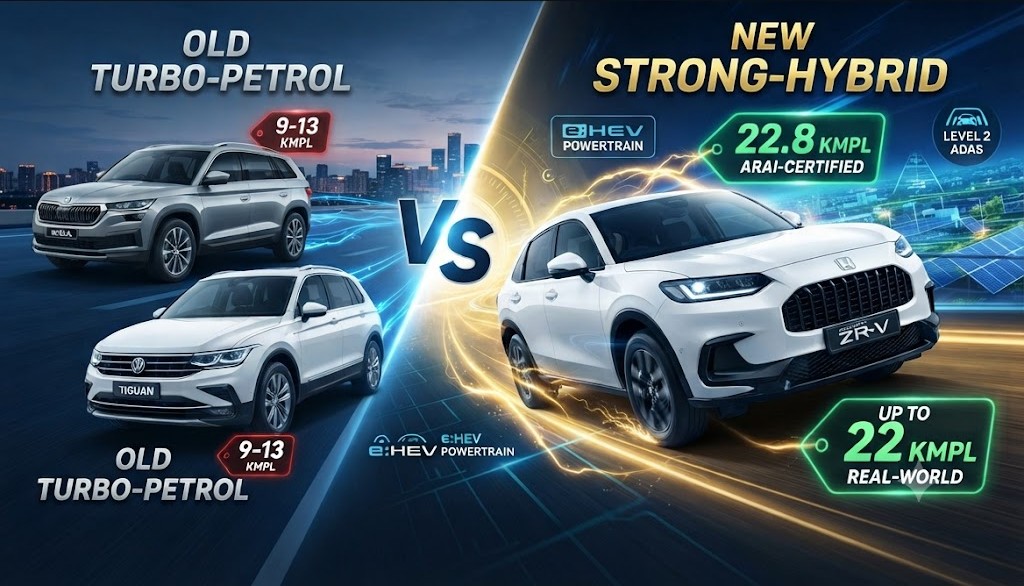
Honda has re-entered India’s premium SUV segment with a bold statement. The Honda ZR-V e:HEV, the Japanese automaker’s latest strong-hybrid SUV, is all set for customer deliveries starting July 2026 — and it arrives with a claim that no rival in the Rs 40-50 lakh bracket can match: 22.8 kmpl ARAI-certified fuel efficiency. That figure, nearly double what its closest turbo-petrol competitors return, is the centrepiece of Honda’s pitch in a segment long dominated by the Skoda Kodiaq and Volkswagen Tiguan.
The Honda ZR-V India price 2026 is expected to land between Rs 40 and Rs 50 lakh (ex-showroom Delhi), making it a direct challenger to European SUVs in this space. Sourced as a CBU (Completely Built Unit) from Japan, the ZR-V comes with an exclusivity premium but also brings Honda’s most advanced e:HEV hybrid powertrain to Indian roads for the very first time in an SUV form. This article covers everything you need to know — confirmed specs, variant details, mileage figures, features breakdown, and how it stacks up against the competition.
Honda ZR-V India Price & Variants
Honda India has confirmed a single variant strategy for the ZR-V in India — the fully-loaded ZR-V e:HEV Hybrid. This single-trim approach means every buyer gets the complete feature package without having to choose between trims. Based on pre-launch information and Honda India’s official communications, the expected price is:
| Variant | Expected Price (Ex-Showroom Delhi) | Estimated On-Road Price (Delhi) |
|---|---|---|
| Honda ZR-V e:HEV Hybrid | Rs 40–50 lakh | ~Rs 52–58 lakh |
The pricing reflects the CBU import duty structure. As a Completely Built Unit imported from Japan, the ZR-V attracts higher import duties compared to locally assembled vehicles. Honda has absorbed some of this premium, but buyers should expect to pay a markup over locally manufactured rivals of similar specification. That said, at the expected price point, it undercuts the revised GST-adjusted on-road prices of some fully-loaded European SUVs in this segment.
Honda India has opened pre-launch bookings through their official website and authorised dealerships. The booking amount has not been officially disclosed, but dealers are accepting reservations. Given the CBU import status and limited initial allocation, early booking is advisable to secure a preferred colour.
2.0L e:HEV Hybrid Powertrain Explained
The ZR-V’s powertrain is what sets it apart from everything else in this price bracket. Honda’s e:HEV (electrified Hybrid Electric Vehicle) system is a two-motor strong-hybrid setup — fundamentally different from the mild hybrids found in several rivals. Here’s how it works:
At its heart is a 2.0-litre Atkinson-cycle naturally aspirated petrol engine paired with two electric motors. The first motor generates electricity to charge the battery, while the second motor drives the wheels directly in most driving scenarios. The petrol engine primarily acts as a generator and only directly drives the wheels at higher cruising speeds when it’s most efficient to do so. This architecture results in three distinct drive modes:
- EV Drive: Pure electric propulsion from the traction motor. Used at low speeds, in traffic, and when the battery has sufficient charge. Completely silent, zero tailpipe emissions during this phase.
- Hybrid Drive: The petrol engine generates electricity while the electric motor drives the wheels. The most common mode in city driving and moderate speeds. Provides a seamless, CVT-like acceleration feel.
- Engine Drive: At highway speeds (typically above 80-90 km/h), the petrol engine locks directly to the drivetrain via a clutch for maximum efficiency. The electric motor supplements power as needed.
The combined system output is 184 PS and 315 Nm, delivered through Honda’s e-CVT transmission. The 0-100 km/h sprint is estimated at approximately 7.8-8 seconds — respectable for a hybrid SUV of this class. Importantly, the ZR-V is Front-Wheel Drive (FWD) only — there is no AWD option available for the Indian market. This is a notable trade-off buyers should consider, especially those who value all-weather or mild off-road capability.
Honda’s track record with this technology is reassuring. The same e:HEV architecture has powered the Honda City Hybrid in India and the Honda Jazz, Accord, and CR-V internationally. According to Honda’s global data, this system has accumulated over 8 million hybrid vehicles on roads worldwide, with exceptional long-term reliability data.
Fuel Efficiency & Real-World Mileage Expectations
The ZR-V’s ARAI-certified mileage of 22.8 kmpl is the number that stops conversations in this segment. To put that in perspective, here’s how it compares with its direct rivals:
| Model | Engine Type | ARAI Mileage | Real-World Estimate |
|---|---|---|---|
| Honda ZR-V e:HEV | 2.0L Strong Hybrid | 22.8 kmpl | 17–20 kmpl (city/highway) |
| Skoda Kodiaq | 2.0L Turbo Petrol | 14.86 kmpl | 10–13 kmpl |
| VW Tiguan R-Line | 2.0L TSI Turbo Petrol | 12.58 kmpl | 9–12 kmpl |
| Jeep Meridian | 2.0L Diesel | 16.25 kmpl | 12–15 kmpl |
Owners of the Honda City e:HEV in India — the closest sibling using a similar hybrid system — consistently report real-world figures between 18 and 22 kmpl in a mixed city-highway cycle, with the system excelling particularly in stop-and-go city traffic where regenerative braking recovers maximum energy. The ZR-V, being heavier than the City, should return approximately 17-20 kmpl in real-world Indian conditions — still comfortably ahead of any turbo-petrol rival in this space.
At an assumed fuel cost of ₹105/litre, covering 15,000 km annually would cost approximately ₹78,750 in the ZR-V versus ₹1,06,237 in the Kodiaq and ₹1,25,356 in the Tiguan. Over five years, the ZR-V’s fuel savings against the Tiguan alone could exceed ₹2.33 lakh — a compelling argument that offsets a portion of the ZR-V’s potential price premium.
Exterior Design & Dimensions
The ZR-V cuts a distinctive silhouette that Honda describes as a “bold and dynamic” crossover SUV. Its design borrows elements from Honda’s global design language while maintaining its own identity — one that notably does not look like the CR-V, even though both are SUVs. The ZR-V is positioned as a sportier, slightly more urban proposition.
Key design highlights include slender full-LED headlamps with integrated L-shaped Daytime Running Lights, sequential LED turn indicators, a prominent vertical front grille, and 18-inch diamond-cut alloy wheels. At the rear, LED tail lamps and dual exhaust tips complete a well-resolved design. Four exterior colour options are available: Twilight Mist Black Pearl, Platinum White Pearl, Crystal Black Pearl, and Meteoroid Grey Metallic.
| Dimension | Honda ZR-V | Skoda Kodiaq | VW Tiguan R-Line |
|---|---|---|---|
| Length | 4,567 mm | 4,758 mm | 4,539 mm |
| Width | 1,840 mm | 1,864 mm | 1,859 mm |
| Height | 1,621 mm | 1,679 mm | 1,656 mm |
| Wheelbase | 2,655 mm | 2,791 mm | 2,680 mm |
| Ground Clearance | 180 mm | 155 mm | 178 mm |
| Boot Space | 281 L (seats up) | 490 L | 652 L |
The ZR-V is the most compact of the three in length and wheelbase, which translates to marginally tighter rear legroom compared to the Kodiaq (which also offers a 7-seat option). However, for Indian urban roads, the ZR-V’s slightly smaller footprint makes it easier to manoeuvre and park — a practical advantage in congested city environments. The boot space of 380 litres (expandable to 1,312 litres with rear seats folded) is adequate but trails the Tiguan’s 652 litres.
Interior, Features & Technology
Step inside the ZR-V and Honda’s emphasis on quality over quantity becomes apparent. The cabin uses premium materials with soft-touch surfaces, ambient lighting, and a clean, driver-focused dashboard layout. The centrepiece is a 9-inch touchscreen infotainment system paired with a 10.2-inch fully digital instrument cluster — a combination that feels thoroughly modern without being overcomplicated.
The 12-speaker Bose premium audio system is a standout feature at this price point and matches what rivals charge extra for. Wireless Apple CarPlay and Android Auto are standard, as is a wireless charging pad. Other comfort features include:
- 8-way powered driver’s seat and 4-way powered front passenger seat
- Heated front seats and heated steering wheel
- Dual-zone automatic climate control
- Panoramic sunroof with tilt and slide function
- Hands-free powered tailgate with gesture control
- Air purifier with PM2.5 filter
- Ambient lighting with multiple colour modes
- Connected car features via Honda Connect app
However, it’s worth noting what the ZR-V doesn’t have compared to some rivals: ventilated front seats (notable absence given Indian summers), adaptive suspension dampers, and a significantly larger boot. Rivals like the top-selling SUVs in India increasingly offer ventilated seats even at lower price points. This is an area Honda may need to address if they want to hold price-sensitive buyers.
Safety & Honda SENSING ADAS Suite
Safety is a genuine strong suit for the ZR-V. Honda’s SENSING driver assistance suite brings Level 2 ADAS capability as standard — not as an option. The full Honda SENSING package includes:
- Collision Mitigation Braking System (CMBS): Detects vehicles and pedestrians ahead and applies brakes automatically if a collision is imminent
- Adaptive Cruise Control with Low-Speed Follow: Maintains set speed and distance from the vehicle ahead, including stop-and-go traffic
- Lane Keeping Assist System (LKAS): Provides gentle steering inputs to keep the vehicle within lane markings
- Road Departure Mitigation (RDM): Detects unintended road departures and steers back
- Lead Car Departure Notification: Alerts the driver when the vehicle ahead moves off at a traffic signal
- Auto High Beam: Automatically switches between high and low beam based on oncoming traffic
Passive safety includes 8 airbags (front, side, curtain, and driver knee airbag), Vehicle Stability Assist (VSA/ESC), Hill Start Assist, Hill Descent Control, and a 360-degree surround-view camera system. The ZR-V’s 8-airbag count matches most rivals, though the Volkswagen Tiguan R-Line edges ahead with 9 airbags. The ZR-V’s global equivalent (sold in Japan and Europe) achieved a 4-star Euro NCAP rating.
Honda ZR-V Delivery Timeline & Booking Details
Honda unveiled the ZR-V in India at a joint launch event alongside the new Honda City 2026 in May 2026, generating significant media attention and buyer interest. The timeline as of June 2026 is as follows:
- May 2026: Official unveil at Honda India event; pre-launch bookings open
- July 15, 2026 (expected): Official launch and price announcement
- Mid-July 2026: First customer deliveries commence
Bookings can be placed online via Honda India’s official website (hondacarindia.com) or at any authorised Honda dealership. The booking amount has not been officially disclosed but is expected to be in line with Honda’s other premium models (typically Rs 50,000-1,00,000).
A word of caution on availability: As a CBU import, the ZR-V will arrive in India in limited batches. Honda has not disclosed annual import volumes, but CBU models historically have waiting periods that can stretch from weeks to several months depending on demand. Given the high pre-launch interest, buyers looking to secure early delivery should place bookings without delay. The limited import volumes also mean Honda dealerships may not carry demo units in large numbers — test drives may require advance appointments.
Honda ZR-V vs Rivals: Where Does It Stand?
The premium midsize SUV segment in India around the Rs 40-50 lakh mark features some formidable European competition. Here’s a comprehensive look at how the ZR-V positions itself:
| Specification | Honda ZR-V e:HEV | Skoda Kodiaq | VW Tiguan R-Line | Jeep Meridian |
|---|---|---|---|---|
| Price (Ex-Delhi) | Rs 40–50 lakh* | Rs 36.99–46.99 lakh | Rs 47.11 lakh (as of June 2026) | Rs 23.33–44.61 lakh |
| Engine | 2.0L Strong Hybrid | 2.0L Turbo Petrol | 2.0L Turbo Petrol | 2.0L Diesel |
| Power | 184 PS | 204 PS | 204 PS | 170 PS |
| Torque | 315 Nm | 320 Nm | 320 Nm | 350 Nm |
| Gearbox | e-CVT | 7-speed DSG | 7-speed DSG | 9-speed Auto |
| Drivetrain | FWD only | AWD available | AWD (standard) | FWD / 4WD |
| ARAI Mileage | 22.8 kmpl | 14.86 kmpl | 12.58 kmpl | 16.25 kmpl |
| Seating | 5-seat only | 5 or 7-seat | 5-seat | 5 or 7-seat |
| Airbags | 8 | 9 | 9 | 6 |
| Boot Space | 380 L | 490 L | 652 L | 528 L |
*Expected price pending official launch announcement
ZR-V’s strengths: Fuel efficiency advantage is unmatched. Hybrid technology credibility backed by Honda’s global hybrid legacy. Single fully-loaded variant means no compromise on features. Honda’s reputation for reliability and low maintenance costs is a strong pull factor for value-conscious buyers.
ZR-V’s weaknesses: No AWD option — a significant miss against the Tiguan which offers 4MOTION AWD as standard. Smaller boot compared to rivals. No 7-seat option (the Kodiaq and Meridian offer this). No diesel engine for those who prefer that fuel type. CBU import means potentially long waiting periods and premium pricing. Notably, with the Skoda Kodiaq’s entry price now at Rs 36.99 lakh (following its 2026 relaunch), the ZR-V’s Rs 40 lakh starting point sits slightly above the Kodiaq’s base variant — a positioning shift buyers should factor into their shortlist decisions.
Verdict: Should You Wait for the Honda ZR-V?
The Honda ZR-V e:HEV is a genuinely compelling proposition, but it is one that suits a specific buyer profile exceptionally well — and is not the right answer for everyone.
Buy the ZR-V if: You clock significant urban kilometres and want to dramatically cut fuel costs. You value Honda’s proven hybrid reliability over the relative complexity of turbo-petrol DSG drivetrains. You prioritise a well-equipped, single-variant buying experience over choice paralysis. You find the feature-rich cabin, Bose audio, and ADAS suite a compelling proposition at the price. You don’t need AWD or 7 seats, and your daily driving profile is city-highway without serious off-road excursions.
Consider alternatives if: You need AWD capability — the Volkswagen Tiguan R-Line with its 4MOTION system is the only direct rival that offers this as standard. You need 7-seat flexibility — the Skoda Kodiaq (available in both 5 and 7-seat configurations) is a better fit. Your annual mileage is low enough that the hybrid efficiency advantage doesn’t offset the price premium. Or if you prefer the driving dynamics of a turbo-petrol setup — the Kodiaq’s TSI engine with DSG is a sportier, more viscerally engaging experience.
The Honda ZR-V occupies a unique space in the Indian market — it is the only strong-hybrid SUV in its price bracket, and that alone makes it worthy of serious consideration. Honda’s e:HEV technology has matured considerably through its application in the Honda City Hybrid and global models. For a buyer who commutes extensively in Indian cities and wants technology that genuinely reduces running costs without sacrificing premium comfort, the ZR-V is arguably the most forward-thinking choice in its segment right now. As Autocar India noted at the unveil, this is “Honda’s most significant India launch in years.”
Honda ZR-V Full Specifications
| Specification | Detail |
|---|---|
| Engine | 2.0L Atkinson-cycle Petrol + Electric Motor (e:HEV) |
| Displacement | 1,993 cc |
| Combined Power | 184 PS (combined system output) |
| Combined Torque | 315 Nm (electric motor) |
| Transmission | e-CVT |
| Drivetrain | Front-Wheel Drive (FWD) |
| ARAI Fuel Efficiency | 22.8 kmpl |
| Drive Modes | EV Drive / Hybrid Drive / Engine Drive |
| Length | 4,567 mm |
| Width | 1,840 mm |
| Height | 1,621 mm |
| Wheelbase | 2,655 mm |
| Ground Clearance | 180 mm |
| Boot Space | 380 L (seats up) / 1,312 L (seats folded) |
| Seating Capacity | 5 |
| Airbags | 8 (front, side, curtain, driver knee) |
| Infotainment | 9-inch touchscreen |
| Instrument Cluster | 10.2-inch fully digital |
| Audio System | 12-speaker Bose premium |
| ADAS | Honda SENSING (Level 2) |
| Camera | 360-degree surround-view |
| Sunroof | Panoramic sunroof |
| Charging | Wireless Qi charging |
| Apple CarPlay / Android Auto | Wireless (both) |
| Alloy Wheels | 18-inch diamond-cut |
| Colours | 4 (Twilight Mist Black Pearl, Platinum White Pearl, Crystal Black Pearl, Meteoroid Grey Metallic) |
Source: Honda Cars India — Official ZR-V Page
Honda ZR-V FAQ
What is the Honda ZR-V price in India?
The Honda ZR-V is expected to be priced between Rs 40 lakh and Rs 50 lakh (ex-showroom Delhi). The official price will be announced at the launch event expected on or around July 15, 2026. As a CBU import from Japan, the ZR-V attracts higher import duties which are reflected in its pricing. On-road price in Delhi is estimated to be approximately Rs 52–58 lakh depending on the final ex-showroom price announced.
What engine does the Honda ZR-V use?
The Honda ZR-V India uses Honda’s e:HEV strong-hybrid powertrain — a 2.0-litre Atkinson-cycle naturally aspirated petrol engine combined with two electric motors. The system produces a combined output of 184 PS and 315 Nm. Unlike mild hybrids, the ZR-V’s e:HEV system can drive the wheels purely on electric power in city traffic, making it significantly more fuel-efficient than conventional petrol SUVs. Power is sent to the front wheels via an electronically controlled e-CVT gearbox.
What is the Honda ZR-V mileage?
The Honda ZR-V delivers an ARAI-certified fuel efficiency of 22.8 kmpl — the highest figure in its price segment. This is nearly double the mileage of the Volkswagen Tiguan R-Line (12.58 kmpl) and significantly better than the Skoda Kodiaq (14.86 kmpl). In real-world Indian driving conditions (mixed city and highway), owners can expect approximately 17–20 kmpl, based on performance data from Honda’s similarly powered City e:HEV in India.
When will Honda ZR-V deliveries start in India?
Honda India has confirmed that ZR-V customer deliveries will begin in mid-July 2026. The official launch event is expected around July 15, 2026. Bookings are currently open through Honda’s official website (hondacarindia.com) and authorised dealerships. Since the ZR-V is a CBU import with limited initial allocation, buyers are advised to book early to avoid long waiting periods. The first batch of units is expected to reach dealerships in the first two weeks of July 2026.
Does the Honda ZR-V have AWD?
No, the Honda ZR-V in India is available only with Front-Wheel Drive (FWD). Honda has not offered the AWD version of the ZR-V for the Indian market. This is a notable trade-off compared to the Volkswagen Tiguan R-Line, which comes with 4MOTION AWD as standard in India. Buyers who require AWD capability should consider the Tiguan. The FWD setup does, however, contribute to the ZR-V’s superior fuel efficiency, as AWD systems add mechanical resistance and weight.