Walk into any Royal Enfield showroom with a budget of around ₹2 lakh and you will almost certainly end up standing between two bikes that share the same beating heart: the Royal Enfield Classic 350 and the Meteor 350. Both run the same 349cc J-series engine, make identical power, and cost within a few thousand rupees of each other. So this is not a spec-sheet shootout — it is a character decision. One is a retro roadster, the other a laid-back cruiser, and picking wrong means living with the mismatch for years.
This 2026 comparison cuts through the aggregator noise with confirmed prices, real ergonomics differences, a 3-year running-cost estimate, and a straight persona-based verdict on which Royal Enfield 350 actually fits your riding.
What Is the Difference Between the Classic 350 and Meteor 350?
The Royal Enfield Classic 350 and Meteor 350 use the same 349cc J-series engine (20.2 PS, 27 Nm) but are built for different riders. The Classic 350 is a retro roadster with an upright, neutral stance for city and all-round use. The Meteor 350 is a low-slung cruiser with forward-set footpegs, a lower seat and Tripper navigation, tuned for relaxed highway touring. As of July 2026 the Classic starts around ₹1.87 lakh and the Meteor from around ₹1.99 lakh, ex-showroom.
Classic 350 vs Meteor 350: Quick Comparison Table
Here is the side-by-side at a glance. Prices are ex-showroom and dated July 2026; they vary by variant and city, so always confirm the on-road figure for your RTO before booking.
| Specification | Royal Enfield Classic 350 | Royal Enfield Meteor 350 |
|---|---|---|
| Body style | Retro roadster | Cruiser |
| Engine | 349cc, air/oil-cooled J-series single | 349cc, air/oil-cooled J-series single |
| Max power | 20.2 PS | 20.2 PS |
| Max torque | 27 Nm | 27 Nm |
| Gearbox / clutch | 5-speed, assist & slipper clutch (2026, ABS variants) | 5-speed, slipper clutch (2026) |
| Claimed mileage | ~41.5 kmpl (ARAI-certified) | ~41.5 kmpl (ARAI-certified) |
| Kerb weight | ~195 kg | ~191 kg |
| Seat height | ~805 mm | 765 mm |
| Fuel tank | ~13 litres | ~15 litres |
| Brakes | 300 mm front disc / 270 mm rear disc | 300 mm front disc / 270 mm rear disc |
| ABS | Single- or dual-channel (by variant) | Dual-channel |
| Wheels / tyres | Spoke + tube-type (alloy/tubeless on select trims) | Alloy + tubeless (standard) |
| Tripper navigation | Not part of the 2026 update | Yes (2026) |
| Ex-showroom price (Jul 2026) | From ~₹1.87 lakh (ABS variants from ~₹1.95 lakh) | From ~₹1.99 lakh (top variant ~₹2.21 lakh) |
The Classic 350’s 805 mm seat, 13-litre tank, ~195 kg kerb weight and 41.55 kmpl ARAI-certified mileage are listed by Autocar India, while the Meteor 350’s ~191 kg weight, 765 mm seat, ~15-litre tank and brakes come from Cycle World (and match Autocar India’s Meteor listing). Note that both bikes gained a slipper clutch for 2026 — the Classic’s is an assist and slipper unit, so that upgrade is no longer a Meteor-only advantage.
Same Engine, Different Character: Design & Riding Position
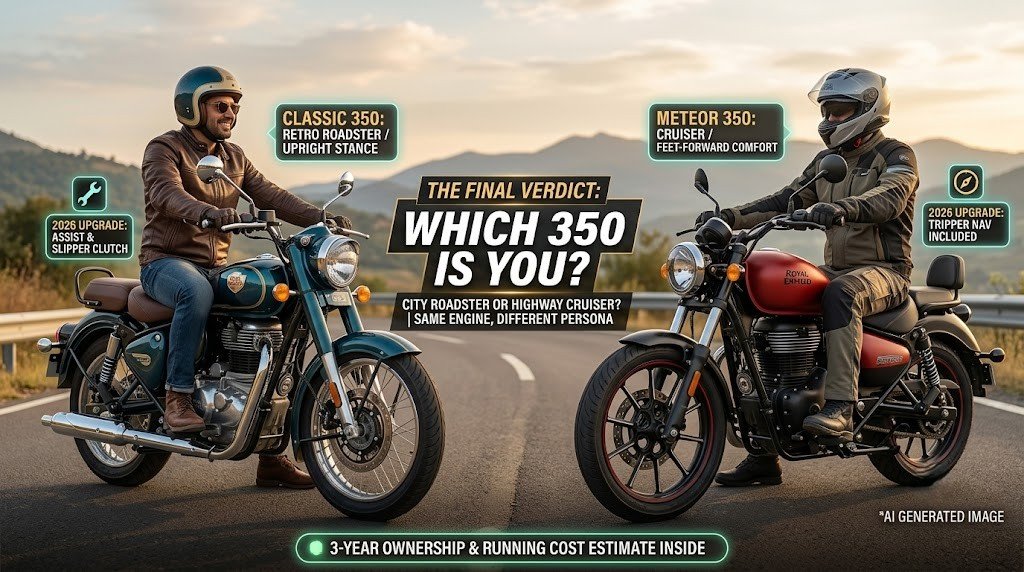
This is where the decision is really made. The Classic 350 wears the timeless post-war Redditch silhouette — a rounded tank, valanced fenders and that unmistakable thump-and-swagger road presence. You sit upright, the handlebar is wide and close, and the footpegs sit roughly under you in a neutral riding triangle. It feels like a proper standard-issue motorcycle: planted, honest, and equally at home filtering through traffic or holding a steady lane.
The Meteor 350 takes the same engine and wraps a genuine cruiser around it. The 765 mm seat is roughly 40 mm lower than the Classic’s ~805 mm perch, the footpegs are set forward, and the handlebar sweeps back to you. The result is a feet-forward, arms-relaxed posture that many riders find easier on the lower back over long stints.
What does that mean in practice?
- City riding: The Classic’s upright stance gives better control at crawl speeds and easier U-turns. The Meteor’s low seat helps shorter riders flat-foot at lights, but the forward pegs feel slightly awkward in stop-go traffic.
- Highway cruising: The Meteor is the more relaxed long-distance companion — the laid-back posture and larger fuel tank suit 200-300 km days. The Classic is comfortable too, just more of an all-rounder than a dedicated tourer.
- Approachability: New and shorter riders almost always find the Meteor less intimidating to throw a leg over, thanks to that lower seat and slightly lighter kerb weight.
Engine, Ride & Real-World Performance
Under both tanks sits the same 349cc, air/oil-cooled, single-cylinder J-series engine producing 20.2 PS and 27 Nm, mated to a 5-speed gearbox. On paper they are identical, and on the road the differences come down to weight distribution and posture rather than outright grunt.
This engine is not about acceleration — it is about the long-legged, low-frequency thump the J-series delivers. Both bikes are happiest cruising at 80-90 kmph, where the motor settles into a relaxed rhythm with far less vibration than the old UCE 350s. Push toward 100-110 kmph and you feel the aerodynamic wall of a naked retro; the Meteor’s slightly better wind management and lower centre of gravity make sustained highway speeds marginally more relaxed.
For 2026, both models gained a slipper clutch — a genuinely useful update. It cuts clutch-lever effort in traffic and smooths out aggressive downshifts. On the Classic 350, this assist and slipper unit (along with a USB Type-C port) applies to the dual-channel ABS variants, while the entry Redditch Red continues unchanged. On the Meteor, the slipper clutch is part of the standard 2026 package.
Real-world mileage tracks closely between them because they share the engine. Royal Enfield’s ARAI-certified claimed figure is about 41.5 kmpl (Autocar India lists 41.55 kmpl for the Classic 350, and the Meteor uses the identical engine), but expect a more realistic 35-40 kmpl in mixed riding depending on how hard you chase the redline. You can estimate your own numbers using our Mileage Calculator.
Features & Tech: Tripper Nav, Console, Brakes
With the mechanicals matched, the feature list is where a real gap opens up — and it now favours the Meteor.
- Tripper navigation: The 2026 Meteor 350 gets Royal Enfield’s Tripper turn-by-turn navigation pod as part of its update, alongside LED lighting and a slipper clutch. The Classic 350’s 2026 changes centred on the slipper clutch and USB-C rather than adding Tripper, so navigation availability is the Meteor’s clearest tech edge.
- Charging: Both now offer a USB Type-C charging port on their updated variants — handy for keeping a phone alive on longer rides.
- Instrumentation: Both use Royal Enfield’s semi-digital cluster: an analogue speedometer paired with a small digital inset for the odometer, trip and fuel readout.
- Brakes & ABS: Each bike runs a 300 mm front disc and 270 mm rear disc. The Meteor comes with dual-channel ABS as standard; the Classic offers single- or dual-channel depending on the variant you pick, so choose an ABS-equipped Classic trim if two-wheel ABS matters to you.
- Wheels & tyres: The Meteor ships with alloy wheels and tubeless tyres as standard — a real convenience for roadside puncture repairs. The Classic uses spoke wheels with tube-type tyres on most variants, with alloys and tubeless reserved for select higher trims.
Price, Variants & On-Road Cost
As of July 2026, the Classic 350 is offered across the Redditch, Halcyon, Signals and Dark trim families, while the Meteor 350 comes in Fireball, Stellar and Supernova variants (with additional colour packs).
On pricing, editorial reporting from Autocar India puts the updated Classic 350 at ₹1.87 lakh ex-showroom for the entry Redditch Red, with the assist-clutch-equipped dual-channel ABS variants starting from around ₹1.95 lakh. Autocar India’s listing puts the Meteor 350 from around ₹1.99 lakh ex-showroom (rising to about ₹2.21 lakh for the top variant), as of July 2026. So the two overlap heavily — a well-specced Classic and an entry Meteor can be within touching distance.
Remember that ex-showroom is only the starting point. Once you add RTO road tax and insurance, the on-road price of a top Classic 350 or a Meteor 350 comfortably crosses ₹2 lakh in most cities. The exact jump depends on your state’s road tax, so work out your precise figure with our On-Road Price Calculator before you commit. If you are financing, our Vehicle EMI Calculator will show your monthly outgo for different down payments and tenures.
A note on the wider Royal Enfield 350 family: if you find both of these a touch big, the more compact Hunter 350 shares this engine in a lighter, cheekier roadster body — see our look at the Royal Enfield Hunter 350.
3-Year Ownership & Running Cost
Because they share an engine, the Classic and Meteor cost almost the same to run. The table below is an estimate for roughly 10,000 km a year over three years, assuming petrol around ₹100/litre and real-world efficiency near 38 kmpl. Treat these as ballpark planning numbers, not quotes.
| Cost head (3 years / ~30,000 km, estimated) | Classic 350 | Meteor 350 |
|---|---|---|
| Fuel (~38 kmpl @ ~₹100/L) | ~₹79,000 | ~₹79,000 |
| Periodic service (approx.) | ~₹16,000-20,000 | ~₹16,000-20,000 |
| Insurance (3 years, approx.) | ~₹24,000-30,000 | ~₹24,000-30,000 |
| Cost per km (fuel only, approx.) | ~₹2.6/km | ~₹2.6/km |
Fuel is the biggest variable, and it depends entirely on your riding style and local petrol price — plug your own numbers into our Fuel Cost Calculator for a personalised estimate. On resale, both bikes are among the strongest value-holders in the segment; Royal Enfield’s brand pull means well-kept 350s command healthy second-hand prices, with the Classic’s iconic status giving it a slight edge in desirability.
Scored Pros & Cons: Classic 350
Our score: 4.3 / 5 — the definitive all-rounder for buyers who want the classic Royal Enfield look and stance.
- Pros: Iconic, timeless design with unmatched road presence; upright, neutral ergonomics that suit city and all-round use; strongest resale desirability in the family; 2026 slipper clutch and USB-C on ABS variants.
- Cons: Heaviest of the 350 duo at ~195 kg; taller ~805 mm seat is less friendly for shorter riders; spoke/tube-type tyres on most variants mean trickier roadside puncture fixes; not as relaxed as the Meteor over very long highway hauls.
Scored Pros & Cons: Meteor 350
Our score: 4.2 / 5 — the relaxed, feature-rich cruiser for easy touring and newer riders.
- Pros: Low 765 mm seat and cruiser ergonomics ideal for relaxed touring; Tripper turn-by-turn navigation as part of the 2026 update; alloy wheels with tubeless tyres as standard; dual-channel ABS standard; slightly lighter and larger fuel tank for longer legs between fills.
- Cons: Costs a little more than an entry Classic; forward-set footpegs feel awkward for some in stop-go city traffic; cruiser styling is more polarising than the universally-loved Classic look.
Which Royal Enfield 350 Should You Buy? (Persona Matrix)
Both bikes are excellent — there is no wrong answer, only the right fit. Match yourself to a rider profile below.
| If you are… | Best pick | Why |
|---|---|---|
| Style-first, want the iconic RE look | Classic 350 | Timeless design, best road presence and resale desirability. |
| Mostly city + all-round use | Classic 350 | Upright, neutral ergonomics give better low-speed control. |
| Relaxed highway touring | Meteor 350 | Feet-forward comfort, bigger tank, Tripper nav for long routes. |
| A shorter or first-time big-bike rider | Meteor 350 | Lower 765 mm seat and lighter feel are less intimidating. |
| Want the most convenience tech + tubeless | Meteor 350 | Tripper nav, alloy wheels and tubeless tyres come standard. |
The verdict: If you love the classic Royal Enfield shape and mostly ride in and around the city, the Classic 350 is the emotional and practical all-rounder — and it holds its value beautifully. If your riding leans toward relaxed weekend highway runs, you value a low seat, or you want the most convenience features for the money, the Meteor 350 is the smarter buy. Whatever the spec sheet says, take a test ride on both: the posture that feels right after ten minutes is the one you should trust, because the engine underneath is identical.
Cross-shopping beyond Royal Enfield? See how the modern-retro roadster class stacks up in our Guerrilla 450 vs Speed 400 vs X440 vs Mavrick 440 comparison, or read where the brand is heading with the electric Royal Enfield Flying Flea C6.
Frequently Asked Questions
Which is better, the Royal Enfield Classic 350 or Meteor 350?
Neither is outright better — they share the same engine and are built for different riders. The Classic 350 suits style-focused city and all-round riders who want the iconic look and best resale. The Meteor 350 suits relaxed highway touring, shorter riders and buyers who want Tripper navigation and tubeless tyres as standard.
What is the mileage difference between the Classic 350 and Meteor 350?
Very little. Both use the same 349cc engine, with an ARAI-certified claimed figure of about 41.5 kmpl (Autocar India lists 41.55 kmpl for the Classic 350). In real-world mixed riding, expect roughly 35-40 kmpl on either bike depending on your riding style.
Is the Meteor 350 more comfortable than the Classic 350?
For relaxed, long-distance riding, yes — the Meteor’s lower 765 mm seat, forward footpegs and laid-back cruiser posture are easier over long hauls and for shorter riders. The Classic’s upright stance is arguably better for city control and tighter manoeuvres. Comfort is posture-dependent, so a test ride is the real decider.
What is the price difference between the Classic 350 and Meteor 350?
As of July 2026, the Classic 350 starts around ₹1.87 lakh ex-showroom (dual-channel ABS variants from about ₹1.95 lakh) while the Meteor 350 starts from around ₹1.99 lakh ex-showroom. A well-specced Classic and an entry Meteor can end up very close on price; check your on-road figure before deciding.
Which Royal Enfield 350 is best for touring?
The Meteor 350. Its cruiser ergonomics, lower seat, larger fuel tank and standard Tripper navigation make it the more natural highway tourer of the two. The Classic 350 can tour comfortably too, but it is more of an all-rounder than a dedicated long-distance machine.
Do both bikes get a slipper clutch for 2026?
Yes. Both the Classic 350 and Meteor 350 received a slipper clutch for 2026. On the Classic it is an assist and slipper unit fitted to the dual-channel ABS variants (the entry Redditch Red continues unchanged), while on the Meteor the slipper clutch is part of the standard 2026 package.