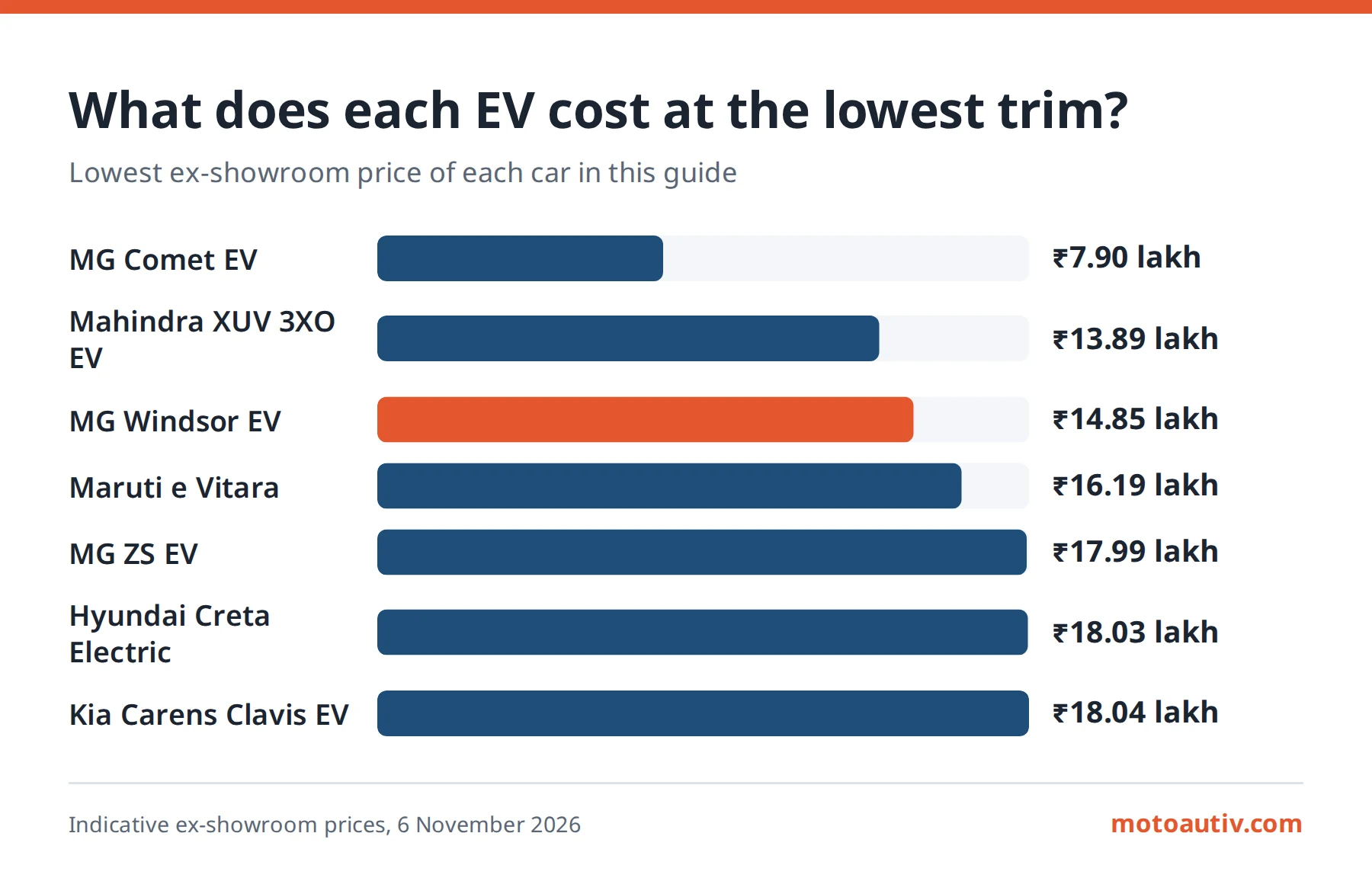
The best electric cars under 20 lakh now give you a real choice. At the low end is a small city car at ₹7.90 lakh. At the top are family SUVs that start at about ₹18 lakh. The catch is the label. Many cars fit the budget only in their cheapest trims, or only if you rent the battery.
This guide sorts the options by budget and shows what each car claims on paper. It then says what range to plan for. Finally it works out the running cost against petrol.
Prices are indicative ex-showroom figures from the makers’ own websites as of 6 November 2026. Confirm with your dealer before you book.
Best electric cars under 20 lakh at a glance
The best electric car under ₹20 lakh depends on how you drive. The MG Windsor EV suits most families. The Maruti e Vitara offers the longest claimed range. The Kia Carens Clavis EV fits bigger families. The MG Comet EV is the pick for a tight city budget.
| Model | Lowest ex-showroom price | Battery (kWh) | Claimed range | Best for |
|---|---|---|---|---|
| MG Comet EV | ₹7.90 lakh | 17.4 | 230 km | Small city car on a tight budget |
| Mahindra XUV 3XO EV | ₹13.89 lakh | 39.4 | 456 km | Compact SUV for city and weekend trips |
| MG Windsor EV | ₹14.85 lakh | 38 or 52.9 | 331 to 449 km | All-round family car |
| Maruti e Vitara | ₹16.19 lakh | 49 or 61 | 440 or 543 km | Longer drives and highway use |
| MG ZS EV | ₹17.99 lakh | 50.3 | 461 km | Buyers who want a larger MG SUV |
| Hyundai Creta Electric | ₹18.03 lakh | 42 or 51.4 | 420 or 510 km | Buyers who value a long battery warranty |
| Kia Carens Clavis EV | ₹18.04 lakh | 42 or 51.4 | 404 or 490 km | Families that need six or seven seats |
Figures are approximate and indicative; the range is the maker’s claimed figure, not what you will see every day.
Tata also sells electric cars in this price band, including the Tiago, Punch and Nexon. Check TATA.ev for current prices. Our Tata Tiago EV guide and Tata Punch on-road price guide have more detail.
How “under 20 lakh” works: ex-showroom, on-road and BaaS
A car under ₹20 lakh ex-showroom can still cost more on the road. On-road price adds insurance, registration and, in some states, road tax. Work out your exact figure with our On-Road Price Calculator before you decide that a top trim fits.
Several makers also offer Battery-as-a-Service, or BaaS. You buy the car without the battery. You then pay a fee for every kilometre you drive. The upfront price falls sharply, but the fee never stops.
| Model | Price with BaaS | Battery fee per km |
|---|---|---|
| MG Comet EV (Executive) | ₹4.99 lakh | ₹3.3 |
| MG Windsor EV (Excite) | ₹9.99 lakh | ₹4.3 |
| Kia Carens Clavis EV | ₹12.88 lakh | ₹3.3 |
| MG ZS EV (Executive) | ₹13.00 lakh | ₹4.5 |
| Hyundai Creta Electric | ₹10.99 lakh | ₹3.90 (starting fee) |
Is it worth it? Take the Windsor Excite. Buying the battery costs about ₹4.86 lakh more upfront. At ₹4.30 a km, that gap equals roughly 113,000 km of battery fees. At 12,000 km a year, that is about 9.4 years.
For the Comet EV the gap is about ₹2.91 lakh. The fee is ₹3.3 a km. That is roughly 88,000 km of fees, or about 7.3 years. BaaS suits a low-mileage buyer who is short of cash today. If you drive a lot or keep the car long, buying the battery works out cheaper. Use the Vehicle EMI Calculator to compare loan options for both routes.
Best EVs under 10 lakh and under 15 lakh
For a budget under ten lakh, look at the MG Comet EV. The Executive trim lists at ₹7,89,800 and the Excite FC at ₹9,26,800. The Exclusive FC costs ₹10,16,800, which is just over the line. It is a small city car with a claimed range of 230 km, so it suits short daily trips rather than highway travel.
| MG Comet EV trim | Ex-showroom price | Fast charging |
|---|---|---|
| Executive | ₹7,89,800 | No AC fast charging listed |
| Excite FC | ₹9,26,800 | AC fast charging |
| Exclusive FC | ₹10,16,800 | AC fast charging |

Under ₹15 lakh, two cars stand out. The Mahindra XUV 3XO EV is priced from ₹13.89 lakh to ₹14.96 lakh. It carries a 39.4 kWh battery. The MG Windsor EV Excite starts at ₹14,84,800, just inside the limit. Mahindra says the XUV 3XO EV gives about 280 km in real-world use, so it works best as a city and short-trip SUV.
Best EVs between 15 and 20 lakh
This band has the widest choice, and it is where most first-time EV buyers end up. The table shows which variants sit under the ₹20 lakh line on ex-showroom price. Several trims miss it by a small margin, and those are the ones to avoid if ₹20 lakh is your hard limit.
| Model and variant | Ex-showroom price | Under ₹20 lakh? |
|---|---|---|
| MG Windsor EV Exclusive | ₹16,14,800 | Yes |
| MG Windsor EV Essence | ₹17,14,800 | Yes |
| MG Windsor EV Exclusive Pro (52.9 kWh) | ₹18,04,800 | Yes |
| MG Windsor EV Essence Pro (52.9 kWh) | ₹19,14,800 | Yes |
| Maruti e Vitara Delta (49 kWh) | ₹16,19,000 | Yes |
| Maruti e Vitara Zeta (61 kWh) | ₹17,94,000 | Yes |
| Maruti e Vitara Alpha (61 kWh) | ₹20,21,000 | No |
| MG ZS EV Executive | ₹17,99,000 | Yes |
| MG ZS EV Exclusive Plus | ₹19,99,600 | Yes, by a thin margin |
| MG ZS EV Essence | ₹20,74,600 | No |
| Hyundai Creta Electric (entry) | ₹18,02,800 | Yes |
| Kia Carens Clavis EV HTK+ 7 | ₹18,03,900 | Yes |
| Kia Carens Clavis EV HTX (E) 7 | ₹19,99,900 | Yes, by a thin margin |
Kia lists nine trims for the Clavis EV, and only these two sit under ₹20 lakh ex-showroom. On-road, the HTX (E) 7 and the ZS EV Exclusive Plus are likely to cross ₹20 lakh, as the on-road example below shows. Hyundai lists the Creta Electric from ₹18,02,800, so check the upper trims with a dealer.
On-road price example and road-tax rules
Insurance alone can push a ₹19.99 lakh car past ₹20 lakh on the road. The table is an illustration, not a quote. It assumes comprehensive insurance of 3 per cent of the ex-showroom price and no other charges.
| Car and variant | Ex-showroom price | Insurance (assumed 3%) | Estimated on-road price in Delhi |
|---|---|---|---|
| MG Windsor EV Essence Pro | ₹19,14,800 | ₹57,444 | ₹19,72,244 |
| MG ZS EV Exclusive Plus | ₹19,99,600 | ₹59,988 | ₹20,59,588 |
| Kia Carens Clavis EV HTX (E) 7 | ₹19,99,900 | ₹59,997 | ₹20,59,897 |
Delhi is used because its rules are published officially. The Delhi government’s EV Policy 2026-30 exempts electric cars up to ₹30 lakh ex-showroom from road tax and registration fees. The exemption is 100 per cent and runs until 31 March 2030. This example is an illustration: it leaves out TCS (tax collected at source), which may apply to cars priced above ₹10 lakh, and other charges. Other states have their own rules, so your on-road price may be higher.
The calculator linked earlier lets you test your own city and variant.
Safety, seats and boot space
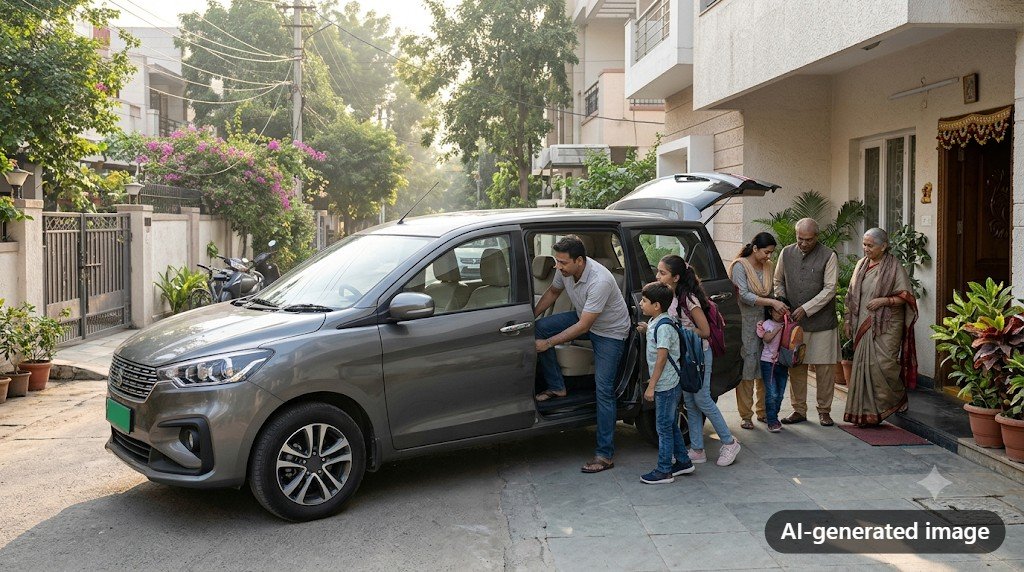
Where makers list airbag counts, most cars here have six or more. Seat count matters more than most buyers expect, so check it against your family size before you shortlist.
| Car | Seats | Airbags listed by the maker | Boot space |
|---|---|---|---|
| MG Comet EV | 4 | Dual airbags | Not listed |
| Mahindra XUV 3XO EV | 5 | 6 | 364 litres |
| MG Windsor EV | 5 | 6 | 604 litres |
| Maruti e Vitara | Not listed | 7 | Not listed |
| MG ZS EV | 5 | 6 | Not listed |
| Hyundai Creta Electric | 5 | Not listed | 22 litres front boot (frunk) |
| Kia Carens Clavis EV | 6 or 7 | 6 | Not listed |
Several makers also list Level 2 ADAS, a set of driver-assist features such as adaptive cruise control. Kia lists it with 20 autonomous features on the Clavis EV. Mahindra, MG and Maruti list it too. It is often limited to higher trims, so check which variants get it.
The Mahindra XUV 3XO EV lists a ground clearance of 190 mm. Tata says its Punch.ev and Nexon.ev both earned 5 stars in the government’s Bharat NCAP crash tests in June 2024. Tata lists six airbags as standard on both.
Ranked picks: our top 5 and why
We ranked these on usable range, price inside the budget, warranty and how few compromises you make. This is our opinion, built on the makers’ own figures.
- MG Windsor EV: best all-rounder. Five variants run from ₹14.85 lakh to ₹19.15 lakh. The two Pro variants carry a 52.9 kWh battery. They claim 449 km. MG lists a lifetime battery warranty for the first owner. The trade-off: the Pro trims cost ₹18.05 lakh and ₹19.15 lakh, close to your limit.
- Maruti e Vitara: best for longer trips. The Zeta costs ₹17.94 lakh. Its 61 kWh battery claims 543 km, the longest in this list. The Delta at ₹16.19 lakh claims 440 km. The trade-off: the top Alpha costs ₹20.21 lakh, so stay with Delta or Zeta. See how it compares in our Maruti Suzuki e Vitara vs Hyundai Creta Electric article.
- Kia Carens Clavis EV: best for big families. It comes with six or seven seats and starts at ₹18.04 lakh. The two battery packs claim 404 km and 490 km. The trade-off: only two trims are under ₹20 lakh, and both are close to it.
- Hyundai Creta Electric: best for peace of mind. Hyundai lists an 8 year or 1,60,000 km battery warranty. A DC fast charger takes it from 10 to 80 per cent in 39 minutes. It starts at ₹18.03 lakh. The trade-off: the entry price is all that is confirmed under ₹20 lakh. Our Kia Syros EV vs Hyundai Creta Electric comparison shows the alternatives.
- Mahindra XUV 3XO EV: best SUV for the money. At ₹13.89 lakh to ₹14.96 lakh it is the lowest-priced SUV here. The trade-off: Mahindra quotes about 280 km in real use, shorter than the larger-battery rivals.
The MG ZS EV is a sensible sixth choice. The Executive trim costs ₹17.99 lakh. It claims 461 km from a 50.3 kWh battery. Choose it only if you prefer its styling and features over the Windsor.
Claimed vs real-world range: what to expect
Plan for a real range that is clearly lower than the claimed figure. Claimed range comes from a test cycle (ARAI or MIDC) run in controlled conditions. AC use, highway speed, load and traffic all reduce it. Brands also word their claims differently, so compare cars on the same footing.
Some makers publish their own real-world estimate. The table uses those figures where they exist. Maruti, Hyundai and Kia do not give one. Until you test the car, treat about two-thirds to three-quarters of the claim as a cautious planning range.
| Model | Claimed range | Real-world range stated by the maker |
|---|---|---|
| MG Comet EV | 230 km | 170 to 200 km |
| MG Windsor EV (52.9 kWh) | 449 km | 400 km or more |
| MG ZS EV | 461 km | 350 to 420 km |
| Mahindra XUV 3XO EV | 456 km | about 280 km |
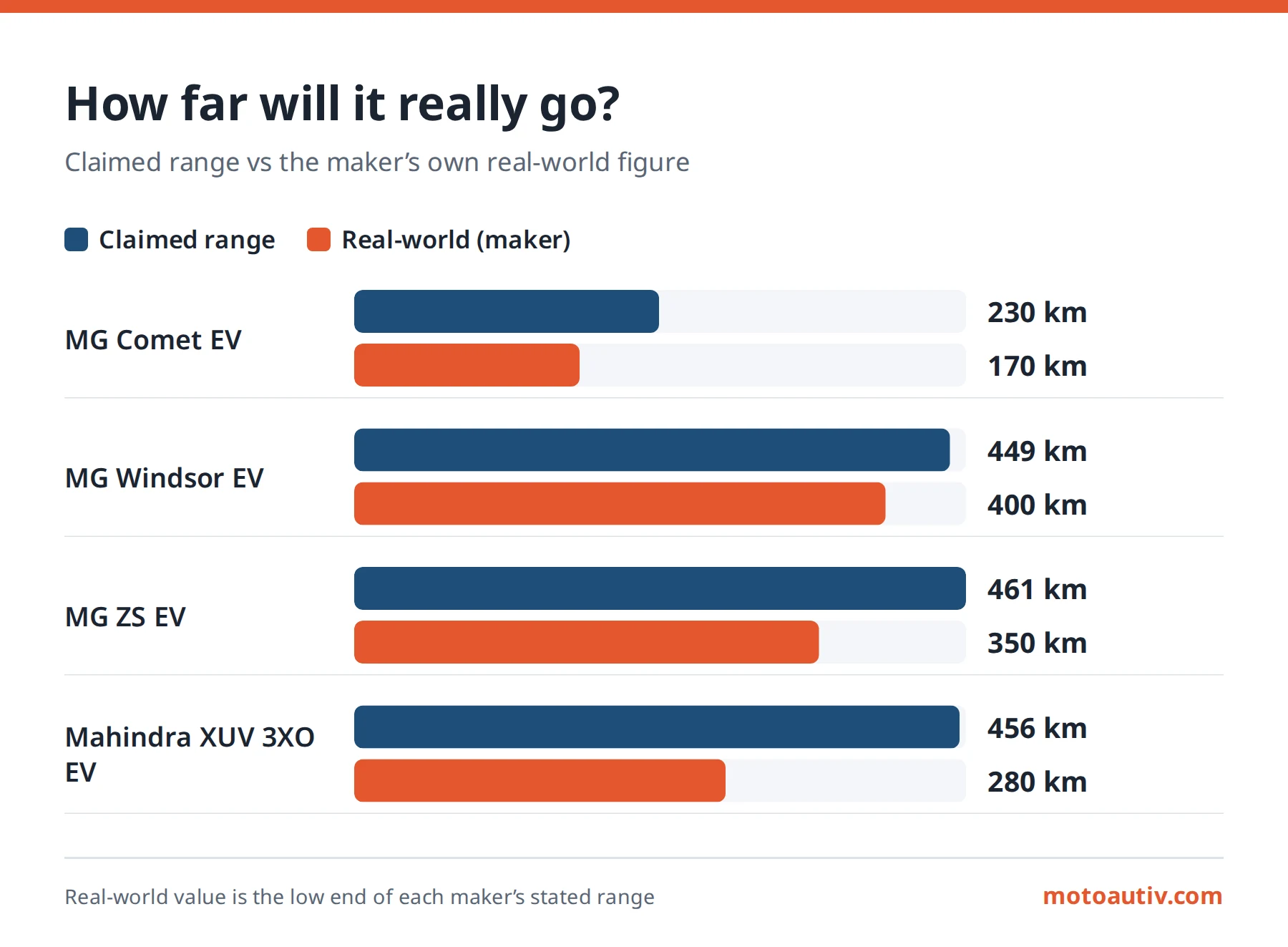
The Mahindra gap is the widest, at 456 km claimed against about 280 km. The Windsor holds up best. For a 40 km round-trip commute, any car here will need charging only once or twice a week.
Running cost: charging cost per km vs petrol
At home, an EV in this list costs roughly ₹1 a km to run. A petrol hatchback costs about ₹6.67. That is the biggest reason to switch. The figures below are estimates, built on stated assumptions, so change them for your own tariff in the Fuel Cost Calculator.
Assumptions: home electricity at ₹8 per kWh and petrol at ₹100 per litre. The petrol car does 15 km/l. Everyone drives 12,000 km a year. Energy use is battery size divided by the lower end of the real-world range. Charging losses are ignored.
| Car | Real range used | Cost per km | Cost for 12,000 km a year |
|---|---|---|---|
| MG Comet EV | 170 km | ₹0.82 | ₹9,840 |
| MG Windsor EV (52.9 kWh) | 400 km | ₹1.06 | ₹12,720 |
| Mahindra XUV 3XO EV | 280 km | ₹1.13 | ₹13,560 |
| MG ZS EV | 350 km | ₹1.15 | ₹13,800 |
| Petrol hatchback (15 km/l) | Not applicable | ₹6.67 | ₹80,000 |
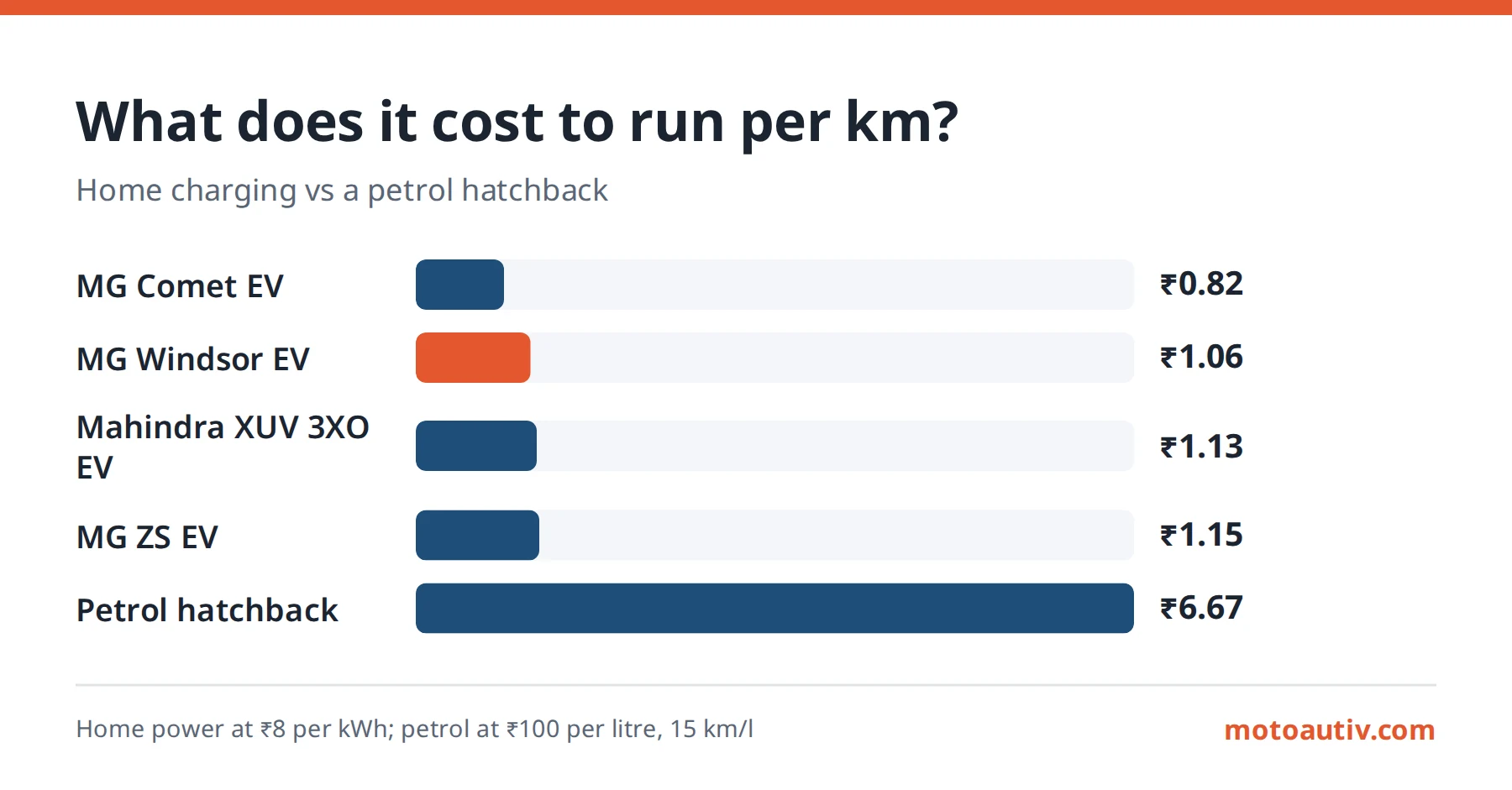
On these assumptions the Windsor saves about ₹67,000 a year over the petrol car. Public fast chargers usually charge more per kWh than your home meter, so a driver who relies on them will save less. Check the rate in the charging app.
Get insurance quotes before you finalise, because a higher-priced car costs more to insure.
Which EV is right for you: city, family, highway
Match the car to your longest regular trip, not your longest dream trip. If most days are under 40 km, a smaller battery is enough. If you drive between cities every month, buy the bigger pack.
| If you are… | Look at | Why |
|---|---|---|
| A city commuter on a tight budget | MG Comet EV | Lowest price here, ₹0.82 a km in running cost |
| A first-time buyer who wants an SUV | Mahindra XUV 3XO EV or MG Windsor EV | Both start below ₹15 lakh |
| A family of five with mixed use | MG Windsor EV Exclusive Pro | 52.9 kWh battery and 449 km claimed range |
| A family of six or seven | Kia Carens Clavis EV | Six and seven-seat versions are offered |
| A highway driver | Maruti e Vitara Zeta | 543 km claimed, the longest in this guide |
| A buyer who keeps cars for 8 years | Hyundai Creta Electric | 8 year or 1,60,000 km battery warranty |
Common mistakes buyers make with a first EV
- Judging by ex-showroom price alone. Add insurance, registration and any road tax to see the true cost.
- Trusting the claimed range. Use the real-world figure for your own route, and keep a margin of at least 20 per cent.
- Ignoring where you will charge. Ask your housing society about a charger before you book. A home point makes the saving real.
- Choosing BaaS without doing the sums. The per-km fee can add up over many years, as shown above.
- Skipping the battery warranty terms. Read the years, the kilometre limit and who is covered, including whether it passes to a second owner.
- Assuming incentives. Ask your dealer whether your state waives road tax or registration fees on EVs today.
Charging, subsidies and battery warranty
At home, expect an overnight charge; on the highway, expect a stop of about 40 minutes. On a 7.4 kW home charger, MG lists about 6.5 hours (0–100%) for the 38 kWh Windsor and about 9.5 hours (10–100%) for the 52.9 kWh Pro. Kia quotes an 11 kW AC charger for the Clavis EV. The 42 kWh pack takes 4 hours. The 51.4 kWh pack takes 4 hours 45 minutes.
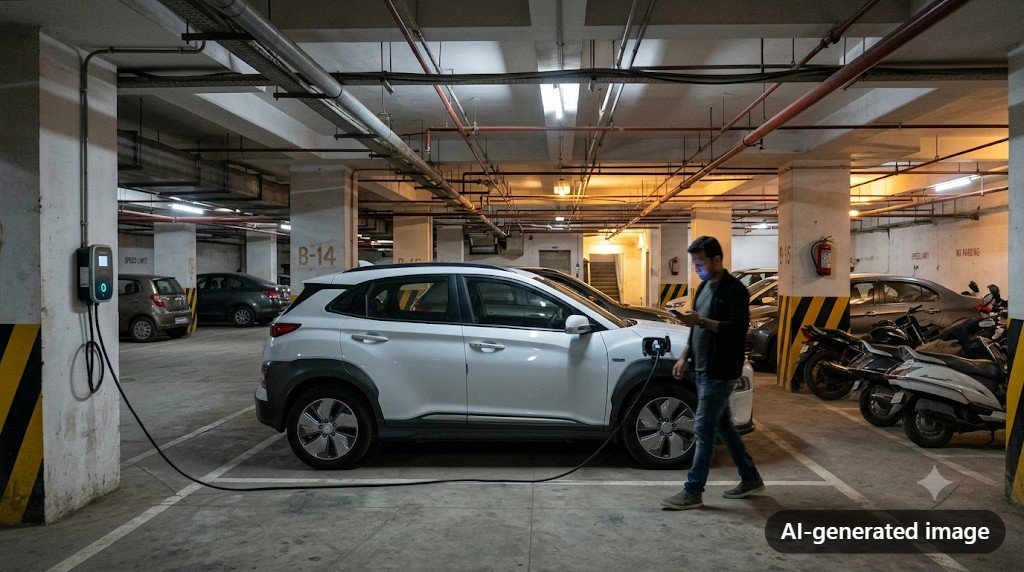
On a DC fast charger, Hyundai and Kia both claim 39 minutes for 10 to 80 per cent. Mahindra lists 50 minutes on a 50 kW charger for the XUV 3XO EV.
Warranty terms differ. Hyundai gives 8 years or 1,60,000 km on the battery. MG lists a lifetime battery warranty for the first owner. Maruti lists a standard 3 year or 1,00,000 km warranty on the e Vitara, which you can extend. Check the exact battery cover in writing. Our EV Battery Health Calculator shows how battery health changes over time.
Outside Delhi, subsidies and road-tax waivers change by state and over time. Confirm the current rules with your dealer or state transport office.
Should you buy now or wait?
If a car on this list suits you today, buy it; waiting rarely pays when prices and offers keep changing. If you are also eyeing a Tata, our Tata Sierra EV guide covers that car. Check the maker’s site for its current price and availability. Wait only if you want a specific model that is not on sale yet.
Our verdict: for most buyers, the MG Windsor EV Exclusive Pro or the Maruti e Vitara Zeta gives the best mix of range and price. Choose the Comet EV if your trips are short, and the Clavis EV if you need more seats.
FAQs
Which is the best electric car under 20 lakh in India?
The MG Windsor EV is the best all-rounder, with five variants from ₹14.85 lakh to ₹19.15 lakh. Pick the Maruti e Vitara Zeta for the longest claimed range and the Kia Carens Clavis EV for six or seven seats. Check which variant fits your on-road budget.
Which is the best EV under 10 lakh?
Among the cars covered here, the MG Comet EV is the one to look at. The Executive trim lists at ₹7,89,800 and the Excite FC at ₹9,26,800 ex-showroom. It claims 230 km, so it suits city driving and short daily trips more than long highway journeys.
Which EV is best under 15 lakh?
The two main options are the Mahindra XUV 3XO EV and the MG Windsor EV Excite. The XUV 3XO EV costs ₹13.89 lakh to ₹14.96 lakh. The Windsor Excite costs ₹14,84,800. Mahindra quotes about 280 km of real-world range.
What is the on-road price of electric cars under 20 lakh?
On-road price is the ex-showroom price plus insurance, registration and, in some states, road tax. It varies by city, so a ₹19 lakh car can cross ₹20 lakh. Use the On-Road Price Calculator on this site for an exact figure for your city.
Is Battery-as-a-Service (BaaS) worth it?
BaaS cuts the upfront price but adds a fee for every km. On the Windsor Excite, buying the battery costs about ₹4.86 lakh more. That equals roughly 113,000 km of fees at ₹4.30 a km. It suits low-mileage buyers; high-mileage drivers usually save by buying the battery.
How much does it cost to run an EV per km?
At home, the cars in this guide cost roughly ₹0.82 to ₹1.15 per km. A petrol hatchback costs about ₹6.67. These are estimates based on ₹8 per kWh and ₹100 a litre. Public fast charging costs more than home charging.
What real-world range should I expect?
Expect less than the claimed range. MG says the Windsor delivers 400 km or more in real use, against 449 km claimed. Mahindra says about 280 km for the XUV 3XO EV, against 456 km claimed. Plan around the lower real-world figure, especially on highways with the AC on.
Sources: MG Windsor EV, MG Comet EV, MG ZS EV, Mahindra XUV 3XO EV, Maruti Suzuki e Vitara, Hyundai Creta Electric, Kia Carens Clavis EV, Delhi EV Policy 2026-30, Tata Motors Bharat NCAP release.