Quick Analysis
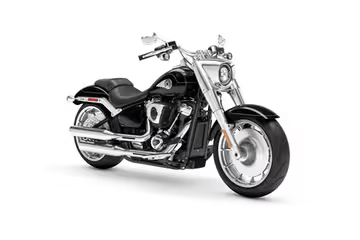
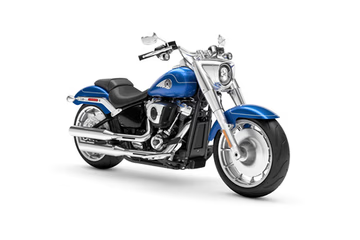
Harley Davidson Fat Boy
10.5 pts
Unweighted: 6 advantages
EnginePerformanceDimensionsBrakesTyresFeaturesOther
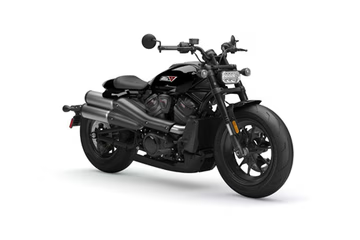
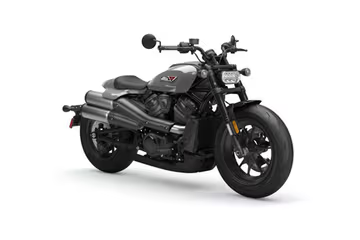
Sportster S
15.5 pts
Unweighted: 10 advantages
EnginePerformanceDimensionsBrakesTyresFeaturesOther
| Specification | ||
|---|---|---|
Engine Specifications |
||
| Cooling System | Air-cooled | Liquid‑cooled |
| Displacement | 1,923 cc | 1,252 cc |
| Engine Type | Milwaukee-Eight™ 117 Custom | Revolution Max 1250T V‑twin (DOHC, VVT) |
| Power | 103 HP / 77 kW @ 5020 rpm | 122.3 PS @ 7500 rpm |
| Torque | 168 Nm @ 3000 rpm | 125 Nm @ 6000 rpm |
Performance & Efficiency |
||
| Fuel Tank Capacity | 18.9 litres | 11.7 L |
| Mileage | 18.18 Kmpl | 19.6 Kmpl |
Dimensions & Weight |
||
| Kerb Weight | 315 | 228 |
| Seat Height | 675 | 765 |
Brakes & Suspension |
||
| ABS | Dual-channel ABS | Cornering (dual-channel) ABS |
| Front Brake | Disc | 320 mm Disc |
| Front Suspension | Dual-bending valve 49 mm telescopic with aluminum fork triple clamps, dual rate spring | 43 mm inverted fork with compression, rebound and spring preload adjustability. Aluminum fork triple clamps. |
| Rear Brake | Disc | 260 mm Disc |
| Rear Suspension | Hidden, free piston, coil-over monoshock; 43mm stroke, hydraulic preload adjustment | Linkage-mounted, piggyback monoshock with compression, rebound and hydraulic spring preload adjustability |
Tyres & Wheels |
||
| Front Tyre | 160/60 R18 | 160/70 R17 Dunlop Harley‑Davidson radial |
| Rear Tyre | 240/40 R18 | 180/70 R16 Dunlop Harley‑Davidson radial |
| Tyre Type | Tubeless | Radial, tubeless |
| Wheel Type | Cast aluminum (Lakester) | Alloy |
Features & Technology |
||
| Headlight | LED | LED |
Other Specifications |
||
| Battery | — | 12 V, 12 Ah, 225 CCA |
| Bike Image 1 | https://motoautiv.com/wp-content/uploads/2025/06/Blue.avif | https://motoautiv.com/wp-content/uploads/2025/06/Brilliant-red-1.avif |
| Bike Image 2 | https://motoautiv.com/wp-content/uploads/2025/06/Grey.avif | https://motoautiv.com/wp-content/uploads/2025/06/Mystic-shift-1.avif |
| Bike Image 3 | https://motoautiv.com/wp-content/uploads/2025/06/Whiskey-fire.avif | https://motoautiv.com/wp-content/uploads/2025/06/Vivid-Black-2.avif |
| Cluster | Analog with LCD | 4‑in full‑color TFT display |
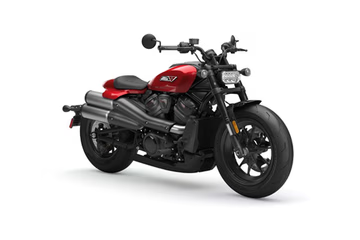
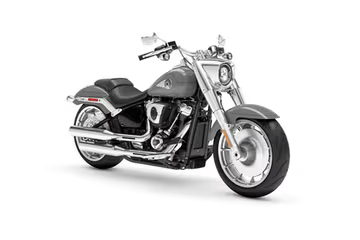
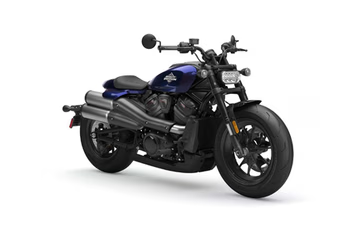
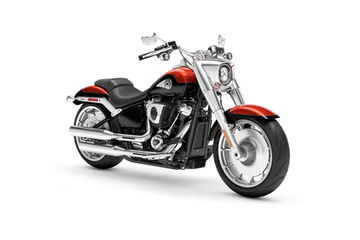
| Color Options | Billiard Gray | #6B7074 Vivid Black | #0F0F10 Blue Burst | #1E4D8C Whiskey Fire / Vivid Black | #7A2D1B, #0F0F10 | Vivid Black | #0F0F10 Billiard Gray | #6B7074 Brilliant Red | #A01824 Mystic Shift | #4B4F59 |
| Cons | The Weight Is Impossible to Ignore – Parking, reversing, or making tight U-turns requires more effort than on most motorcycles. The bike feels considerably lighter once moving, but the weight is always present at low speeds. Not a Motorcycle That Enjoys Tight Corners – The Fat Boy is happiest on flowing roads. When the road becomes tight and twisty, its size and geometry become more noticeable. Wind Hits You Directly at Highway Speeds – Without a fairing or windscreen, long highway rides can become tiring because the rider takes the full force of the wind. Can Feel Warm in Traffic – Sitting in slow-moving traffic on a hot day makes the large V-twin's heat more noticeable around the legs. Passenger Comfort Is Average – The stock setup feels more focused on the rider. For frequent two-up riding, many owners look at accessory seats and backrests. Not Built Around Practicality – There is no meaningful storage space, and carrying luggage usually requires additional accessories. Running Costs Are Higher Than Average – Tyres, servicing, insurance, and genuine accessories can all add up compared to smaller motorcycles. Requires Some Experience to Get the Best Out of It – The combination of weight, engine size, and physical dimensions can feel intimidating for riders who are new to large-capacity cruisers. Floorboards Touch Down Earlier Than You Might Expect – Riders who push harder through corners will eventually find the limits of the cruiser-style setup. | Rear Suspension Travel Is Limited – The motorcycle's low profile comes at the expense of suspension travel, which can make sharp bumps and rough roads more noticeable. Fuel Tank Capacity Is Smaller Than Expected – The relatively compact fuel tank can require more frequent fuel stops than some riders might anticipate from a large-capacity motorcycle. Riding Position Can Feel Unusual – The combination of mid-to-forward controls and a relatively upright upper body position doesn't suit every rider, especially on longer journeys. Passenger Accommodation Is Minimal – The motorcycle is clearly designed with the rider as the priority, and pillion comfort is limited in stock form. Engine Heat Is Noticeable in Traffic – The high-performance engine can generate considerable heat during slow-moving urban riding. Not as Relaxed as Traditional Cruisers – Riders expecting the laid-back feel of motorcycles such as the Fat Boy or Heritage Classic may find the Sportster S considerably more focused and demanding. Limited Touring Practicality – There is little wind protection, no integrated luggage, and fewer long-distance touring conveniences than Harley's cruiser-touring models. |
| Detailed Overview | Even among Harley-Davidson’s own motorcycles, the Fat Boy has always been difficult to mistake for anything else. The solid-disc Lakester wheels, broad fuel tank, chunky tyres, and low stance give it a silhouette that looks substantial from every angle. While many cruisers rely on chrome and visual complexity to create an impression, the Fat Boy’s design is built around simple, oversized elements that have remained part of its identity for decades. The motorcycle is based on Harley-Davidson’s Softail platform, which uses a hidden rear suspension arrangement beneath the seat area. From the side, the frame still resembles the rigid hardtail cruisers that inspired it, but underneath there is a modern monoshock setup responsible for absorbing road imperfections. The front suspension uses telescopic forks designed to support the motorcycle’s considerable weight while maintaining stability over varying road surfaces. A 1,923cc Milwaukee-Eight 117 V-twin engine sits prominently in the center of the motorcycle. Rather than encouraging riders to explore the upper reaches of the rev range, the engine develops much of its performance lower down, which influences how the Fat Boy behaves in everyday riding. The motorcycle can accelerate with relatively little throttle input, and the six-speed gearbox allows the engine to remain relaxed during highway travel. The large displacement and V-twin configuration are also major contributors to the motorcycle’s mechanical character and riding feel. Dimensionally, the Fat Boy is a substantial machine. Wide tyres at both ends, a long wheelbase, and a low seat height all contribute to its proportions. The low seating position places the rider close to the ground, while forward-mounted foot controls create the stretched riding posture commonly associated with large American cruisers. Combined with the wide handlebar, the rider’s position is very different from what would be experienced on a roadster or sport motorcycle. The Lakester wheels remain one of the defining visual features of the Fat Boy. Unlike conventional alloy wheels, their solid-disc-inspired design creates a unique appearance that has become closely associated with the model over the years. Alongside the broad tyres and muscular bodywork, these wheels play a significant role in shaping the motorcycle’s overall identity. Technology is present, although it is integrated more discreetly than on Harley-Davidson’s touring motorcycles. Modern versions include selectable riding modes, traction control, and ABS, with certain markets also receiving cornering-sensitive rider-assistance systems. Instead of a large touchscreen display, the Fat Boy uses a compact instrument setup focused primarily on essential riding information. An 18.9-litre fuel tank sits above the engine and forms one of the largest visual elements of the motorcycle. Lighting throughout the motorcycle uses LED technology, while the overall design remains intentionally uncluttered. There are few body panels, minimal visual distractions, and a clear emphasis on exposing the mechanical components that define the motorcycle. The Fat Boy’s specifications reveal a motorcycle shaped around traditional cruiser principles: a large-capacity V-twin engine, long-wheelbase chassis, low seating position, and substantial physical presence. Although modern electronics and engineering have been incorporated over time, the underlying layout remains closely tied to the formula that has defined the model for decades. | The Sportster S represents a very different chapter in the history of Harley-Davidson’s Sportster line. For decades, the Sportster name was associated with air-cooled V-twin engines, relatively simple technology, and a riding experience rooted in traditional cruiser values. The current Sportster S moves away from that formula and adopts a platform that shares far more with modern performance motorcycles than with its predecessors. While the styling still carries some Harley-Davidson influence, much of the motorcycle’s engineering has been developed around a different set of priorities. The most significant change is found in the engine. Instead of using an air-cooled V-twin, the Sportster S is powered by Harley-Davidson’s Revolution Max 1250T engine. This 1,252cc liquid-cooled V-twin is a stressed member of the chassis, meaning it contributes to the motorcycle’s structural rigidity rather than simply sitting within a frame. The engine produces its power differently from traditional Harley-Davidson motors, with a broader operating range and a willingness to rev higher. A six-speed gearbox transfers power to the rear wheel, while electronic engine management systems oversee throttle response, fuel delivery, and rider-assistance functions. Visually, the motorcycle is defined by a compact body, a short rear section, and a high-mounted dual exhaust system positioned on the right side. The fuel tank shape appears larger than it actually is because part of the visible structure functions as a cover, while the fuel itself is stored lower within the chassis. This layout helps centralize mass and contributes to the motorcycle’s proportions. The actual fuel capacity is 11.8 litres, which is smaller than what is commonly found on many touring-oriented motorcycles. The chassis differs substantially from Harley-Davidson’s traditional cruiser platforms. Rather than using a steel frame with conventional architecture, the Sportster S combines the engine with separate front and rear frame sections. Suspension duties are handled by upside-down front forks and a rear monoshock, both of which offer adjustment options. Compared to many cruisers, the suspension components are more performance-oriented in both design and appearance. Wheel and tyre specifications also play a major role in defining the motorcycle’s character. The Sportster S uses wide tyres at both ends, including a particularly large front tyre that immediately stands out. This setup contributes to the motorcycle’s visual identity and influences steering feel and overall handling behaviour. Braking is managed through a single front disc with a radial-mounted Brembo caliper and a rear disc brake, supported by modern electronic systems. Technology forms a larger part of the package than it does on many traditional Harley-Davidson models. A round TFT display serves as the motorcycle’s instrument cluster and allows access to a range of vehicle settings. Through this interface, riders can view ride information, adjust ride modes, and interact with connectivity features. The motorcycle includes selectable ride modes, traction control, cornering-enhanced ABS, wheel-lift mitigation, engine braking control, and cruise control. These systems are managed through sensors that continuously monitor riding conditions and rider inputs. The riding position differs from both conventional cruisers and naked motorcycles. Mid-to-forward-mounted foot controls place the rider’s legs ahead of the body, while the handlebar keeps the upper body relatively upright. The seat height of approximately 765 mm is higher than many Harley-Davidson cruisers, reflecting the motorcycle’s different chassis layout and intended riding dynamics. Taken together, the Sportster S combines a liquid-cooled Revolution Max engine, electronically managed rider aids, adjustable suspension, TFT instrumentation, and a compact chassis architecture. Its specification sheet reflects a motorcycle developed around modern engineering solutions while retaining a visual connection to Harley-Davidson’s broader lineup. |
| Expert Review | The Fat Boy has always been a motorcycle that prioritizes presence as much as performance. Even by cruiser standards, it feels substantial, whether you're looking at it parked or riding it down the road. The Milwaukee-Eight 117 engine suits the character of the bike perfectly, producing the kind of effortless torque that allows you to ride without constantly thinking about gear selection or engine speed. What stands out most is how planted the motorcycle feels once it's moving. The wide tyres, long wheelbase, and considerable weight create a sense of stability that encourages a relaxed riding style rather than an aggressive one. At the same time, those same traits mean the Fat Boy asks for a bit more effort in slow-speed situations and doesn't feel particularly eager when the road becomes tight and technical. The riding experience is less about chasing performance figures and more about the way the motorcycle delivers its power, carries its weight, and settles into a steady rhythm on open roads. Modern electronics have improved safety and usability, but they remain secondary to the traditional cruiser character that continues to define the Fat Boy., 4.4, MotoAutiv Team | The Sportster S is one of the most significant departures Harley-Davidson has made from its traditional formula in recent years. Despite carrying the Sportster name, the motorcycle feels fundamentally different from the air-cooled models that built the badge's reputation. The Revolution Max 1250T engine is the centerpiece of the experience, delivering performance that feels considerably stronger and more urgent than what many riders expect from a Harley-Davidson cruiser. The chassis and electronics package have been developed to match that performance, giving the bike handling and braking capabilities that place it closer to modern roadsters and power cruisers than traditional cruisers. At the same time, the Sportster S makes a few compromises in pursuit of its aggressive styling and performance-focused character. Suspension travel is limited, the riding position can feel unusual on longer rides, and touring practicality is not a priority. What emerges is a motorcycle that feels deliberately different from the rest of Harley-Davidson's cruiser lineup. Rather than focusing on heritage and nostalgia, it emphasizes performance, technology, and a more contemporary interpretation of what a Harley-Davidson can be., 4.5, MotoAutiv Team |
| FAQ (Manual Override) | Q: What type of motorcycle is the Harley-Davidson Fat Boy? A: The Fat Boy is classified as a heavyweight cruiser motorcycle, designed around relaxed riding ergonomics, a large V-twin engine, and long-distance road comfort. Q: Which engine powers the Fat Boy? A: The latest model uses the Milwaukee-Eight 117 V-twin engine paired with a 6-speed gearbox. Q: Is the Fat Boy suitable for long-distance rides? A: Yes. The relaxed ergonomics and torque-rich engine make it capable of covering long distances, although many owners add touring accessories for greater comfort. Q: What is the seat height of the Fat Boy? A: The seat height is approximately 675 mm, making it accessible to a wide range of riders. Q: Does the Fat Boy have cruise control? A: Availability depends on market and model year. Some versions include cruise control, while others may offer it as an accessory. Q: What is the fuel tank capacity of the Fat Boy? A: The motorcycle is equipped with an 18.9-litre fuel tank. Q: Does the Fat Boy have riding modes? A: Yes. Modern versions include selectable riding modes and electronic rider-assistance systems. Q: Is the Fat Boy comfortable for a passenger? A: Occasional two-up riding is possible, but the stock setup is more rider-focused than dedicated touring motorcycles. Q: How is the Fat Boy different from the Breakout? A: The Fat Boy focuses on a broad, muscular cruiser character with solid-disc wheels, while the Breakout adopts a stretched custom-cruiser design with a much wider rear tyre. Q: Does the Fat Boy have traction control and ABS? A: Yes. Modern versions include ABS, traction control, and other rider-assistance technologies. Q: What is the kerb weight of the Harley-Davidson Fat Boy? A: The motorcycle weighs approximately 315 kg in running condition, depending on market specification. Q: Is the Fat Boy beginner-friendly? A: The low seat height helps with accessibility, but the weight, engine size, and overall dimensions make it better suited to riders with some experience. Q: Does the Fat Boy support smartphone connectivity? A: The Fat Boy uses a relatively simple instrumentation setup compared to Harley's touring models, so smartphone integration is limited. Q: What body type does the Fat Boy belong to? A: It is categorized as a cruiser motorcycle, specifically a heavyweight cruiser designed around comfort, torque delivery, and road presence. | Q: Which engine powers the Sportster S? A: The motorcycle uses Harley-Davidson's 1,252cc Revolution Max 1250T liquid-cooled V-twin engine. Q: Is the Sportster S air-cooled? A: No. Unlike older Sportster models, the Sportster S uses a liquid-cooled engine. Q: How is the Sportster S different from older Sportsters? A: The Sportster S uses a completely different platform with a liquid-cooled engine, TFT display, ride modes, traction control, and a more performance-focused chassis. Q: Does the Sportster S have ride modes? A: Yes. Multiple ride modes are available, allowing riders to adjust throttle response and electronic intervention settings. Q: Does the Sportster S have cruise control? A: Yes. Cruise control is included as standard equipment. Q: What is the fuel tank capacity of the Sportster S? A: The motorcycle has an 11.8-litre fuel tank. Q: Is the Sportster S suitable for long-distance touring? A: It can handle longer rides, but its compact fuel tank, limited wind protection, and firm suspension make it less touring-oriented than Harley-Davidson's cruiser-touring models. Q: Is the Sportster S comfortable for a passenger? A: Passenger accommodation is limited in stock form and is not one of the motorcycle's primary focuses. Q: What is the seat height of the Sportster S? A: The seat height is approximately 765 mm. Q: Does the Sportster S have traction control and cornering ABS? A: Yes. The motorcycle includes cornering-enhanced ABS, traction control, and other electronic rider-assistance systems. Q: What is the kerb weight of the Harley-Davidson Sportster S? A: The motorcycle weighs approximately 228 kg in running condition. Q: Is the Sportster S beginner-friendly? A: Due to its performance, power output, and responsive throttle characteristics, it is generally more suitable for riders with some experience. Q: Does the Sportster S support smartphone connectivity? A: Yes. The TFT display supports smartphone connectivity, navigation functions, and various connected features. |
| Fuel System | Fuel Injection | Fuel Injection |
| Price Variants | STD | 2803000 | STD | 1805000 |
| Pros | Instantly Recognizable Design – Few motorcycles are as easy to identify from a distance as the Fat Boy. The solid-disc wheels, wide stance, and muscular proportions give it a presence that stands out even among other cruisers. Torque-Rich Engine Character – The Milwaukee-Eight 117 doesn't need to be revved hard to make progress. A small twist of the throttle is usually enough to get the bike moving with very little effort. Relaxed Riding Position – The low seat, wide handlebar, and stretched-out foot controls create a laid-back riding posture that suits cruising and long hours in the saddle. Feels Stable on Open Roads – Once the bike is moving, its weight starts working in its favour. It feels planted at highway speeds and doesn't get unsettled easily. High-Quality Finish – From the paintwork to the chrome detailing and metal components, the overall fit and finish reflects the premium nature of the motorcycle. Low Seat Height Helps at Stops – Despite being a large motorcycle, the low seat makes it easier for many riders to place both feet firmly on the ground. Modern Electronics Without Changing the Character – Features such as ABS, traction control, and riding modes work in the background without taking away from the traditional cruiser feel. Comfortable Engine for Cruising – The engine settles into a relaxed rhythm at highway speeds and rarely feels stressed during normal riding. | Engine Completely Changes the Character of the Bike – The Revolution Max 1250T engine feels very different from traditional Harley-Davidson V-twins. It revs higher, responds quicker to throttle inputs, and delivers performance in a way that feels more modern and energetic. Strong Acceleration Across the Rev Range – Whether pulling away from a traffic light or overtaking on a highway, the engine has enough power in reserve that the motorcycle rarely feels short of performance. Surprisingly Capable Handling – Compared to most cruisers, the Sportster S feels noticeably more willing to lean into corners and change direction. Modern Electronics Package – Ride modes, traction control, cornering ABS, cruise control, and a TFT display bring a level of technology that wasn't traditionally associated with the Sportster name. Distinctive Design – The short tail section, high-mounted exhaust, fat tyres, and exposed engine give the motorcycle a look that stands apart from both traditional cruisers and naked bikes. High-Quality TFT Display – The instrument screen is clear, modern, and provides access to a wide range of riding information and settings. Strong Braking Performance – The braking setup offers a level of stopping power that matches the motorcycle's performance capabilities. Lighter and More Agile Than Many Harley-Davidsons – While not a lightweight motorcycle by industry standards, it feels noticeably more manageable than Harley's larger cruiser and touring models. |
| Starter | Electric | Electric |
| Transmission | 6-speed manual | 6‑speed manual |