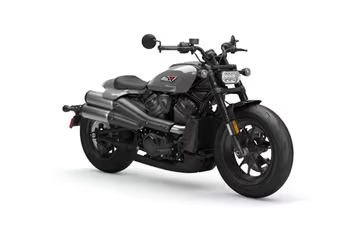
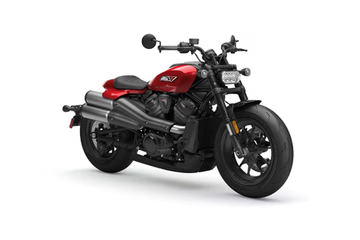
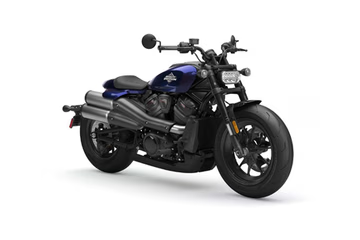
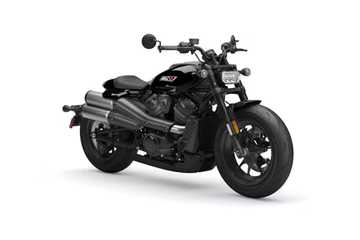
The Sportster S represents a very different chapter in the history of Harley-Davidson’s Sportster line. For decades, the Sportster name was associated with air-cooled V-twin engines, relatively simple technology, and a riding experience rooted in traditional cruiser values. The current Sportster S moves away from that formula and adopts a platform that shares far more with modern performance motorcycles than with its predecessors. While the styling still carries some Harley-Davidson influence, much of the motorcycle’s engineering has been developed around a different set of priorities.
The most significant change is found in the engine. Instead of using an air-cooled V-twin, the Sportster S is powered by Harley-Davidson’s Revolution Max 1250T engine. This 1,252cc liquid-cooled V-twin is a stressed member of the chassis, meaning it contributes to the motorcycle’s structural rigidity rather than simply sitting within a frame. The engine produces its power differently from traditional Harley-Davidson motors, with a broader operating range and a willingness to rev higher. A six-speed gearbox transfers power to the rear wheel, while electronic engine management systems oversee throttle response, fuel delivery, and rider-assistance functions.
Visually, the motorcycle is defined by a compact body, a short rear section, and a high-mounted dual exhaust system positioned on the right side. The fuel tank shape appears larger than it actually is because part of the visible structure functions as a cover, while the fuel itself is stored lower within the chassis. This layout helps centralize mass and contributes to the motorcycle’s proportions. The actual fuel capacity is 11.8 litres, which is smaller than what is commonly found on many touring-oriented motorcycles.
The chassis differs substantially from Harley-Davidson’s traditional cruiser platforms. Rather than using a steel frame with conventional architecture, the Sportster S combines the engine with separate front and rear frame sections. Suspension duties are handled by upside-down front forks and a rear monoshock, both of which offer adjustment options. Compared to many cruisers, the suspension components are more performance-oriented in both design and appearance.
Wheel and tyre specifications also play a major role in defining the motorcycle’s character. The Sportster S uses wide tyres at both ends, including a particularly large front tyre that immediately stands out. This setup contributes to the motorcycle’s visual identity and influences steering feel and overall handling behaviour. Braking is managed through a single front disc with a radial-mounted Brembo caliper and a rear disc brake, supported by modern electronic systems.
Technology forms a larger part of the package than it does on many traditional Harley-Davidson models. A round TFT display serves as the motorcycle’s instrument cluster and allows access to a range of vehicle settings. Through this interface, riders can view ride information, adjust ride modes, and interact with connectivity features. The motorcycle includes selectable ride modes, traction control, cornering-enhanced ABS, wheel-lift mitigation, engine braking control, and cruise control. These systems are managed through sensors that continuously monitor riding conditions and rider inputs.
The riding position differs from both conventional cruisers and naked motorcycles. Mid-to-forward-mounted foot controls place the rider’s legs ahead of the body, while the handlebar keeps the upper body relatively upright. The seat height of approximately 765 mm is higher than many Harley-Davidson cruisers, reflecting the motorcycle’s different chassis layout and intended riding dynamics.
Taken together, the Sportster S combines a liquid-cooled Revolution Max engine, electronically managed rider aids, adjustable suspension, TFT instrumentation, and a compact chassis architecture. Its specification sheet reflects a motorcycle developed around modern engineering solutions while retaining a visual connection to Harley-Davidson’s broader lineup.