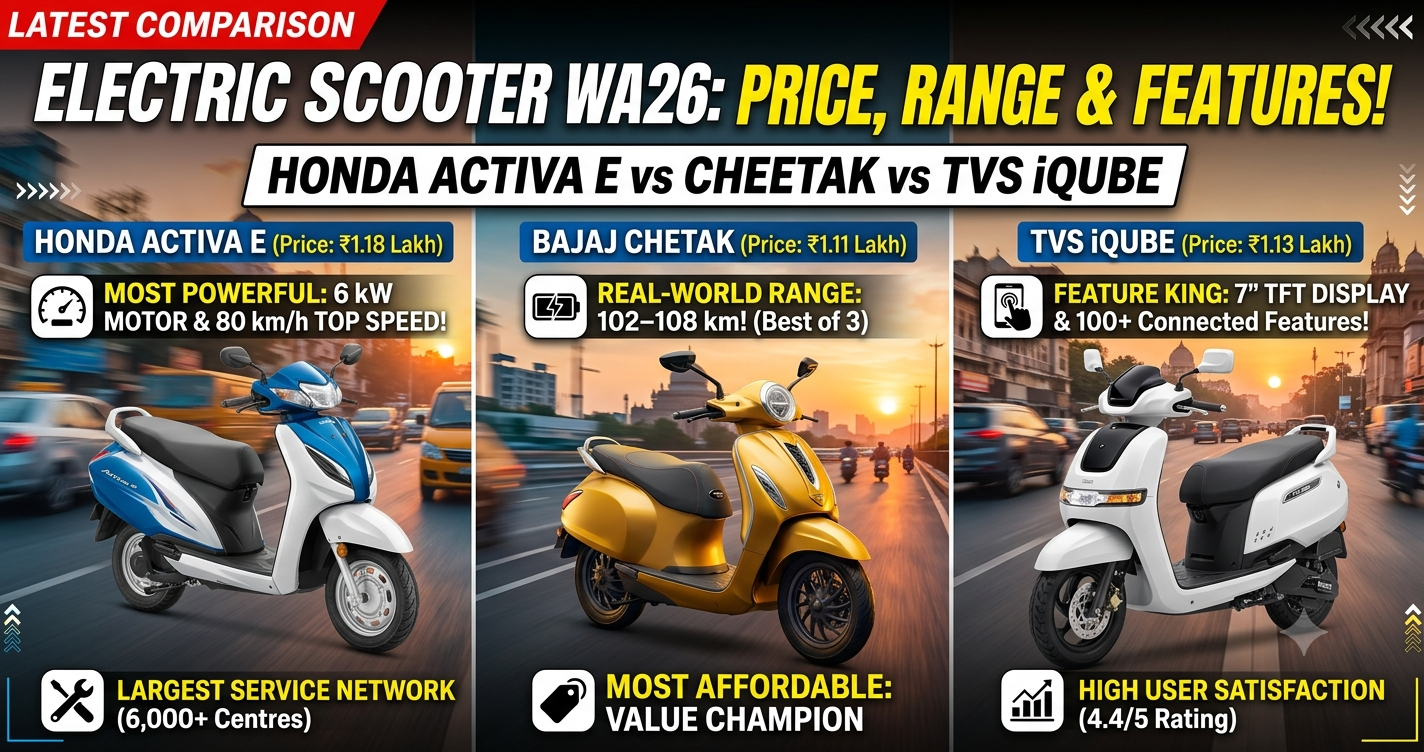
India’s electric scooter market hit a genuine tipping point in 2026. For the first time, three genuinely compelling options sit under the ₹1.2 lakh ex-showroom mark — and they couldn’t be more different from each other!
The Honda Activa e arrives carrying the weight of India’s most trusted scooter nameplate, backed by the country’s largest two-wheeler service network. The Bajaj Chetak 3001 quietly keeps raising the bar on real-world range while staying the most affordable of the trio. And the TVS iQube pulls ahead on connected technology with features that rival premium smartphones.
Searching for the right answer to the Honda Activa e vs Bajaj Chetak vs TVS iQube 2026 question isn’t a spec-sheet exercise — it’s a question of what kind of rider you are. This comparison cuts through the marketing claims to give you a clear, practical verdict.
Price & Variants: What You Actually Pay in 2026
The Bajaj Chetak leads the pricing battle. The Chetak 3001 starts at ₹1,11,006 ex-showroom Delhi, making it the most affordable of the three by a meaningful margin. It comes in four variants ranging from ₹91,399 (base) up to ₹1,56,243 for the premium long-range variants, giving buyers a genuine price ladder to climb.
The TVS iQube (standard variant) is next at ₹1,13,742–₹1,17,518 ex-showroom Delhi. TVS offers multiple iQube trims — the standard iQube, iQube S (4.7 kWh, 150+ km), and iQube ST (the latter with a significantly larger 4.56 kWh battery and 145+ km range). For this comparison, we’re focusing on the standard iQube at the price-parity sweet spot.
The Honda Activa e tops the pricing chart at ₹1,18,147–₹1,19,909 ex-showroom Delhi depending on variant (standard vs. dual-battery). For context, on-road prices in Delhi typically add 10–12% for registration, insurance, and handling charges, pushing all three scooters into the ₹1.25–1.35 lakh on-road range.
All three scooters are eligible for state EV subsidies where applicable — Maharashtra, Gujarat, Delhi, and Rajasthan offer additional benefits over central FAME-II terms. Check your state transport portal for exact subsidy figures before visiting a showroom!
| Scooter | Ex-Showroom (Delhi) | Variants |
|---|---|---|
| Bajaj Chetak 3001 | ₹1,11,006 | 4 variants |
| TVS iQube | ₹1,13,742–₹1,17,518 | 3 trims (iQube / S / ST) |
| Honda Activa e | ₹1,18,147–₹1,19,909 | 2 variants |
Battery, Range & Charging: The Real-World Test
Range anxiety remains the single biggest barrier to EV adoption in India, and the three scooters handle it very differently. According to Bajaj Auto’s official specifications, the Chetak 3001 packs a 3.0 kWh lithium-ion battery with a claimed range of 127 km. (Note: the premium Chetak 3501 variant carries a 3.5 kWh battery with 153 km claimed range at a higher price point.) In real-world city riding — accounting for Indian traffic conditions, AC usage, and rider weight — subtract 15–20% from any claimed figure. That gives the Chetak 3001 approximately 102–108 km of practical daily range, comfortably the best of the three.
The Honda Activa e uses a dual removable 1.5 kWh battery system (3 kWh total) with a claimed 102 km range. Real-world performance lands around 82–87 km per full charge. The removable battery design is Honda’s bet on flexibility — you can carry both batteries upstairs and charge them from any standard socket. However, Honda’s Battery as a Service (BaS) swap station network is still nascent as of mid-2026, so treat swap infrastructure as a future benefit rather than a present reality.
The TVS iQube (standard variant) carries a 2.2 kWh battery with a 94 km claimed range — the lowest of the three. Real-world range is approximately 75–80 km. For most urban commuters averaging 30–40 km per day, this is perfectly adequate with every-other-day charging. The iQube S (4.7 kWh, 150+ km range) and iQube ST (4.56 kWh, 145+ km range) variants are available if range is your primary concern, though they sit at higher price points outside this ₹1.2 lakh bracket.
Charging times are broadly similar: the Chetak 3001 takes approximately 3.5 hours (0–80%) via its portable home charger. The Activa e takes around 3 hours per battery (so roughly 3–4 hours if you charge both simultaneously using two sockets). The iQube takes approximately 4–4.5 hours on a standard 5A home socket. None of the three support DC fast charging in these variants as of 2026 — an industry-wide limitation in this price bracket.
Note on range claims: The 15–20% real-world reduction is consistent across all EV scooters in India and has been validated by owner reports on automotive forums, real-world tests conducted by publications including Autocar India and Overdrive, and EV-specialist analysis from EVFY.in. Always use the lower figure for daily commute planning.
Performance & Ride Quality
The Honda Activa e dominates performance. Its 6 kW PMSM motor (Permanent Magnet Synchronous Motor) produces 22 Nm of torque and pushes the Activa e to a top speed of 80 km/h. The 0–40 km/h sprint takes approximately 4.5 seconds, and the motor handles a 13° gradeability — sufficient for most city flyovers and ramps. The dual-battery setup does add bulk: the Activa e weighs 118–119 kg, the heaviest of the three.
The TVS iQube (standard) uses a 4.4 kW BLDC motor delivering a top speed of around 75 km/h (some sources cite 78 km/h in Sport mode). Its 0–40 km/h time is slightly quicker at approximately 4.2 seconds, reflecting the BLDC motor’s characteristic instant torque delivery. The iQube weighs a nimble 110 kg and features TVS’s well-sorted suspension setup that owners consistently praise for urban pothole absorption.
The Bajaj Chetak 3001 runs a 3.1 kW continuous-rated motor (with peak output higher), topping out at approximately 70 km/h — the lowest top speed of the trio, but one that barely matters in city traffic. What the Chetak offers instead is exceptional refinement at speed. The motor is notably quiet, the ride quality is plush, and Bajaj’s chassis tuning gives it a planted, premium feel. Gradeability is impressive at 22.8° — outperforming the Activa e’s 13° on steep climbs. The Chetak 3001 weighs around 111 kg.
Ride quality verdict: The Activa e is the fastest, the iQube is the quickest off the line, and the Chetak is the most refined at cruising speeds. For mixed urban-highway use, the Activa e’s higher top speed and power give it the edge. For pure city commuting, all three are equally capable.
Features & Tech: Smart Scooter Showdown
This is where the TVS iQube beats all competition thanks to its sheer breadth of features. According to TVS Motor’s official specifications, the iQube (standard) comes with a 7-inch TFT colour display — the largest in the segment — paired with over 100 connected features via the SmartXonnect platform. These include real-time navigation, geofencing alerts, remote diagnostics, over-the-air (OTA) software updates, call and SMS notifications, find-my-scooter, and the distinctive Q-Park Assist (a creep-forward/reverse function for tight parking spots). The SmartXonnect app gives riders a detailed dashboard of ride statistics, battery health, and trip history. If technology is what you’re buying, the iQube is in a different league.
The Bajaj Chetak steps up meaningfully on features compared to its earlier generation. It offers a 5-inch TFT touchscreen, Bluetooth connectivity, turn-by-turn navigation, keyless riding, and hill-hold assist — the only one of the three to offer this as standard inclusion. The Chetak app provides ride analytics and remote monitoring. It’s a well-rounded connected feature set, just not as expansive as the iQube’s SmartXonnect platform.
To be fair, even the Honda Activa e is way more capable on display technology than one might think. The Activa e RoadSync Duo variant (₹1,19,909) features a 7-inch TFT display with Honda RoadSync Duo app connectivity — matching the iQube on screen size. The base STD variant (₹1,18,147) uses a simpler digital display. Honda’s differentiator is reliability and simplicity over the iQube’s 100+ connected feature depth: the Activa e offers iOS and Android connectivity via Honda RoadSync, a dual battery level indicator (crucial given the two-battery system), Bluetooth, and turn-by-turn navigation. It’s a deliberately curated, less complex experience for riders who don’t want to manage 100 app settings.
Storage-wise, the Chetak wins clearly: 35 litres of underseat storage plus a 5-litre glove box is the most practical setup in the segment. The iQube offers approximately 30 litres underseat, while the Activa e’s dual battery pack occupies significant underseat space, leaving approximately 20–22 litres for storage (Honda has not published an official figure on this spec as of now).
All three feature regenerative braking, USB charging port, and keyless entry/ignition — these are now segment-standard rather than differentiators.
Safety, Braking & Build Quality
All three scooters feature Combi Braking System (CBS) as standard — a regulatory requirement in India that simultaneously applies both brakes for safer stops. Specific brake configurations differ: the Honda Activa e uses a 160mm front disc and 130mm rear drum on the standard variant. The TVS iQube sports a 220mm front disc and 130mm rear drum, giving it the largest front brake rotor of the three. The Bajaj Chetak 3001’s base variant uses drum brakes front and rear, while higher variants upgrade to disc-front setups.
Build quality perception leans toward Honda and Bajaj. The Chetak’s steel body and metal panel construction give it a premium, solid feel that TVS’s lighter build doesn’t fully match. The Activa e inherits Honda’s well-established assembly quality from the Activa ICE platform, translating to tight panel gaps and a familiar, confidence-inspiring build. The iQube is well-built for its price but feels marginally lighter and less substantial in hand.
User satisfaction ratings reflect this: the Activa e scores the highest at 4.6/5 (based on 95+ reviews on BikeDekho as of mid-2026), the iQube follows at 4.4/5 (483 reviews — a much larger sample, reflecting its longer market tenure), and the Chetak trails at 3.7/5. The Chetak’s lower score is partly attributable to early-adopter reviews from previous Chetak generations; the 3001 variant has received more positive reception since launch.
For monsoon use — a key consideration for Indian riders — all three carry IP ratings for water and dust resistance. Honda and TVS have both published IP67 or equivalent ratings for their battery packs. Bajaj cites IP67 compliance for the Chetak’s battery. Real-world monsoon performance has been broadly positive across all three, with no major water-intrusion complaints reported in owner forums.
Service Network & After-Sales Support
This is Honda’s trump card, and it’s decisive for buyers outside metro cities. Honda’s two-wheeler service network spans 6,000+ dealer touchpoints across India — the widest coverage of any two-wheeler brand in the country. Whether you’re in Patna, Coimbatore, or a tier-3 town in Rajasthan, a Honda service centre is rarely far away. For riders choosing their first EV, this peace-of-mind factor cannot be overstated.
Bajaj has 4,500+ service centres nationwide, and the Chetak gets dedicated EV-trained technicians at major outlets. TVS follows with 3,500+ touchpoints, with iQube-specific service bays increasingly common in tier-1 and tier-2 cities. For urban buyers in the top 15 cities, the service gap between the three is negligible. For everyone else, Honda’s advantage compounds.
Battery warranty is broadly equivalent: all three manufacturers offer a 3-year or 50,000 km battery warranty (whichever comes first). Honda and TVS also offer extended warranty packages at additional cost. Bajaj’s Chetak battery warranty is backed by Bajaj Auto’s in-house warranty team — an important consideration since battery replacement costs can reach ₹40,000–₹60,000 outside warranty.
Total Cost of Ownership — where EVs shine: Assume a rider covering 1,500 km per month. A petrol scooter at ₹105/litre and 50 kmpl costs approximately ₹3,150/month in fuel. An electric scooter at ₹0.30/km (electricity at roughly ₹8/unit, consuming approximately 4 km per unit) costs approximately ₹450/month — a saving of ₹2,700/month or ₹32,400/year. Service costs for EVs are also significantly lower given fewer moving parts (no oil changes, no spark plugs, simpler transmission). Across 5 years of ownership, the savings easily offset the premium over a comparable petrol scooter. For more on the growing EV landscape, see our coverage of the TVS Orbiter electric scooter launch and Hero’s VIDA VX2, two other strong contenders in the segment. The broader EV market shift in India provides useful context on why now is a particularly good time to make the switch.
Honda Activa e vs Bajaj Chetak vs TVS iQube 2026: Full Spec Comparison Table
Here is the complete 3-way specification comparison for the Honda Activa e, Bajaj Chetak 3001, and TVS iQube (standard variant). All prices are ex-showroom Delhi as of June 2026.
| Specification | Honda Activa e | Bajaj Chetak 3001 | TVS iQube |
|---|---|---|---|
| Price (Ex-Showroom Delhi) | ₹1,18,147–₹1,19,909 | ₹1,11,006 | ₹1,13,742–₹1,17,518 |
| Motor Power | 6 kW (PMSM) | 3.1 kW (BLDC) | 4.4 kW (BLDC) |
| Peak Torque | 22 Nm | 20 Nm | Not published |
| Battery Capacity | 3 kWh (2×1.5 kWh) | 3.0 kWh | 2.2 kWh |
| Claimed Range | 102 km | 127 km | 94 km |
| Real-World Range* | ~82–87 km | ~102–108 km | ~75–80 km |
| Top Speed | 80 km/h | ~70 km/h | 75–78 km/h |
| Charging Time | ~3–4 hrs (home) | ~3.5 hrs (0–80%) | ~4–4.5 hrs |
| Kerb Weight | 118–119 kg | ~111 kg | 110 kg |
| Underseat Storage | ~20–22 L (est.) | 35 L + 5 L glove box | 30 L |
| Display | 7″ TFT (RoadSync Duo) / Digital (STD) | 5″ TFT | 7″ TFT colour |
| Connected Features | Honda RoadSync Duo | Bluetooth, Nav, App | 100+ (SmartXonnect) |
| Front Brake | Disc 160mm | Drum (base) / Disc (upper) | Disc 220mm |
| Rear Brake | Drum 130mm | Drum 130mm | Drum 130mm |
| Gradeability | 13° | 22.8° | 10° |
| Battery Warranty | 3 yr / 50,000 km | 3 yr / 50,000 km | 3 yr / 50,000 km |
| User Rating | 4.6/5 | 3.7/5 | 4.4/5 |
| Service Network | 6,000+ centres | 4,500+ centres | 3,500+ centres |
*Real-world range estimate based on 15–20% reduction from claimed figures, consistent with owner reports and media test data from Autocar India and Overdrive.
Verdict: Which Electric Scooter Should You Buy?
There is no single winner in the Honda Activa e vs Bajaj Chetak vs TVS iQube 2026 battle — and that’s actually good news for buyers. The three scooters serve genuinely different rider profiles, and choosing correctly matters more than picking the objectively “best” spec sheet.
Buy the Bajaj Chetak 3001 if: Range is your non-negotiable. With 127 km claimed (and around 102–108 km real-world), the Chetak 3001 is the right choice for riders covering 50+ km per day or those without daily access to charging. The ₹1,11,006 ex-showroom price makes it the best value proposition of the three. The premium build quality and plush ride add to its appeal for riders who value a refined, understated ownership experience. As Autocar India noted in their long-term Chetak review, “it drives less like an EV and more like a very refined scooter that happens to be electric.” Also check the Honda Activa e vs Suzuki e-Access comparison if Activa e is on your radar against more rivals.
Buy the Honda Activa e if: You trust Honda implicitly and want the most powerful motor in the segment. The 6 kW motor and 80 km/h top speed give the Activa e genuine confidence on mixed roads and short highway stretches. The removable dual-battery system offers future flexibility as Honda’s swap network expands. Crucially, for buyers in smaller cities or towns where after-sales peace of mind is paramount, Honda’s 6,000+ service network is an advantage that no competitor can match today. The 4.6/5 user rating — the highest of the three — reflects early adopter satisfaction.
Buy the TVS iQube if: You want the most feature-rich electric scooter under ₹1.2 lakh, full stop. The 7-inch TFT display, 100+ connected features, OTA updates, and Q-Park Assist put it in a different technological league. For urban tech-first riders who spend time in app ecosystems and want their scooter to integrate with their digital life, the iQube is the natural choice. Its 4.4/5 rating across 483 reviews — a much larger and more statistically significant sample than the Activa e’s 95 reviews — speaks to consistent, sustained owner satisfaction.
Who should skip EVs altogether: If your daily commute regularly exceeds 80 km, you lack reliable home charging access, or you frequently use highways above 80 km/h for sustained stretches — none of these three scooters will serve you well today. Come back in 12–18 months when the segment matures further.
Motoautiv’s overall pick: The TVS iQube for feature-forward urban buyers, and the Bajaj Chetak 3001 for range-first, value-conscious buyers. The Activa e is the safe, trust-based choice — excellent for risk-averse buyers who want Honda’s name behind their first EV purchase.
Frequently Asked Questions
Which is the best electric scooter under ₹1.5 lakh in India 2026?
Among the top three contenders, the TVS iQube (₹1,13,742 ex-showroom) offers the best feature set for tech-first buyers, the Bajaj Chetak 3001 (₹1,11,006) delivers the longest real-world range at around 102–108 km, and the Honda Activa e (₹1,18,147) provides the most powerful motor and Honda’s trusted after-sales network. The best choice depends on your priorities: range, features, or brand reliability.
What is the real-world range of Honda Activa e?
Honda claims 102 km on a full charge for the Activa e (dual 1.5 kWh batteries). In real-world city conditions — factoring in traffic stops, rider weight, and Indian road conditions — expect approximately 82–87 km per charge. This 15–20% reduction from claimed figures is standard across all electric scooters and is consistent with owner feedback on automotive forums and test data published by Autocar India.
Does Bajaj Chetak support fast charging?
The Bajaj Chetak 3001 does not support DC fast charging. It uses a standard 5A home charger that takes approximately 3.5 hours to charge from 0–80%. The charger is portable and plugs into any standard 15A socket. Bajaj has not announced fast-charge capability for the current Chetak lineup as of mid-2026.
Which electric scooter has the best after-sales service in India?
Honda leads on after-sales service coverage with over 6,000 dealer touchpoints across India, making the Activa e the safest choice for riders in tier-2 and tier-3 cities. Bajaj follows with 4,500+ service centres, and TVS has 3,500+ touchpoints. For rural buyers, Honda’s unmatched network is a decisive advantage that no spec sheet can overcome.
Is TVS iQube good for daily commuting?
Yes, the TVS iQube is an excellent daily commuter for urban and semi-urban riders. Its 94 km claimed range (real-world ~75–80 km) covers most city commutes comfortably. The 7-inch TFT display, 100+ connected features, Q-Park Assist for parking in tight spots, and SmartXonnect app integration make it particularly suited for tech-savvy riders. The 30-litre underseat storage is also practical for grocery runs and daily essentials.