
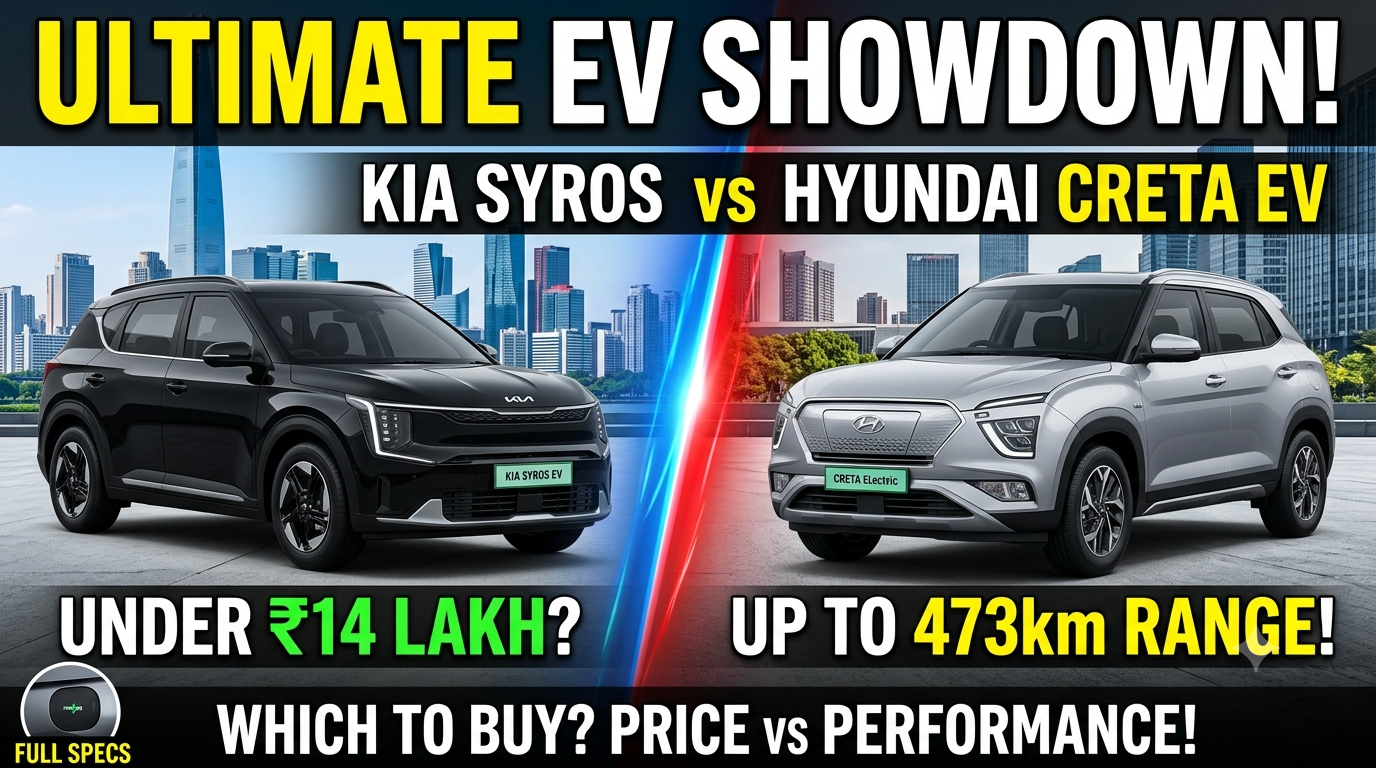
Two Korean electric SUVs. One shared platform. A price gap of nearly Rs 4 lakh. When Kia India confirmed the Syros EV debut for July 2026, it set up what could be the most significant affordable EV face-off India has seen — the Kia Syros EV vs Hyundai Creta Electric.
These are not merely rivals; they are siblings built on Hyundai-Kia’s K1 EV platform, expected to share the same 42kWh and 51.4kWh battery packs, and engineered by the same Korean parentage. Yet they target strikingly different buyers.
The Hyundai Creta Electric, priced from Rs 18.02 lakh (ex-showroom Delhi), is already India’s bestselling electric SUV — a proven product with ARAI-certified ranges of 390km and 473km and a feature list that embarrasses many premium cars. The Kia Syros EV is expected to undercut it by starting at around Rs 14 lakh (expected, unconfirmed), bringing that same Korean EV DNA to buyers who find the Creta Electric just out of reach. But does saving Rs 4 lakh mean giving up too much? This comparison digs into price, battery, range, space, technology, and real-world ownership costs to help you decide.
As India’s EV market matures, understanding the competitive electric SUV landscape is essential before making a buying decision of this magnitude. Let us break it down, section by section.
Master Comparison Table: Kia Syros EV vs Hyundai Creta Electric
Before diving into the details, here is the full side-by-side specification comparison:
| Specification | Kia Syros EV | Hyundai Creta Electric |
|---|---|---|
| Expected Price (ex-showroom) | Rs 14–20 lakh (expected) | Rs 18.02–24.55 lakh (confirmed) |
| Battery Options | 42kWh / 51.4kWh (expected) | 42kWh / 51.4kWh (confirmed) |
| ARAI Range | ~390km / ~473km (estimated) | 390km / 473km (ARAI certified) |
| Motor Output | ~135–170hp (expected) | 169hp (confirmed) |
| Drive Type | FWD (expected) | FWD (confirmed) |
| Length | 3,995mm (confirmed) | 4,340mm (confirmed) |
| DC Fast Charging (10–80%) | ~58 minutes (expected) | 58 minutes (confirmed) |
| Platform | K1 EV Platform (expected) | K1 EV Platform (confirmed) |
| Infotainment | Triple-screen display (revealed) | Dual 12.3-inch screens (confirmed) |
| Audio | Harman Kardon (revealed) | Bose Premium Sound (confirmed) |
| ADAS | Level 2 (expected) | Level 2 (confirmed) |
| Airbags | 6 minimum (expected) | 6 minimum (confirmed) |
| V2L Charging | Expected | Confirmed |
| Ventilated Seats | Expected (higher trims) | Confirmed |
| Panoramic Sunroof | Expected | Confirmed |
| Launch Status | July 2026 (confirmed debut) | On sale now |
Note: All Kia Syros EV figures marked “expected” or “estimated” are based on pre-launch information and multiple source consensus. Hyundai Creta Electric figures are from Hyundai India’s official specifications.
Kia Syros EV vs Hyundai Creta Electric: Price Comparison
The most compelling aspect of this comparison is the expected price gap. Kia India has confirmed the Syros EV debut for July 2026, and multiple industry sources — including CarDekho, DriveSpark, and AutoSpecy — place its expected starting price at Rs 14 lakh (ex-showroom), with the range extending to approximately Rs 20 lakh for fully loaded variants. This positions the Syros EV as a genuinely accessible entry point into the Korean EV ecosystem.
The Hyundai Creta Electric, on the other hand, has confirmed pricing from Rs 18.02 lakh to Rs 24.55 lakh (ex-showroom Delhi) across its variant lineup. Here is how the Creta Electric’s confirmed variant pricing breaks down:
- Executive (42kWh): Rs 18.02 lakh
- Smart (42kWh): Rs 19.50 lakh (approx.)
- Smart+ (51.4kWh): Rs 21.00 lakh (approx.)
- Excellence (51.4kWh): Rs 22.50 lakh (approx.)
- Excellence (O) (51.4kWh): Rs 24.55 lakh
If the Syros EV launches at Rs 14 lakh, it would be Rs 4 lakh cheaper than the base Creta Electric — a substantial difference that could determine the choice for many first-time EV buyers. However, at the top of the range, both vehicles may converge near the Rs 20 lakh mark, making the higher-variant comparison much tighter.
On-road prices (after registration, insurance, and applicable charges) are typically 12–15% above ex-showroom in major metros. This means the base Creta Electric’s on-road price in Delhi would be approximately Rs 20.5–21 lakh, while the expected base Syros EV could be on-road at roughly Rs 16–16.5 lakh (estimated).
Battery, Range & Charging Compared
One of the most significant technical facts about this comparison — and one that few competitor articles are discussing — is the expected shared battery architecture. Both the Hyundai Creta Electric and the Kia Syros EV are built on the K1 EV platform, the mutual Hyundai-Kia electric vehicle foundation (Basically, his platform is designed to accommodate the same battery pack family across multiple vehicles).
The Hyundai Creta Electric offers two confirmed battery options: a 42kWh standard pack delivering an ARAI-certified range of 390km, and a 51.4kWh long-range pack with an ARAI-certified range of 473km (source: Automotive Research Association of India certification data, as published by Hyundai India). The Kia Syros EV is widely expected to use the same 42kWh and 51.4kWh packs — meaning comparable ranges are highly likely, though not yet confirmed by Kia India.
Charging performance — the Creta Electric’s confirmed specs: DC fast charging takes the 51.4kWh pack from 10% to 80% in 58 minutes. The Syros EV is expected to offer identical charging capability given the shared hardware. AC home charging (via the supplied charger) takes approximately 6–8 hours for a full charge on either battery variant — well-suited for overnight charging.
Real-world range in Indian conditions: Autocar India’s long-term test of the Creta Electric 51.4kWh reported real-world ranges of 350–420km depending on AC usage and driving conditions. In Indian summers with AC running, expect 15–20% less than ARAI figures. Owners on Indian EV forums consistently report 320–380km in mixed city-highway use. The Syros EV, being a smaller and lighter vehicle (3,995mm vs 4,340mm length), may actually deliver comparable or marginally better efficiency per kWh — though this remains to be verified after launch.
Motor, Power & Performance
The Hyundai Creta Electric runs a confirmed 169hp (126kW) front-mounted electric motor with front-wheel drive. It offers multiple driving modes including Eco, Normal, and Sport, along with adjustable regenerative braking through paddle shifters — a feature owners on forums cite as genuinely useful in stop-and-go city traffic.
The Kia Syros EV’s motor output is unconfirmed as of June 2026. Industry analysts and multiple automotive outlets estimate output in the 135–170hp range, consistent with what Kia’s K1-platform vehicles have delivered in other markets. Given that the Syros EV is positioned below the Creta Electric in price, a slightly lower output figure on the base variant is plausible, but buyers should wait for Kia India’s official confirmation at the July 2026 debut.
In practical terms, both vehicles offer instant torque delivery that makes city driving effortlessly brisk. The Creta Electric’s 0–100 km/h time is approximately 7.9 seconds (as tested by Overdrive India), which is decisively sporty in daily use. The Syros EV’s smaller, lighter body may partially compensate for any power deficit, potentially delivering similar real-world urgency despite lower headline figures.
Dimensions, Space & Practicality
This is where the two vehicles diverge most significantly, and it is the most important factor for family buyers. The Hyundai Creta Electric measures 4,340mm in length — placing it firmly in the compact SUV segment with genuinely usable rear-seat space and a claimed boot volume of 433 litres (rear seats up).
The Kia Syros EV, at 3,995mm in length, is 345mm shorter — nearly equivalent to an entire wheel in length. This is not a trivial difference. The Syros EV sits in the sub-4-metre category, making it more manoeuvrable in congested Indian cities, easier to park in tight urban spaces, and potentially eligible for sub-4m GST positioning. However, rear-seat passengers and boot space will inevitably be more constrained compared to the Creta Electric.
For a family of four with young children, the Creta Electric’s additional length translates to meaningfully more rear legroom and boot capacity. For urban singles, couples, or small families who primarily drive in dense cities, the Syros EV’s compact footprint is genuinely advantageous. EV comparisons such as the Tata Tiago EV demonstrate how sub-4m EVs excel in urban contexts despite size constraints.
Design & Exterior Comparison
The Hyundai Creta Electric carries forward the Creta’s familiar SUV silhouette with an EV-appropriate evolution: a closed-off parametric pixel grille, pixel LED DRLs, and clean bodywork designed for aerodynamic efficiency. It is a handsome, mainstream design that appeals to the widest possible buyer base — which partly explains the Creta Electric’s bestseller status.
The Kia Syros EV takes a more distinctive, bold direction. Based on what was revealed ahead of its July 2026 debut, it features Kia’s signature boxy proportions with sharp creases, a closed Star Map front fascia, and a design language that signals a clear break from conventional SUV aesthetics. For buyers who find the Creta Electric’s design too conservative, the Syros EV’s visual statement is a genuine differentiator.
Colour options for the Syros EV (as revealed) include Black, Red, and White. The Hyundai Creta Electric is available in 11 colours, including monotone shades like Titanium Black, Atlas White, and Fiery Red, matte finishes such as Ocean Blue Matte and Robust Emerald Matte, plus dual-tone options pairing Ocean Blue or Atlas White with a Titanium Black roof.
Ground clearance for the Syros EV has not been officially confirmed; the Creta Electric offers 190mm ground clearance — adequate for most Indian road conditions including light unpaved surfaces and city speed-breakers.
Interior, Features & Technology
The interior technology battle between these Korean EV siblings is where both vehicles genuinely impress. The Hyundai Creta Electric features a dual 12.3-inch display setup — one for the digital instrument cluster and one for the infotainment — running Hyundai’s BlueLink connected car system with over-the-air update capability. Bose Premium Sound, ventilated front seats, a panoramic sunroof, Level 2 ADAS (including lane keeping assist, adaptive cruise control, and forward collision warning), and V2L (Vehicle-to-Load) charging capability round out an exceptional feature set for its price band.
The Kia Syros EV, based on its pre-launch reveal, features a triple-screen display setup — a bold one-upmanship over the Creta Electric’s dual-screen layout. Harman Kardon audio (revealed, not confirmed for all Indian variants), ventilated seats, a 360-degree surround camera, and a dual dashcam were shown at the reveal, though which of these features appear at which price points in India will only be clear at the July 2026 official launch. These should be treated as “revealed” features, not confirmed for all variants.
Feature-for-feature, the Creta Electric’s advantage is certainty — you know exactly what you get at every confirmed price point. The Syros EV’s feature list looks compelling on paper, and the triple-screen setup is genuinely exciting, but variant-wise distribution will only be clear at launch.
Safety Features Compared
Both vehicles are expected to offer a minimum of 6 airbags across their lineups — a baseline that has become standard for Korean OEMs in India. The Hyundai Creta Electric’s ICE counterpart achieved a 5-star Global NCAP rating, and the EV is expected to perform comparably given its shared body structure with additional EV-specific battery protection engineering.
The Creta Electric’s confirmed safety suite includes Electronic Stability Control (ESC), Vehicle Stability Management (VSM), Hill Start Assist, Tire Pressure Monitoring System (TPMS), and a Level 2 ADAS package covering autonomous emergency braking, blind-spot warning, rear cross-traffic alert, and lane departure warning. A 360-degree surround-view monitor is available on higher trims.
The Syros EV is expected to offer a comparable ADAS suite — the 360-degree camera was specifically highlighted in its pre-launch reveal. The exact NCAP testing timeline for the Syros EV has not been announced. Both brands have consistently prioritised safety in their Indian products, and buyers can reasonably expect both vehicles to deliver strong safety benchmarks.
Running Costs & Ownership: Which Is Cheaper to Own?
This is where EVs — and particularly these two — make a compelling case against petrol alternatives. Using a home charging rate of Rs 8 per kWh (a reasonable approximation of daytime residential electricity tariffs across most Indian metros):
Running Cost Calculator (Rs 8/kWh Home Charging)
| Metric | Kia Syros EV 42kWh (Expected) | Creta Electric 42kWh | Creta Electric 51.4kWh |
|---|---|---|---|
| Battery Capacity | 42kWh (expected) | 42kWh | 51.4kWh |
| ARAI Range | ~390km (estimated) | 390km (ARAI certified) | 473km (ARAI certified) |
| Full charge cost at Rs 8/kWh | Rs 336 (est.) | Rs 336 | Rs 411 |
| Cost per km (ARAI basis) | ~Rs 0.86/km (est.) | Rs 0.86/km | Rs 0.87/km |
| Real-world range (est. -20%) | ~310km | ~312km | ~378km |
| Cost per km (real-world) | ~Rs 1.08/km (est.) | Rs 1.08/km | Rs 1.09/km |
| Monthly cost (1,500km/month) | ~Rs 1,620 (est.) | Rs 1,620 | ~Rs 1,635 |
| Petrol equivalent (Rs 100/L, 15kmpl) | Rs 10,000/month | ||
| Monthly saving vs petrol | ~Rs 8,365–8,380/month | ||
The running cost arithmetic is nearly identical between both vehicles — both cost approximately Rs 0.86–1.09 per km at home charging rates, compared to roughly Rs 6.67 per km for a petrol car at Rs 100/litre and 15kmpl. Monthly savings versus petrol for a 1,500km driver: approximately Rs 8,365 per month. Over five years, that is roughly Rs 5–5.5 lakh in fuel savings — substantially offsetting the price premium over equivalent petrol SUVs.
Servicing costs: Both Kia and Hyundai have extensive dealer networks in India. EV servicing is inherently cheaper than ICE — no oil changes, no timing belt replacements, significantly fewer brake pad changes thanks to regenerative braking. Expect annual service costs of Rs 3,000–7,000 for routine maintenance on either vehicle.
Battery warranty: The Creta Electric carries an 8-year/1.6 lakh km battery warranty — a strong ownership confidence signal. The Syros EV is expected to offer a comparable warranty in line with Kia’s EV battery warranty norms across global markets (typically 8 years). This long warranty significantly reduces the battery replacement risk that concerns many prospective EV buyers.
India’s rapidly evolving EV market — as illustrated by new entrants such as the VinFast India EV launch — shows that competitive ownership economics are now a primary purchase driver, and both these Korean EVs deliver strongly on this front.
Pros and Cons: Kia Syros EV
Pros
- Expected starting price ~Rs 14 lakh — most affordable Korean EV anticipated in India
- Compact 3,995mm length — superior urban maneuverability and parking ease
- Triple-screen display (revealed) — more futuristic interior than the Creta Electric
- Harman Kardon audio system revealed — premium sound experience expected
- Shared K1 platform with Creta Electric — proven battery and charging hardware
- Distinctive, bold Kia design — visual standout on Indian roads
- 360-degree camera and dual dashcam revealed — strong safety tech package
Cons
- All specs are pre-launch estimates — no confirmed Indian pricing or variant features yet
- 345mm shorter than Creta Electric — less rear-seat space and boot capacity
- Kia India service network slightly smaller than Hyundai’s — relevant for Tier 2/3 city buyers
- Unproven in Indian market — no long-term reliability data or real owner feedback
- Feature availability by variant unknown — top features may require expensive trims
- Motor output unconfirmed — could be lower than Creta Electric’s confirmed 169hp
Pros and Cons: Hyundai Creta Electric
Pros
- Confirmed ARAI range: 390km (42kWh) and 473km (51.4kWh) — India’s best-range compact EV SUV
- On sale now — no waiting; immediate availability across India
- Larger cabin: 4,340mm length — genuinely comfortable for five adults
- 433-litre boot — practical for family road trips and daily cargo
- Established owner community — real-world data, forum reviews, long-term insights available
- V2L charging confirmed — powers external appliances during camping or power outages
- Wide Hyundai service network — 1,350+ touchpoints across India
- 169hp confirmed motor — brisk, predictable performance
Cons
- Rs 18.02 lakh base price — steep for first-time EV buyers on a tighter budget
- 4,340mm length makes parking cumbersome in tight city spaces
- Top variants at Rs 24.55 lakh push into near-luxury territory
- Design is evolutionary, not revolutionary — familiar Creta face may feel conservative
- Dual-screen setup now looks modest against the Syros EV’s triple-screen reveal
Verdict: Kia Syros EV or Hyundai Creta Electric — Which Should You Buy?
The editorial team at Motoautiv has closely tracked the Indian EV market since the Creta Electric’s launch, and the arrival of the Kia Syros EV in July 2026 represents a genuinely important inflection point for affordable EVs in India. Here is the assessment of our experts:
The Hyundai Creta Electric is the safer, more complete choice right now. It is a proven, on-sale product with confirmed specs, real-world owner data, and a comprehensive feature set. Its 473km long-range variant is one of the best-value EV propositions in India today. The established Hyundai service network means peace of mind even in Tier 2 cities. For families who need the space, for buyers who want a fully validated product in Indian conditions, and for anyone planning long highway drives — the Creta Electric is the clear choice. Our detailed coverage of the Hyundai Creta King Edition underlines why this brand has earned enormous trust with Indian buyers over a decade.
The Kia Syros EV could be a game-changer — if the pricing holds. If Kia India confirms an Rs 14 lakh starting price in July 2026, it will bring Korean EV technology to a buyer segment that previously could not access it. For urban buyers who want the EV experience, a distinctive design, and can live with a compact cabin — the Syros EV is worth waiting for. Its shared DNA with the Creta Electric means the core technology is not a compromise. Early adopters who are comfortable waiting for post-launch real-world reviews stand to benefit the most.
Our clear recommendation: if you need an EV right now, buy the Creta Electric without hesitation. If you can wait until August–September 2026 and your budget is below Rs 16 lakh — wait for the Syros EV’s official launch before deciding.
Buy the Kia Syros EV If…
- Your budget is Rs 14–18 lakh and maximising value matters most
- You primarily drive in the city — navigating congestion and parking in tight spaces daily
- You love bold, distinctive design and want to stand out on the road
- You are comfortable being an early adopter and waiting for post-launch real-world reviews
- You want the latest tech features (triple screen, Harman Kardon) at a lower price than the Creta Electric
- Your household is a couple or a small family of three — then the compact cabin works perfectly
Buy the Hyundai Creta Electric If…
- You need the car immediately — no waiting for post-launch review period
- You have a family of four or five and rear-seat comfort and boot space matter
- You take regular highway road trips and the 473km long-range pack gives you confidence
- You want V2L charging for camping or backup power during power cuts
- Peace of mind from an established, well-reviewed product is important to you
- You live in a Tier 2 or Tier 3 city where service infrastructure is a critical factor
For buyers exploring the full range of electric SUV options entering the Indian market, our coverage of the JSW Jetour T2 SUV provides useful context on how competitive this segment is becoming.
FAQ: Kia Syros EV vs Hyundai Creta Electric
1. Which is cheaper — Kia Syros EV or Hyundai Creta Electric?
The Kia Syros EV is expected to be cheaper, with an anticipated starting price of around Rs 14 lakh (ex-showroom, unconfirmed). The Hyundai Creta Electric starts at a confirmed Rs 18.02 lakh (ex-showroom Delhi). The expected price gap at base level is approximately Rs 4 lakh in favour of the Syros EV. However, official Syros EV pricing will only be confirmed by Kia India at the July 2026 debut event. Buyers should treat the Rs 14 lakh figure as an industry estimate, not a confirmed price.
2. Do the Kia Syros EV and Hyundai Creta Electric share the same battery?
Both vehicles are expected to share the same 42kWh and 51.4kWh battery packs, as they are both built on Hyundai-Kia’s K1 EV platform. Sharing a platform means battery management systems, charging hardware, and thermal management are likely very similar — giving buyers reasonable confidence that the Syros EV’s real-world performance will closely mirror the Creta Electric’s well-documented figures.
3. What is the expected range of the Kia Syros EV?
The Kia Syros EV’s range is not yet officially confirmed by Kia India. Based on the expected shared K1 platform and shared battery packs, range estimates are approximately 390km for the 42kWh variant and 473km for the 51.4kWh variant — mirroring the Creta Electric’s ARAI-certified figures. These remain estimates until Kia India reveals official specifications at the July 2026 launch. Real-world range in Indian conditions with AC running may be 15–20% below ARAI figures for either vehicle.
4. Which has more boot space — Kia Syros EV or Hyundai Creta Electric?
The Hyundai Creta Electric has more boot space, with a confirmed 433-litre boot capacity (rear seats up). The Kia Syros EV’s boot volume has not been officially confirmed. Given its significantly shorter length (3,995mm vs 4,340mm — a difference of 345mm), the Syros EV’s boot will be smaller. Kia’s platform engineering often maximises interior packaging efficiency, but physics limits how much can be recovered.
5. Are the Kia Syros EV and Hyundai Creta Electric built on the same platform?
Yes — both the Kia Syros EV and the Hyundai Creta Electric are expected to be built on Hyundai-Kia’s K1 EV platform. This shared architecture means they likely share battery chemistry, charging hardware, thermal management systems, and core electrical architecture. The practical implication for buyers: both EVs offer comparable charging speeds, battery longevity credentials, and similar fundamental driving characteristics.
6. Which is better for city driving — Kia Syros EV or Hyundai Creta Electric?
The Kia Syros EV is likely to be better for city driving, primarily due to its compact 3,995mm length — 345mm shorter than the Creta Electric. This makes it significantly easier to manoeuvre in congested traffic, navigate narrow lanes common in Indian cities, and park in tight urban spaces. The smaller footprint is a genuine urban advantage. For buyers in dense metros like Mumbai, Delhi NCR, or Bengaluru who rarely need the extra interior space, the Syros EV’s city-friendly dimensions are a meaningful selling point that the numbers alone do not fully convey.
7. When does the Kia Syros EV launch in India?
Kia India has officially confirmed the Syros EV debut for July 2026. The launch event will reveal final Indian pricing, confirmed variant structure, full specifications, and available colour options. Based on the announcement timeline, deliveries may begin in August–September 2026.
Disclaimer: As of June 2026. All Kia Syros EV specifications, pricing, and features marked “expected,” “anticipated,” or “estimated” are pre-launch figures based on industry sources and are subject to change. Official confirmation will come at the July 2026 Kia India debut. Hyundai Creta Electric pricing and specifications are sourced from Hyundai India official data. ARAI range figures are from the Automotive Research Association of India certification as published by Hyundai India. Motoautiv recommends verifying all specifications with your local dealer before making a purchase decision.
One thought on “Kia Syros EV vs Hyundai Creta Electric: Price, Range, Battery, Features Compared — Which Should You Buy?”