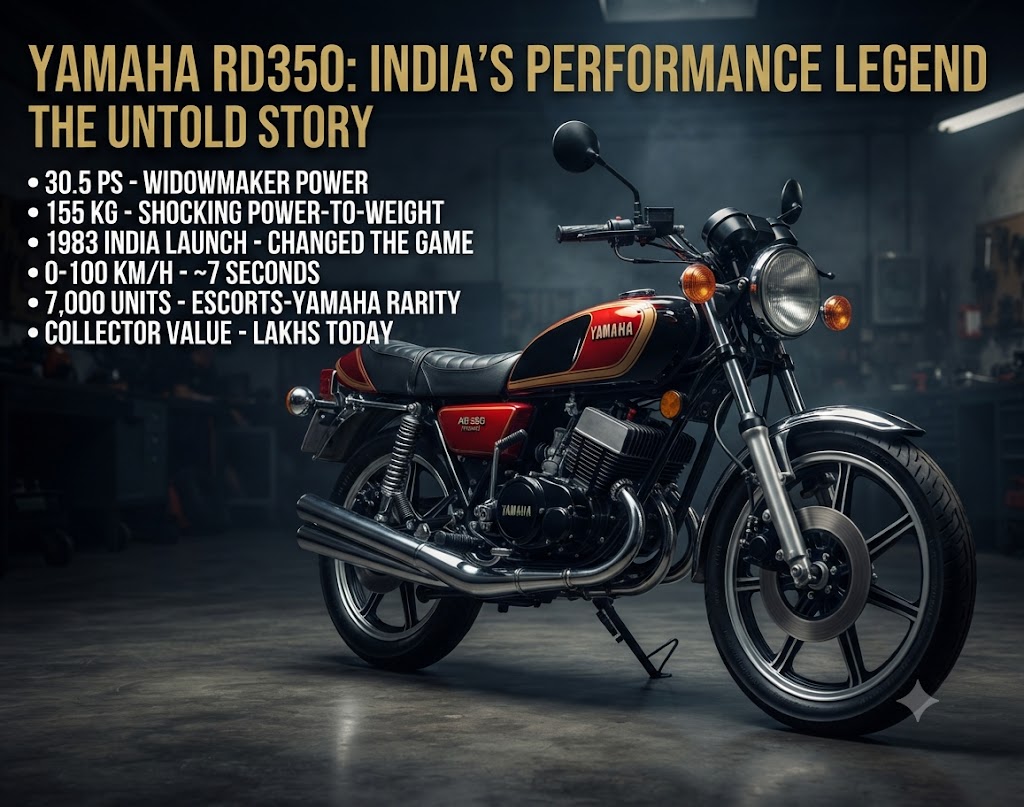
In 1983, the fastest motorcycle on Indian roads was the Royal Enfield Bullet 350 — a thumping, agricultural four-stroke that managed about 18 PS and needed 15 full seconds to reach 60 km/h. Then a 347cc two-stroke parallel twin arrived from the Escorts-Yamaha factory in Faridabad and changed the game. The Yamaha RD350 produced 30.5 PS — nearly double the Bullet — weighed just 155 kg wet, and could blast from 0 to 100 km/h in roughly 7 seconds. It earned nicknames like “Widowmaker” and “Rapid Death 350.” The Yamaha RD350 India history is the story of a machine that was too fast, too thirsty, and too unforgiving for 1980s India — and that is precisely why it became a legend. Originally priced at approximately ₹18,000, pristine examples now command ₹5–7 lakh in the collector market. Here is the definitive account of India’s first performance motorcycle.
How the Yamaha RD350 Came to India: The Escorts-Yamaha Partnership
India’s motorcycle landscape in the early 1980s was dominated by a handful of slow, heavy, utilitarian machines. The Royal Enfield Bullet, Yezdi Roadking, and Rajdoot 175 made up the bulk of two-wheeler sales. Performance simply was not a consideration — fuel economy and reliability ruled purchasing decisions.
Against this backdrop, the Escorts Group — one of India’s largest engineering conglomerates — signed a technical collaboration agreement with Yamaha Motor Company of Japan. The deal allowed Escorts to manufacture the Yamaha RD350B under licence at their Faridabad plant in Haryana. Production commenced in 1983, and the bike was sold under both the Rajdoot and Yamaha badges at different points during its Indian run.
The Indian RD350 was a modified version of the global Yamaha RD350B, adapted for local conditions. Two variants were offered: the HT (High Torque) producing 30.5 PS and the LT (Low Torque) detuned to 27 PS for marginally better fuel economy. Production ran from 1983 to 1989 (some sources cite 1990), during which approximately 7,000 units were manufactured — a tiny number that would later fuel its collector rarity. By the end of production, Escorts had achieved nearly 100% local parts sourcing, a remarkable feat for such a specialised machine.
Specifications That Shocked a Nation
To understand why the RD350 was so revolutionary, you need to appreciate the context. In 1983, the most powerful Indian motorcycle made about 18 PS. The RD350 HT made 30.5 PS — a 70% power advantage over literally everything else on the road. According to Autocar India’s retrospective review, this was “the most absurdly overpowered motorcycle India had ever seen.”
The 347cc air-cooled, two-stroke parallel-twin engine used a reed-valve induction system and Yamaha’s proprietary Autolube automatic oil injection, eliminating the need for pre-mixing two-stroke oil — a genuine convenience feature for the era. The six-speed gearbox was smooth by period standards, and the powerband, while peaky in typical two-stroke fashion, delivered a rush of acceleration above 5,000 rpm that nothing else in India could match.
Complete Yamaha RD350 Specifications (Indian Market)
| Parameter | HT (High Torque) | LT (Low Torque) |
|---|---|---|
| Engine Type | 347cc air-cooled two-stroke parallel twin | |
| Bore x Stroke | 64 mm x 54 mm | |
| Compression Ratio | 6.6:1 | |
| Max Power | 30.5 PS @ 6,750 rpm | 27 PS @ 7,000 rpm |
| Max Torque | 30.5 Nm @ 7,000 rpm | 28 Nm @ 6,500 rpm |
| Transmission | 6-speed manual | |
| Fuel System | Twin Mikuni carburettors with Autolube oil injection | |
| Kerb Weight | 155 kg (wet) | |
| Fuel Tank Capacity | 16 litres | |
| Top Speed | ~140 km/h | ~130 km/h |
| 0-100 km/h | ~7 seconds | ~8.5 seconds |
| Fuel Efficiency | 15-20 kmpl (real-world, urban) | 30-35 kmpl (real-world) |
| Front Brake | 178mm TLS (Twin Leading Shoe) drum | |
| Rear Brake | Drum | |
| Front Suspension | Telescopic forks | |
| Rear Suspension | Twin shock absorbers | |
Era Comparison: RD350 vs Its Contemporaries
The following table makes clear just how far ahead of its time the RD350 was. As of its 1983 launch, no Indian motorcycle came close to matching its power-to-weight ratio:
| Specification | Yamaha RD350 HT | Royal Enfield Bullet 350 | Yezdi 250 Classic | Yamaha RX100 (1985) |
|---|---|---|---|---|
| Engine | 347cc 2-stroke twin | 346cc 4-stroke single | 246cc 2-stroke single | 98cc 2-stroke single |
| Power | 30.5 PS | ~18 PS | ~16 PS | 11 PS |
| Weight | 155 kg | 187 kg | 160 kg | 95 kg |
| Top Speed | 140 km/h | 110 km/h | 100 km/h | 100 km/h |
| Price (launch) | ~₹18,000 | ~₹16,000 | ~₹12,000 | ~₹8,000 |
| Fuel Efficiency | 15-20 kmpl | 35-40 kmpl | 30-35 kmpl | 55-65 kmpl |
The Widowmaker Reputation: Fear and Fascination
The Yamaha RD350 earned a fearsome reputation on Indian streets, and the nicknames reflect it — “Widowmaker,” “Rapid Death 350,” and “King of the Streets” were all commonly used. But was the bike genuinely dangerous, or was the mythology overblown?
The answer lies in the two-stroke powerband. Unlike a four-stroke engine that delivers power in a relatively linear fashion, the RD350’s twin-cylinder two-stroke had a distinct “power band” — a narrow rpm range where power delivery surged dramatically. Below 5,000 rpm, the bike felt manageable, even docile. Cross that threshold, and the engine came alive with a rush that caught inexperienced riders off guard. In an era with no traction control, no ABS, and skinny cross-ply tyres, that sudden surge of 30.5 PS could overwhelm both the chassis and the rider.
Stories of RD350 crashes became part of its legend. Forum threads on communities like Zigwheels’ retrospective feature document accounts from the era — young riders who underestimated the two-stroke surge, highway blasts that ended badly on undivided single-lane roads, and the apocryphal tales of police unable to catch RD350 riders. The reality was more nuanced: in competent hands, the RD350 was an extraordinarily capable machine. Its drum brakes — a 178mm Twin Leading Shoe unit up front — required confident, planned braking inputs rather than last-second grabs, which rewarded skilled riders who read the road ahead. Its low weight and excellent chassis geometry made it genuinely rewarding. But the bike demanded respect, skill, and attention — qualities not every rider possessed.
Why the RD350 Failed Commercially in India
Despite its legendary status today, the Yamaha RD350 was a commercial disappointment. Just 7,000 units in six years of production tells the story starkly. Several factors conspired against it:
Fuel economy: At 15–20 kmpl in real-world riding, the RD350 was catastrophically thirsty by Indian standards. For context, the Hero Honda CD100, launched in 1985, delivered 80 kmpl and became India’s best-selling motorcycle. Indian buyers overwhelmingly prioritised mileage over performance — a mindset that persists to this day.
High-octane fuel requirement: The two-stroke engine demanded higher-octane fuel for optimal performance, which was not widely available at Indian petrol pumps in the 1980s. Running on standard fuel caused knocking, reduced performance, and accelerated engine wear.
Maintenance intensity: Two-stroke engines require more frequent maintenance than four-strokes. The RD350 needed regular decarbonisation, carburettor synchronisation, and attention to its Autolube system. Most local mechanics had no experience with parallel-twin two-strokes.
Price premium: At approximately ₹18,000, it was the most expensive motorcycle in India. The Bullet 350 cost about ₹16,000, and the hugely popular Yezdi was even cheaper. The additional cost bought performance that most Indian riders neither wanted nor could safely exploit.
Spare parts scarcity: Despite Escorts achieving high localisation, specialised components were often difficult to source, especially as production volumes declined in the late 1980s.
The RD350 vs RX100: Two Yamaha Legends Compared
If the Yamaha RD350 was India’s exotic supercar on two wheels, the Yamaha RX100 was the attainable sports car for the masses. Launched in 1985, the RX100 brought Yamaha two-stroke performance to a wider audience at a fraction of the cost. Together, these two bikes created the foundation of India’s performance motorcycle culture.
The RX100’s 98cc single-cylinder two-stroke made 11 PS — modest on paper, but enough to make it the fastest bike in its class. More importantly, it weighed just 95 kg, returned 55–65 kmpl, and cost around ₹8,000. Where the RD350 intimidated, the RX100 invited. Where the RD350 demanded expertise, the RX100 was forgiving enough for everyday riders while still offering that addictive two-stroke power surge.
The RX100 sold in enormous numbers — over 1 million units during its 1985–1996 production run — proving that Indians did want performance, but in an accessible, affordable package. The RD350 had planted the seed; the RX100 made it bloom. Both bikes are revered today, though the RD350’s rarity gives it significantly higher collector value. A clean RX100 fetches ₹50,000–₹1.5 lakh in 2026, while RD350s command multiples of that.
Cultural Impact: How the RD350 Changed Indian Motorcycling
The Yamaha RD350’s commercial failure masks its enormous cultural significance. This was the bike that proved a crucial point: there existed a segment of Indian riders who craved speed, power, and performance above all else. That insight would take two decades to bear fruit commercially, but when Bajaj launched the Pulsar in 2001, it was tapping into exactly the same desire the RD350 had uncovered in 1983.
The RD350 also created India’s first motorcycle subculture. Owners formed tight-knit communities bound by their shared love of the machine and the practical necessity of helping each other source parts and share maintenance knowledge. These communities endure today — RD350 clubs across India organise regular rides, restoration meets, and rallies. The distinctive two-stroke exhaust note — a crackling, high-pitched scream that is unmistakable — still triggers intense nostalgia among riders who grew up in the 1980s.
The bike’s influence extends to modern Yamaha models in India. The Yamaha R15 and Yamaha R1 carry forward the performance DNA that Yamaha first demonstrated in India with the RD350. The direct lineage is spiritual rather than mechanical — four-stroke liquid-cooled engines have replaced the air-cooled two-stroke — but the brand’s positioning as the performance choice in India traces directly back to the RD350’s impact.
From ₹18,000 to ₹10 Lakh: The Collector’s Market in 2026
The Yamaha RD350’s transformation from commercial failure to collector’s treasure is one of the most dramatic price appreciation stories in Indian automotive history. A motorcycle that cost ₹18,000 in 1983 now commands anywhere from ₹1.5 lakh to ₹10 lakh depending on condition — a return that outperforms most financial investments over the same period.
As of June 2026, the collector market breaks down roughly as follows, based on recent listings on platforms like Bikes4Sale and pricing data compiled by Cartoq’s pricing survey:
| Condition | Price Range (2026) | Notes |
|---|---|---|
| Project/Non-runner | ₹50,000 – ₹1 lakh | Needs complete restoration; may have missing parts |
| Running but rough | ₹1 lakh – ₹2 lakh | Rides but needs significant mechanical and cosmetic work |
| Restored to good standard | ₹2 lakh – ₹4.75 lakh | Mechanically sorted, presentable; most common market segment |
| Professionally restored / Excellent | ₹4.75 lakh – ₹7.5 lakh | High-quality restoration with documented history |
| Pristine / Museum quality | ₹7.5 lakh – ₹10 lakh+ | Concours-level originals or frame-off restorations; very rare |
Recent notable sale listings include examples priced at ₹4.75 lakh, ₹6.5 lakh, ₹6.75 lakh, and ₹7.50 lakh. Several factors drive these values: extreme rarity (just 7,000 ever made), cult status, growing nostalgia among now-wealthy 40–60 year old enthusiasts, and the simple reality that no more RD350s will ever be manufactured.
Tips for buyers: When evaluating an RD350, check the engine numbers against the frame numbers — they should match. Look for original Escorts-stamped components. Verify the Autolube oil injection system is functional (many have been removed for simpler pre-mix setups). Check the expansion chambers (exhaust pipes) for cracks and rust. A genuine HT variant commands a 15–20% premium over the LT version. Always insist on seeing original registration documents — provenance significantly affects value.
Restoration Guide: Bringing an RD350 Back to Life
Restoring a Yamaha RD350 is a labour of love that demands patience, a healthy budget, and access to the right community. The good news: India’s RD350 community is one of the most active and supportive vintage motorcycle groups in the country.
Common restoration challenges: The biggest hurdle is sourcing genuine parts. While the engine internals (pistons, rings, bearings) can often be sourced as aftermarket replacements, original body panels, instrument clusters, and chrome components are scarce and expensive. The twin expansion chambers are particularly prone to rust and difficult to replace with period-correct items. Engine rebuilds are necessary for most projects — expect to have the crankshaft rebuilt, new seals throughout, and fresh bore with oversize pistons.
Typical restoration costs: A basic mechanical restoration (engine rebuild, electrical overhaul, brakes, suspension) typically runs ₹80,000–₹1.5 lakh. A full frame-off restoration with chrome work, new paint in the original colour scheme, and all-new rubber components can cost ₹2–4 lakh on top of the purchase price. The total investment for a show-quality restoration from a project bike can reach ₹5–6 lakh all-in.
Key communities and resources: The RD350 owners’ groups on Facebook and dedicated forums at rd350.info are invaluable for parts sourcing and technical advice. Specialist restorers exist in Bangalore, Pune, and Delhi who have deep experience with these machines. GoMechanic’s blog features a comprehensive RD350 resource with restoration insights.
Street legality and registration: As a vintage motorcycle, the RD350 can be registered under most state RTOs’ vintage vehicle provisions. The bike will need a valid fitness certificate, insurance (vintage bike insurance is available from select providers), and valid registration. Emission norms do not apply to vehicles registered before the relevant cut-off dates, so the two-stroke engine is not a legal obstacle. However, some states have specific rules — check your local RTO before purchasing.
Will Yamaha Ever Make a New RD350?
This question surfaces every few years, driven by persistent rumours and the occasional speculative render from international motorcycle media. The short answer: a new RD350 in the original two-stroke format is impossible. India’s BS-VI emission norms (and global environmental regulations) have effectively killed the two-stroke motorcycle engine. No manufacturer can homologate a new two-stroke for road use in India in 2026.
A modern interpretation, however, is entirely plausible. Yamaha’s current global lineup includes the MT-03 and YZF-R3 — both powered by a 321cc parallel-twin four-stroke engine making approximately 42 PS. These bikes are widely regarded as the spiritual successors to the RD350: accessible, lightweight, twin-cylinder machines with genuine sporting intent. However, neither is currently manufactured in India, which limits their relevance to the domestic market.
Yamaha India’s current lineup focuses on the 150–250cc segment, with models like the R15 V4, MT-15, and FZ-X. A full-fledged RD350 revival — perhaps a 350cc twin branded with RD heritage — would require significant investment in a new platform. Given Yamaha’s cautious approach to the Indian market and the dominance of 150–200cc sportbikes, such a model remains unlikely in the near term. For now, the RD350 remains a singular, unrepeatable chapter in Indian motorcycling history.
Expert Verdict
The Yamaha RD350 is not just a motorcycle — it is a cultural artefact that captures a specific moment in Indian automotive history. It was the machine that proved Indians could love speed, even if the market was not ready to support it commercially. Its commercial failure and cultural triumph are two sides of the same coin, and both are essential to understanding why this bike matters.
Who should buy one: If you are a passionate motorcycle enthusiast with mechanical aptitude (or access to a specialist mechanic), a budget of ₹3–7 lakh for a good example, and space to store and maintain a vintage bike, the RD350 is one of the most rewarding machines you can own. The riding experience — that two-stroke surge, the exhaust crackle, the lightweight agility — is genuinely thrilling and utterly different from any modern motorcycle. It is also a sound investment; values have only risen over the past decade and show no signs of declining.
Who should skip it: If you want a reliable daily rider, look elsewhere. If you are uncomfortable with frequent maintenance, hard-to-source parts, and the attention (both welcome and unwelcome) that comes with riding a loud, smoky two-stroke in 2026, the RD350 is not for you. Consider the Royal Enfield’s modern offerings for vintage aesthetics with contemporary reliability instead.
The Yamaha RD350 occupies a unique and permanent place in the pantheon of iconic Indian motorcycles. It was ahead of its time in every way — and that is both the reason it failed and the reason it endures.
Frequently Asked Questions
What does RD stand for in Yamaha RD350?
RD stands for “Race Derived,” reflecting the motorcycle’s performance-oriented engineering derived from Yamaha’s racing programme. The 350 denotes the approximate engine displacement of 347cc. The RD series was Yamaha’s premium two-stroke sport bike range globally, and the RD350 was the most powerful model in the lineup when it launched in India in 1983.
Is the Yamaha RD350 still street legal in India?
Yes, the Yamaha RD350 can be legally ridden on Indian roads provided it has valid registration, insurance, and a fitness certificate. As a vehicle manufactured before modern emission norms came into effect, it is exempt from BS-VI requirements. Most state RTOs allow re-registration of vintage vehicles. However, specific rules vary by state, so check with your local RTO. Vintage vehicle insurance is available from select providers.
Why is the RD350 called Widowmaker?
The Yamaha RD350 earned the “Widowmaker” nickname because its sudden, powerful two-stroke powerband could catch inexperienced riders off guard. With 30.5 PS, no ABS, no traction control, and skinny period tyres, the bike demanded significant riding skill. In 1980s India, where most riders had only experienced gentle four-strokes, the RD350’s explosive mid-range acceleration led to numerous accidents, cementing its fearsome reputation.
How much does a restored Yamaha RD350 cost in 2026?
As of June 2026, a well-restored Yamaha RD350 typically costs between ₹2 lakh and ₹4.75 lakh. Professionally restored examples with documented history command ₹4.75–7.5 lakh, while pristine, museum-quality machines can exceed ₹7.5 lakh. Project bikes needing complete restoration start from ₹50,000–₹1 lakh. The HT (High Torque) variant typically commands a 15–20% premium over the LT version.
Why was the Yamaha RD350 discontinued in India?
The Yamaha RD350 was discontinued around 1989 due to poor sales. Only about 7,000 units were sold during its entire production run. The primary reasons were its exceptionally poor fuel economy (15–20 kmpl), high price tag (₹18,000 — the most expensive motorcycle in India at the time), high maintenance requirements, need for high-octane fuel, and a market that overwhelmingly prioritised mileage and affordability over performance.