
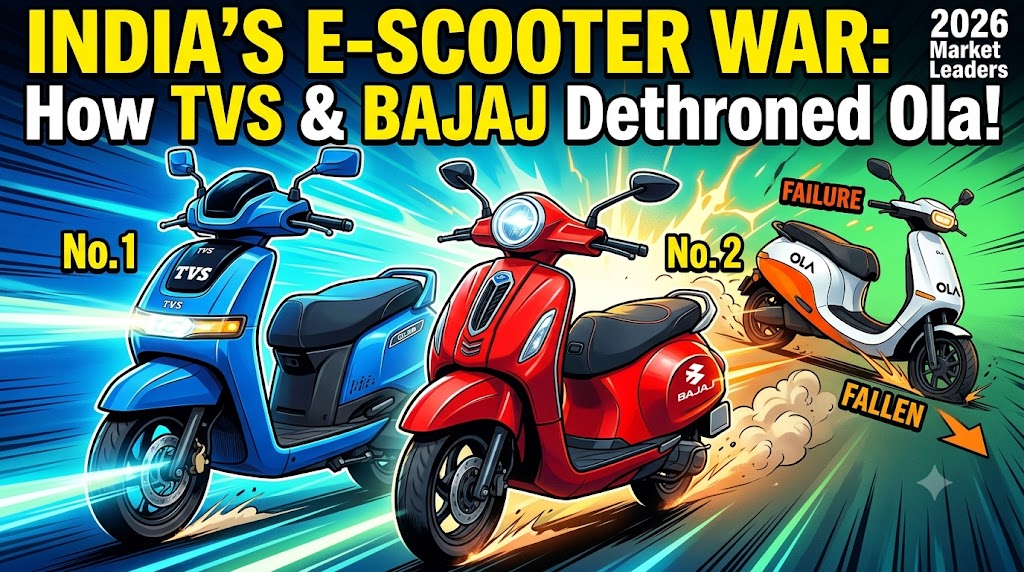
Just two years ago, Ola Electric commanded nearly 40% of India’s electric scooter market. In May 2026, it sits at fifth place with an 8.87% share while TVS Motor (24.87%) and Bajaj Auto (22.96%) together control nearly half the market. With 1.70 lakh electric two-wheelers sold in May 2026 alone — a 63% year-on-year jump — India’s electric scooter segment is booming harder than ever. But the power map has been completely redrawn. This is the story of how legacy automakers reclaimed the throne, why a startup stumbled, and what it all means if you are planning to buy an electric scooter in 2026.
The Numbers: India’s EV Two-Wheeler Market in 2026
India’s electric two-wheeler market has crossed a milestone that even optimists did not predict this soon. According to Vahan dashboard registration data, a record 14.01 lakh electric two-wheelers were sold in FY2026 (April 2025 to March 2026), marking a 22% year-on-year increase over FY2025’s 11.50 lakh units. Electric two-wheelers now command 57% of all EV sales in India, making them the backbone of the country’s electric mobility transition.
The monthly trajectory tells an even more compelling story. March 2026 set an all-time record with 1,99,268 units — the first time the segment crossed the 1.90 lakh mark in a single month. After a natural post-fiscal-year dip to 1,48,740 units in April, May bounced back strongly to 1,70,733 units, up 62.76% year-on-year from 1,04,896 units in May 2025.
Monthly EV Two-Wheeler Sales Trend (2026)
| Month | Units Sold | MoM Change | YoY Growth |
|---|---|---|---|
| January 2026 | 1,22,812 | — | +41% |
| February 2026 | 1,11,709 | -9.04% | +32% |
| March 2026 | 1,99,268 | +78.38% | +45% |
| April 2026 | 1,48,740 | -25.35% | +58% |
| May 2026 | 1,70,733 | +14.79% | +63% |
Perhaps the most significant metric is penetration. Electric scooters accounted for 9.25% of total two-wheeler retail sales in May 2026, up from 6.11% a year ago. In March 2026, one in every ten two-wheelers sold was electric — a psychological tipping point that signals mainstream adoption is no longer a question of “if” but “how fast.” According to Autocar Professional, EV share within the scooter-only segment hit 13% in FY2026.
The Market Share Leaderboard: Who’s Winning and Why
The competitive landscape of India’s electric scooter sales in 2026 looks nothing like it did even 18 months ago. The top five has reshuffled dramatically, and the numbers reveal a clear pattern: brands with strong dealer networks and manufacturing pedigree are pulling ahead.
May 2026 Electric Two-Wheeler Market Share
| Brand | May 2026 Units | Market Share | YoY Growth | May 2025 Units |
|---|---|---|---|---|
| TVS Motor | 42,459 | 24.87% | +64.54% | 25,804 |
| Bajaj Auto | 39,202 | 22.96% | +73.14% | 22,642 |
| Ather Energy | 28,240 | 16.54% | +100.27% | 14,101 |
| Hero Vida | 19,067 | 11.17% | +158.19% | 7,385 |
| Ola Electric | 15,141 | 8.87% | -20.17% | 18,967 |
| Greaves (Ampere) | 7,695 | 4.51% | +77.92% | 4,325 |
| River Mobility | 3,720 | 2.18% | +245.08% | 1,078 |
| BGauss | 3,297 | 1.93% | +204.71% | 1,082 |
Source: Vahan dashboard registration data, compiled from Autocar India and The Bike Junction
TVS Motor has cemented its position as the undisputed leader. The iQube range — bolstered by Battery-as-a-Service (BaaS), which allows buyers to purchase the scooter without the battery and pay a monthly subscription — has brought entry prices down to under ₹1 lakh in some configurations. TVS crossed the 10 lakh cumulative production milestone for the iQube in 2026.
Bajaj Auto’s Chetak range is the quiet force. With 73% year-on-year growth in May and just 3,257 units separating it from TVS, Bajaj is closing the gap rapidly. The Chetak’s strength lies in its quality-first positioning and the trust that the Bajaj brand commands across Tier-2 and Tier-3 India. Bajaj’s dealer network — numbering in thousands across India — gives it an infrastructure advantage that no EV startup can match overnight.
Ather Energy delivered the most dramatic growth story: its May 2026 sales exactly doubled year-on-year. The Rizta, launched as a family-oriented electric scooter, opened an entirely new buyer segment for Ather beyond the urban early-adopter crowd. The company expanded its experience centres from 351 to over 700 within a year.
The Ola Electric Decline: What Went Wrong?
The Ola Electric story is perhaps the most instructive case study in India’s EV industry. The company’s market share has collapsed from 39.5% in January 2024 to 8.87% in May 2026 — a decline so steep that it rewrote the competitive landscape entirely. According to E-Vehicle Info, Ola’s monthly registrations cratered to just 5,488 units in January 2026, before partially recovering to 15,141 in May.
The root cause was not product — it was service infrastructure. CEO Bhavish Aggarwal himself acknowledged that service challenges, not product quality, were the primary issue impacting sales. But the numbers behind that statement are sobering: between September 2023 and August 2024, the National Consumer Helpline received 10,644 complaints against Ola Electric, including 3,389 service delay complaints and 1,899 delivery delay complaints.
The Central Consumer Protection Authority (CCPA) issued a show-cause notice in October 2024. An independent verification exercise found that a majority of contacted customers reported their issues remained unresolved. Battery fire incidents and recurring recalls further eroded consumer confidence.
February 2026 was the nadir: Ola’s sales crashed to approximately 3,968 units, a 47% month-on-month drop. The company has since restructured, cutting its store network from nearly 4,000 outlets to around 550, and is attempting to rebuild from a leaner base. While May showed a 24% month-on-month recovery, the year-on-year decline of 20% underscores that Ola still has a long road to rebuild trust.
Why Legacy Automakers Are Winning the EV Race
The most important lesson from India’s electric vehicle market in 2026 is deceptively simple: in a country as vast and infrastructure-dependent as India, distribution beats disruption.
Service network density is the single biggest competitive advantage. TVS Motor operates thousands of service touchpoints across India — the same network that services Jupiter and Apache owners can handle iQube maintenance. When a TVS iQube owner in Lucknow needs a brake pad replaced, they drive to the same TVS dealership their family has used for years. When an Ola S1 owner in the same city faced a software glitch in 2025, their nearest Ola service centre was often 40 kilometres away — if it was operational at all.
Brand trust built over decades matters enormously for a consideration-heavy purchase like an EV, where range anxiety and battery longevity concerns still linger. Bajaj has been selling two-wheelers in India since the 1960s. That institutional trust does not transfer to a startup simply because it raises venture capital. Buyers, especially in Tier-2 and Tier-3 cities where EV adoption is now accelerating, choose brands their neighbours already ride.
Cross-selling leverage gives legacy OEMs another edge. A customer walking into a Bajaj showroom to look at a Pulsar can be introduced to the Chetak. TVS uses its Jupiter and Ntorq customer base as a funnel for iQube conversions. This is a customer acquisition channel that pure-EV companies simply do not have.
Manufacturing maturity ensures consistent quality at scale. TVS’s Hosur facility — which crossed 10 lakh iQube units — benefits from decades of two-wheeler production expertise. Quality control processes refined over millions of ICE vehicles translate directly into lower defect rates for EVs.
The Rising Stars: Ather, Ampere, River and Simple Energy
While TVS and Bajaj dominate the headlines, several brands are carving out meaningful niches in India’s expanding electric scooter market.
Ather Energy deserves special attention. With 100% year-on-year growth in May 2026 and 2,39,124 units sold in FY2026 (up 82% from FY2025), Ather has proven that a technology-first startup can compete — provided it also invests in distribution. The Rizta, positioned as a comfortable family scooter with a larger seat and higher ground clearance, directly addressed the criticism that Ather only made scooters for tech-savvy urban riders. The company’s expansion to 700+ experience centres shows it has learnt from Ola’s distribution missteps.
Hero Vida is the sleeper hit. Growing at 158% year-on-year in May 2026 to 19,067 units, Vida benefits from Hero MotoCorp’s enormous dealer network — the largest among any two-wheeler manufacturer globally. The VX2 launch as India’s most affordable smart electric scooter has given Vida a compelling entry-level proposition.
Greaves Electric (Ampere) maintains a steady 4.5% share with 7,695 units in May, growing 78% year-on-year. Ampere’s focus on the value segment — affordable, no-frills electric scooters — serves a buyer cohort that premium brands overlook.
River Mobility posted the highest percentage growth among established brands at 245%, albeit from a smaller base.
Simple Energy grew 338% in May, suggesting that well-executed products can still find takers in this expanding market. The top 10 brands accounted for 94% of all electric two-wheeler sales in May 2026, leaving 165 smaller manufacturers competing for the remaining 6%.
What’s Driving the 63% Market Growth?
India’s electric two-wheeler boom in 2026 is not accidental. It sits at the confluence of several macro forces:
Government policy continues to underwrite adoption. The PM E-DRIVE scheme — successor to FAME II — provides an incentive of ₹2,500 per kWh, capped at ₹5,000 per vehicle for electric two-wheelers. Originally set to expire on 31 March 2026, it was extended until 31 July 2026. As of January 2026, over 19.19 lakh electric two-wheelers had been sold under the scheme. Multiple state governments offer additional subsidies: Delhi’s EV Policy 2.0 can reduce the effective price gap between electric and petrol scooters to just ₹12,000-₹25,000.
Battery costs continue to decline. Lithium-ion cell prices have dropped by over 30% since 2023, allowing OEMs to offer more competitive pricing. TVS’s BaaS model takes this further by separating battery cost from the vehicle purchase entirely.
Charging infrastructure is expanding rapidly. Both public and home-charging networks have grown substantially, reducing the “range anxiety” that held back early adoption. Most modern electric scooters now offer 80-120 km of real-world range on a single charge — more than sufficient for daily urban commutes averaging 30-40 km.
Rising petrol prices remain the silent persuader. The second half of May 2026 saw 1,04,083 electric two-wheelers sold versus 66,487 in the first half, with industry analysts attributing the spike partly to petrol price increases during that period.
Consumer awareness has reached critical mass. With over 14 lakh electric two-wheelers on Indian roads after FY2026, word-of-mouth endorsements from friends and family — the most powerful purchase driver in India — are now working in favour of EVs rather than against them.
What This Means for Buyers: Choosing an EV Scooter in 2026
If you are considering an electric scooter purchase in 2026, the market has never offered more choice or better value. Here is a practical framework for making the right decision.
Total Cost of Ownership: EV vs Petrol Scooter (5 Years)
| Cost Component | Electric Scooter | Petrol Scooter (125cc) |
|---|---|---|
| Purchase Price (ex-showroom) | ₹1.00 – ₹1.35 lakh | ₹0.73 – ₹0.88 lakh |
| Annual Fuel/Charging Cost (12,000 km) | ₹1,800 (₹0.15/km) | ₹27,600 (₹2.30/km) |
| Annual Maintenance | ₹3,000 | ₹10,000 |
| Insurance (Annual Average) | ₹2,500 | ₹4,000 |
| 5-Year Total Cost | ₹1.36 – ₹1.72 lakh | ₹2.81 – ₹2.96 lakh |
| 5-Year Savings with EV | ₹1.09 – ₹1.60 lakh | |
Assumptions: 12,000 km/year, electricity at ₹8/unit, petrol at ₹106/litre. Prices are indicative averages for Delhi.
The maths is now decisively in favour of electric scooters. Even accounting for the higher purchase price, EV owners recover the premium within 14-18 months through fuel and maintenance savings alone.
Service Network Comparison
| Brand | Key Model | Price Range (Ex-Showroom) | Service Network Strength |
|---|---|---|---|
| TVS | iQube | ₹1.02 – ₹1.35 lakh | Extensive (thousands of touchpoints via existing TVS network) |
| Bajaj | Chetak | ₹0.96 – ₹1.34 lakh | Extensive (pan-India Bajaj dealer network) |
| Ather | Rizta / 450X | ₹1.09 – ₹1.64 lakh | Growing (700+ experience centres) |
| Hero | Vida V1 | ₹0.96 – ₹1.35 lakh | Largest (Hero’s global dealer network) |
| Ola | S1 series | ₹0.70 – ₹1.50 lakh | Rebuilding (~550 stores post-restructuring) |
The single most important buying criterion in 2026 is service network accessibility. An electric scooter with the best specs on paper is meaningless if the nearest service centre is 50 km away. For buyers in Tier-2 and Tier-3 cities, TVS and Bajaj offer the safest bets simply because their service infrastructure already exists. Ather is a strong choice in metros and Tier-1 cities where its experience centre density is adequate.
For budget-conscious buyers, Bajaj Chetak’s entry variant at ₹96,400 ex-showroom and TVS iQube starting at ₹1.02 lakh offer the best value. For technology enthusiasts who want features like connected apps, over-the-air updates, and fast charging, Ather’s 450 Apex and TVS iQube ST are the benchmarks.
What’s Next: Electric Motorcycles and FY2027 Predictions
The electric two-wheeler story in India is entering its next chapter, and three trends will define FY2027:
Electric motorcycles are coming. While electric scooters dominate today — accounting for virtually all of the 14 lakh e-2W units sold in FY2026 — the motorcycle segment remains largely untapped. Bajaj, TVS, and Ather have all signalled electric motorcycle development programmes. Given that motorcycles outsell scooters roughly 2:1 in India, cracking this segment could multiply the total addressable EV market overnight.
Market consolidation will accelerate. With the top five brands already controlling over 84% of sales, smaller players will face increasing pressure. Expect acquisitions, partnerships, or exits among the 165+ smaller manufacturers currently sharing 6% of the market.
30% penetration by 2030 is realistic. At 9.25% penetration in May 2026 and accelerating EV adoption across segments, industry projections of electric two-wheelers reaching 30% of total two-wheeler sales by 2030 now appear achievable rather than aspirational. The PM E-DRIVE subsidy extension until July 2026 provides near-term policy support, though the industry will need to demonstrate it can sustain growth even as incentives taper.
For buyers, the verdict is clear: the electric scooter market in India has matured past the early-adopter phase. The products are better, the prices are lower, the service networks are wider, and the total cost of ownership case is unassailable. The brands that understood this transition — TVS, Bajaj, and Ather — are reaping the rewards. As of June 2026, the question is no longer whether to go electric, but which electric scooter fits your life best.
Frequently Asked Questions
Which electric scooter brand has the best service network in India in 2026?
TVS Motor and Bajaj Auto have the most extensive service networks for electric scooters in India, leveraging their existing ICE two-wheeler dealership infrastructure that spans thousands of touchpoints across the country. Hero Vida also benefits from Hero MotoCorp’s massive dealer network. Among EV-first companies, Ather Energy has scaled to over 700 experience centres. Service accessibility should be your top priority when choosing an electric scooter.
Why did Ola Electric lose market share in 2026?
Ola Electric’s market share declined from 39.5% in January 2024 to 8.87% in May 2026 primarily due to widespread service infrastructure failures. The National Consumer Helpline received over 10,644 complaints between September 2023 and August 2024. Customers reported delays in repairs, unavailability of spare parts, and service centre wait times exceeding 9 days. The CCPA issued a show-cause notice, and battery fire incidents further eroded trust. Legacy OEMs with established service networks captured Ola’s departing customers.
Is 2026 a good time to buy an electric scooter in India?
Yes, 2026 is arguably the best time to buy an electric scooter in India. Prices have dropped due to falling battery costs and competition. The PM E-DRIVE subsidy of up to ₹5,000 per vehicle is available until 31 July 2026. State subsidies can further reduce costs. Over 5 years, you save ₹1-1.6 lakh compared to a petrol scooter. Service networks have matured significantly, and real-world range of 80-120 km suits most daily commutes.
Which electric scooter offers the best range in India in 2026?
Among the best-selling electric scooters, the Ather 450 Apex claims a certified range of up to 157 km (Eco mode). The TVS iQube ST offers up to 150 km certified range. The Bajaj Chetak offers 108-136 km depending on the variant. Real-world range is typically 60-75% of claimed figures. For daily commuters covering 30-40 km, all top-selling electric scooters from TVS, Bajaj, and Ather offer adequate range with overnight home charging.
What is Battery-as-a-Service (BaaS) and how does it work for electric scooters?
Battery-as-a-Service is a pricing model pioneered by TVS for the iQube where buyers purchase the scooter without the battery pack, significantly reducing the upfront cost. Instead, they pay a monthly subscription (typically ₹1,500-₹2,500 per month) for battery usage. This brings the iQube’s effective purchase price below ₹80,000 in some configurations, making it cheaper than many petrol scooters. BaaS effectively eliminates battery degradation concerns since TVS manages battery health and replacement.
One thought on “India’s Electric Scooter War 2026: How TVS & Bajaj Dethroned Ola Electric”