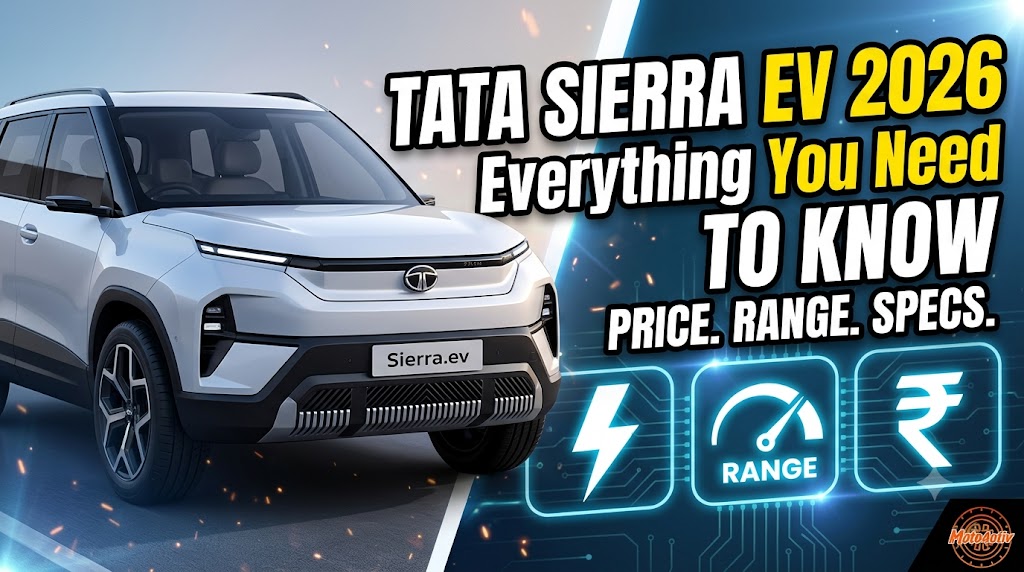
The wait is nearly over. Tata Motors has confirmed that the Tata Sierra EV will make its official debut on June 30, 2026, marking the electrification of one of India’s most iconic SUV nameplates. With an expected Tata Sierra EV 2026 price starting around ₹18.99 lakh (ex-showroom) and stretching to approximately ₹25.49 lakh for the range-topping AWD variant, the Sierra EV enters the fiercely competitive mid-size electric SUV segment as the only all-wheel-drive option under ₹26 lakh — a distinction neither the Hyundai Creta Electric nor the Mahindra BE 6 can claim in their base configurations. Built on Tata’s proven Acti.ev+ platform (shared with the Harrier EV), it promises a claimed range exceeding 500 km, dual battery options, and the retro-modern design DNA that made the original 1991 Sierra a legend. Here is everything you need to know before the launch.
Tata Sierra EV Launch Date and Availability
Tata Motors will officially unveil the production-ready Sierra EV on June 30, 2026. This date has been confirmed through multiple teasers released by the brand and corroborated by reports from Autocar India and CarWale. While June 30 marks the price announcement and formal unveil, deliveries are expected to commence between July and August 2026.
It is worth noting that the ICE-powered Tata Sierra (petrol and diesel) has been on sale since late 2025. The EV variant slots into Tata’s growing electric lineup between the Curvv EV (starting at ₹17.49 lakh) and the Harrier EV (starting above ₹30 lakh), filling a critical gap in the ₹18–25 lakh electric SUV space. Bookings are expected to open around the launch date, and Tata’s extensive dealer and EV charging network across 200+ cities should ensure wide availability from day one. If you are interested in how the ICE version performs, read our detailed Tata Sierra 2025 review.
Tata Sierra EV Expected Price in India
Based on variant-level pricing data from CarWale, the Tata Sierra EV 2026 price is expected to fall in the following range (all prices ex-showroom, estimated):
| Variant | Battery | Drive | Expected Price (Ex-Showroom) |
|---|---|---|---|
| Adventure 2WD | 55 kWh | RWD | ₹18.99 lakh |
| Adventure S 2WD | 55 kWh | RWD | ₹19.49 lakh |
| Fearless Plus 2WD | 55 kWh | RWD | ₹20.99 lakh |
| Fearless Plus 2WD | 60 kWh | RWD | ₹22.49 lakh |
| Empowered 2WD | 60 kWh | RWD | ₹23.99 lakh |
| Empowered QWD (AWD) | 60 kWh | AWD | ₹24.99 lakh |
| Empowered Stealth QWD (AWD) | 60 kWh | AWD | ₹25.49 lakh |
Important note: Multiple sources, including Autocar India, reference 65 kWh and 75 kWh battery packs for the Sierra EV. The final battery capacities and variant-wise pricing will be confirmed at the June 30 launch event. On-road prices for the top AWD variant in Delhi are estimated around ₹26–27 lakh, inclusive of RTO, insurance, and registration charges.
At this price point, the Sierra EV undercuts the Mahindra BE 6 (₹18.90–₹26.90 lakh) in the mid-to-upper range while sitting competitively against the Hyundai Creta Electric (₹18.03–₹24.70 lakh). Tata may also offer a Battery-as-a-Service (BaaS) subscription model — similar to the one available on the Maruti e Vitara — which could reduce the upfront cost by ₹4–5 lakh.
Platform, Battery and Powertrain Options
The Sierra EV is built on Tata’s Acti.ev+ platform, the same skateboard architecture underpinning the Harrier EV. This is Tata’s most advanced EV platform, designed for vehicles in the C+ and D segments with a monocoque construction.
Battery Options
Two battery packs will be offered. Pre-launch sources indicate capacities of 55 kWh and 60 kWh (per CarWale’s variant data), though several reports from Autocar India and CardDekho reference 65 kWh and 75 kWh packs — identical to the Harrier EV. The discrepancy may reflect usable vs. gross capacity, or a late-stage specification change. Final figures will be confirmed on June 30.
Motor and Drivetrain
Based on the shared Acti.ev+ platform and Harrier EV data (according to Autocar India’s Harrier EV 65 review), expect the following powertrain specifications:
| Specification | RWD Variant | AWD (QWD) Variant |
|---|---|---|
| Motor Configuration | Single rear motor | Dual motor (front + rear) |
| Power (estimated) | ~238 PS | ~238 PS (rear) + ~158 PS (front) |
| Torque (estimated) | ~315 Nm | ~504 Nm (combined) |
| Drivetrain | Rear-Wheel Drive | All-Wheel Drive (Tata QWD) |
| Transmission | Single-speed automatic | Single-speed automatic |
Note: These power and torque figures are estimated based on the Harrier EV’s confirmed specs on the same platform. The Sierra EV’s slightly smaller and lighter body could result in marginally different tuning. Official figures are expected at launch.
Charging
The Sierra EV supports DC fast charging up to 120 kW. Based on the Harrier EV’s confirmed charging data on the same platform:
- DC fast charging (20–80%): Approximately 25 minutes at 100+ kW DC charger
- AC home charging (7.2 kW wallbox, 10–100%): Approximately 9–11 hours depending on battery size
- Standard 3.3 kW home socket: Approximately 16–20 hours (not recommended as primary charging method)
This is a gap that most competitor articles miss entirely. For context, charging the smaller battery from 20–80% at a public DC station during a highway stop takes roughly the same time as a quick coffee break — making intercity travel practical.
Range: How Far Can the Tata Sierra EV Go?
Tata has indicated that the Sierra EV’s range will exceed 500 km on the larger battery pack. Using Harrier EV range data as a reference (both share the Acti.ev+ platform), here are the expected figures:
| Battery | Claimed Range (MIDC/ARAI est.) | Real-World Range (est. 70–80%) |
|---|---|---|
| Smaller (55/65 kWh) | ~450–540 km | ~315–430 km |
| Larger (60/75 kWh) | ~520–627 km | ~365–500 km |
| AWD (larger battery) | ~500–622 km | ~350–490 km |
Why real-world range matters: Indian driving conditions — stop-and-go city traffic, air conditioning usage in summer, and highway speeds above 100 kmph — typically reduce claimed range by 20–30%. The Sierra EV’s lighter body compared to the Harrier EV may partially offset this, delivering slightly better real-world efficiency.
Practical context: Even at the conservative end of real-world estimates, the Sierra EV can comfortably cover a Delhi-to-Jaipur run (~280 km) on a single charge with the larger battery, or a Mumbai-to-Pune trip (~150 km) with ample reserve on any variant. For daily urban commuters averaging 40–60 km per day, a full charge would last well over a week.
Design: Exterior and Interior Highlights
Exterior
The Sierra EV retains the retro-modern design language that made the ICE Sierra stand out. Key exterior highlights include:
- Iconic alpine-style rear quarter glass — a direct callback to the legendary 1991 Tata Sierra, and the single most recognisable design element on the vehicle. To understand the heritage behind this design choice, read our piece on Tata Sierra: A Legacy Reborn.
- Full-width connected LED DRLs with a body-coloured trim strip housing the Tata logo
- Horizontal LED headlamps positioned below the DRL strip
- Closed-off, body-coloured front grille — the EV’s calling card
- Flush door handles for improved aerodynamic efficiency
- 19-inch dual-tone alloy wheels on premium variants
- “Sierra.EV” badging on the tailgate
- Silver brushed skid plate on the front bumper
- Colour options: Expected in White, Red, Black, and Yellow (to be confirmed at launch)
Interior
The cabin takes a significant leap over the ICE Sierra, with technology and premium materials befitting the price point:
- Triple-screen dashboard: 12.3-inch touchscreen infotainment + 12.3-inch passenger entertainment display + 10.25-inch digital instrument cluster (top trims); lower trims get a dual-screen setup
- Head-Up Display (HUD) for speed and navigation data
- Panoramic sunroof across mid and top variants
- JBL 12-speaker audio system with Dolby Atmos — a segment-first feature
- Powered and ventilated front seats with memory function on the driver side
- Dual-zone climate control
- Wireless Android Auto and Apple CarPlay
- Wireless phone charger
- Powered tailgate
- Ambient lighting
- V2L (Vehicle-to-Load) and V2V (Vehicle-to-Vehicle) capability — use the Sierra EV to power appliances, charge other EVs, or run camping equipment. A genuinely useful feature for road trips and emergencies.
- Digital IRVM (Interior Rear-View Mirror)
Safety Features and ADAS
Safety has been a cornerstone of Tata’s recent vehicles, and the Sierra EV is expected to continue that tradition. Here is the expected safety equipment list:
- 6 airbags (dual front, side, and curtain) as standard
- Level 2+ ADAS suite — including adaptive cruise control, lane keep assist, lane departure warning, automatic emergency braking, blind spot monitoring, and rear cross-traffic alert
- 360-degree surround-view camera
- Electronic Stability Control (ESC)
- Hill Hold Assist
- Tyre Pressure Monitoring System (TPMS)
- ABS with EBD (Electronic Brakeforce Distribution)
- All four disc brakes
- Electronic parking brake with auto-hold
- ISOFIX child seat mounts
- Front and rear parking sensors
NCAP rating: The Sierra EV has not been crash-tested yet. However, Tata’s recent track record is among the best in India — the Tata Punch scored 5 stars in Global NCAP, the Nexon scored 5 stars, and the Mahindra BE 6 (a key rival) holds a 5-star Bharat NCAP rating. Given Tata’s safety-first approach, a strong NCAP score is widely expected once the Sierra EV is tested.
Tata Sierra EV vs Hyundai Creta Electric vs Mahindra BE 6: How It Compares
This is the comparison that every prospective buyer is looking for. The mid-size electric SUV segment in India now has three strong contenders, each with distinct advantages. Here is how they stack up (as of June 2026):
| Parameter | Tata Sierra EV | Hyundai Creta Electric | Mahindra BE 6 | Maruti e Vitara |
|---|---|---|---|---|
| Price Range (ex-showroom) | ₹18.99–25.49 lakh (est.) | ₹18.03–24.70 lakh | ₹18.90–26.90 lakh | ₹15.99–20.01 lakh |
| Battery Options | 55 kWh / 60 kWh* | 42 kWh / 51.4 kWh | 59 kWh / 79 kWh | 49 kWh / 61 kWh |
| Claimed Range (max) | ~500–627 km (est.) | 510 km (MIDC) | 682 km (ARAI) | 543 km (ARAI) |
| Power | ~238 PS (RWD, est.) | 171 PS | 231–286 PS | 144–174 PS |
| Torque | ~315–504 Nm (est.) | 255 Nm | 380 Nm | — |
| AWD Option | Yes (QWD) | No | Yes (top variant) | No |
| DC Fast Charging | 120 kW | 50 kW | 140 kW | 70 kW |
| Key Unique Feature | Only AWD EV under ₹26L; V2L/V2V; JBL Dolby Atmos | Proven Hyundai reliability; widest dealer network | Highest range (682 km); 5-star Bharat NCAP | Lowest price; BaaS option from ₹10.99L |
| NCAP Rating | Not tested yet | Not tested yet | 5-star (Bharat NCAP) | 5-star (Bharat NCAP) |
| Availability | July–August 2026 (est.) | Available now | Available now | Available now |
*Battery capacities for the Sierra EV may be 65/75 kWh (gross) as per some sources. Final specs to be confirmed at launch. Maruti e Vitara ARAI range is for the 49 kWh variant; the 61 kWh variant delivers 440 km.
Key Takeaways from the Comparison
- Sierra EV’s trump card is its AWD capability under ₹26 lakh. No other EV in this segment offers all-wheel drive at this price point — the BE 6 AWD variant costs significantly more.
- Creta Electric’s advantage is its proven Hyundai reliability and the fact that it is available for purchase right now, with an established service network.
- Mahindra BE 6’s advantage is its class-leading claimed range of 682 km and a confirmed 5-star Bharat NCAP safety rating.
- Maruti e Vitara’s advantage is its aggressive pricing, especially with the BaaS option that brings the entry price down to ₹10.99 lakh.
Warranty and Ownership Costs
Tata’s Lifetime Battery Warranty
According to Tata Motors’ official EV warranty page, the Sierra EV is expected to come with Tata’s Lifetime HV Battery Warranty, which covers:
- First owner: 15 years / unlimited kilometres — the most generous battery warranty in the Indian market
- Second owner onwards: 10 years / 2 lakh km (for Harrier EV platform vehicles; must notify Tata of ownership transfer)
- SOH threshold: Warranty activates if battery State of Health drops below 70%. Upon repair or replacement, Tata restores the battery to steady-state SOH before the issue or 80% SOH, whichever is higher.
- Eligibility: Private individual registrations and company perk car schemes only. Fleet/taxi/commercial use vehicles receive a reduced 10-year/2 lakh km warranty.
Maintenance Costs
Electric vehicles have significantly fewer moving parts than ICE vehicles — no engine oil changes, no clutch replacements, no exhaust system maintenance. Based on Tata’s existing EV portfolio (Nexon EV, Curvv EV), owners can expect:
- Annual maintenance cost: Approximately ₹3,000–5,000 per year (compared to ₹8,000–12,000 for the ICE Sierra)
- Brake pad life: Significantly extended due to regenerative braking
- Tata EV service network: Available across 200+ cities in India
For a broader look at how Tata’s EV range is evolving, including the latest updates on the refreshed Tiago EV, see our 2026 Tata Tiago EV comparison.
Should You Wait for the Tata Sierra EV? — Expert Verdict
The Tata Sierra EV is shaping up to be one of the most compelling electric SUVs in India for 2026. After analysing the expected specifications, pricing, and competitive landscape, here is our assessment.
You should seriously consider the Sierra EV if:
- You want an AWD electric SUV under ₹26 lakh — the Sierra EV is literally the only option in this segment with all-wheel drive at this price.
- You are a Tata loyalist upgrading from a Nexon EV or Curvv EV — the Sierra EV offers a significant step up in size, features, and performance while staying within the Tata ecosystem and its industry-leading 15-year battery warranty.
- You value design heritage and road presence — no other EV in this segment has the iconic lineage that the Sierra nameplate carries. The alpine-style rear glass alone turns heads.
- You need V2L/V2V capability for camping, emergencies, or powering equipment on the go.
You might want to look elsewhere if:
- You need immediate delivery — the Hyundai Creta Electric and Mahindra BE 6 are available for purchase today. The Sierra EV will likely have a 1–2 month waiting period after launch.
- You are budget-conscious below ₹18 lakh — the Tata Curvv EV (from ₹17.49 lakh) or the Maruti e Vitara with BaaS (from ₹10.99 lakh) offer better value at lower price points.
- You prioritise maximum range above all else — the Mahindra BE 6 claims up to 682 km (ARAI), which is likely to exceed the Sierra EV’s range on paper.
Our recommendation: If you are in the market for a mid-size electric SUV and can wait until July 2026 for deliveries, the Tata Sierra EV deserves to be on your shortlist. The combination of AWD capability, Tata’s lifetime battery warranty, V2L functionality, and the JBL Dolby Atmos audio system makes it a uniquely well-rounded package. Wait for the June 30 launch event to confirm final pricing and specs before booking. As of June 2026, we would rate it as the most feature-rich electric SUV in the ₹18–25 lakh bracket — provided the final pricing holds.
Frequently Asked Questions (FAQ)
What is the Tata Sierra EV launch date in India?
Tata Motors will officially unveil and announce pricing for the Sierra EV on June 30, 2026. Deliveries are expected to begin in July–August 2026. Bookings are likely to open around the launch date through Tata’s official website and dealership network across India.
What is the expected price of the Tata Sierra EV?
The Tata Sierra EV 2026 price is expected to range from ₹18.99 lakh to ₹25.49 lakh (ex-showroom). The base Adventure RWD variant starts around ₹18.99 lakh, while the top-spec Empowered Stealth AWD variant is estimated at ₹25.49 lakh. On-road prices will be ₹1–2 lakh higher depending on the city.
What is the range of the Tata Sierra EV on a full charge?
The Tata Sierra EV is expected to deliver a claimed range of 500–627 km depending on the battery variant (MIDC/ARAI estimated). In real-world Indian driving conditions, expect approximately 350–500 km, which is sufficient for most intercity trips like Delhi-to-Jaipur (280 km) on a single charge.
Does the Tata Sierra EV come with all-wheel drive (AWD)?
Yes. The Tata Sierra EV is the only electric SUV under ₹26 lakh in India to offer AWD (Tata calls it QWD — Quad Wheel Drive). AWD is available on the Empowered variants with the larger battery pack, featuring a dual-motor setup with an estimated combined output of ~504 Nm of torque.
How long does it take to charge the Tata Sierra EV?
Using a DC fast charger (100+ kW), the Sierra EV can charge from 20% to 80% in approximately 25 minutes. Using a 7.2 kW AC home wallbox, a full charge (10–100%) takes approximately 9–11 hours overnight. A standard 3.3 kW home socket will take 16–20 hours and is not recommended as the primary charging method.
What is the battery warranty on the Tata Sierra EV?
Tata offers a Lifetime HV Battery Warranty of 15 years with unlimited kilometres for the first owner. Second owners receive coverage for 10 years or 2 lakh km (with ownership transfer notification to Tata). The warranty applies when battery State of Health drops below 70%. This is the most comprehensive battery warranty offered by any carmaker in India.
How does the Tata Sierra EV compare to the Hyundai Creta Electric?
The Tata Sierra EV offers AWD capability, a larger battery, more power (~238 PS vs 171 PS), V2L/V2V functionality, and a JBL Dolby Atmos audio system — none of which the Creta Electric provides. However, the Creta Electric is available for immediate purchase, has a proven Hyundai reliability track record, and starts at a comparable ₹18.03 lakh. The Sierra EV is the better-equipped vehicle; the Creta Electric is the safer, available-now choice.