Quick Analysis
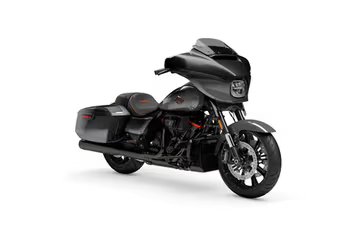
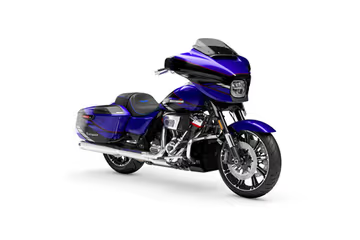
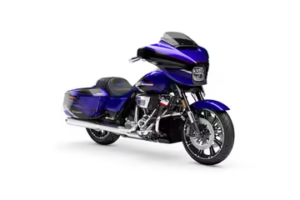
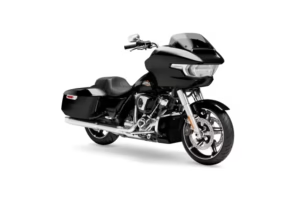
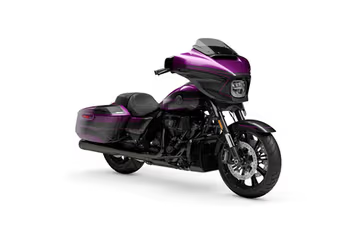
CVO Street Glide & Road Glide
13.0 pts
Unweighted: 8 advantages
EnginePerformanceDimensionsBrakesTyresFeaturesOther
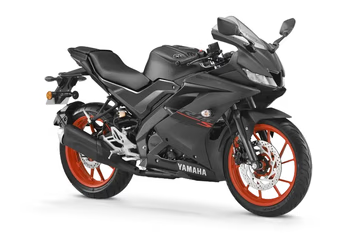
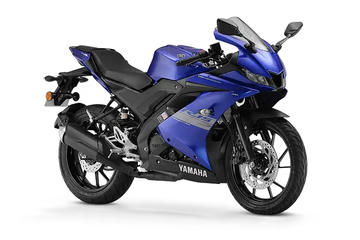
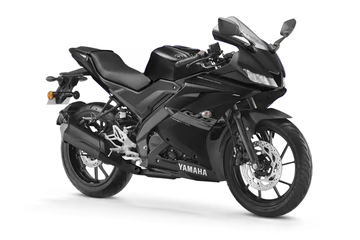
YAMAHA R15 S
12.5 pts
Unweighted: 9 advantages
EnginePerformanceDimensionsBrakesTyresFeaturesOther
| Specification | ||
|---|---|---|
Engine Specifications |
||
| Cooling System | Air-cooled | Liquid-Cooled |
| Displacement | 1,977 cc | 155 CC |
| Engine Type | Milwaukee-Eight® VVT 121 V-Twin | Liquid-cooled, 4-stroke, SOHC, 4-valve |
| Power | 116.6 PS @ 5020 rpm | 13.5kW(18.4PS)/10000 RPM |
| Torque | 189 Nm @ 3,500 rpm | 14.2 Nm (1.4 kgfm) @7,500 RPM |
Performance & Efficiency |
||
| Fuel Tank Capacity | 22.7 litres | 11 L |
| Mileage | — | 40 Kmpl |
Dimensions & Weight |
||
| Kerb Weight | 380 | 142 |
| Seat Height | 715 | 815 |
Brakes & Suspension |
||
| ABS | Dual Channel | Dual channel ABS |
| Front Brake | Double Disc | Disc brake (282 mm) |
| Front Suspension | 47 mm Inverted 1x1 Front Forks | Telescopic Fork |
| Rear Brake | Disc | Disc brake (220 mm) |
| Rear Suspension | Dual adjustable emulsions suspension with remote preload adjustment on the left shock, and threaded preload on the right shock | Monocross (link suspension) |
Tyres & Wheels |
||
| Front Tyre | 130/60 B19 | 100/80-17M/C 52P |
| Rear Tyre | 180/55 B18 | 140/70R17M/C 66H |
| Tyre Type | Tubeless | Tubeless |
| Wheel Type | Cast aluminum | Alloy |
Features & Technology |
||
| Headlight | LED (signature lighting) | LED |
Other Specifications |
||
| Battery | — | 12 V, 4.0 Ah |
| Bike Image 1 | https://motoautiv.com/wp-content/uploads/2025/06/Poison-berry.avif | https://motoautiv.com/wp-content/uploads/2025/05/new-matte-black.avif |
| Bike Image 2 | https://motoautiv.com/wp-content/uploads/2025/06/Raven-fade.avif | https://motoautiv.com/wp-content/uploads/2025/05/racing-blue-1.avif |
| Cluster | 312 mm TFT touchscreen | Digital |
| Color Options | Raven Fade | #2C2C2E Poison Berry | #8A2F6B Blue Streak | #1F4FA3 | Racing Blue | #1B4FAF Matte Black | #1A1A1C Matte Black (New) | #1A1A1C, #C62828 |
| Cons | Weight Is Always Part of the Experience – Despite refinements to the chassis and engine, these remain large touring motorcycles that require effort when manoeuvring at walking pace or parking. Purchase Price Places Them in a Very Exclusive Segment – The CVO range sits at the top of Harley-Davidson's lineup and costs significantly more than standard touring models. The Size Can Be Limiting in Urban Environments – Dense traffic, narrow roads, and tight parking spaces highlight the physical dimensions of the motorcycles. Premium Paint Requires Care – The complex paint finishes are a major part of the motorcycles' appeal, but they can also make owners more cautious about scratches, chips, and cosmetic damage. Engine Heat Is Still Noticeable in Slow Traffic – Although modern engine management has improved thermal control, a large-capacity V-twin still generates noticeable heat during prolonged stop-and-go riding. Most of Their Strengths Are Best Appreciated on Open Roads – Features such as the fairing, luggage capacity, and touring ergonomics become less relevant during short urban rides. Replacement Parts and Accessories Can Be Expensive – Premium components and model-specific parts typically cost more than those used on standard motorcycles. The Feature List Can Feel Overwhelming to Some Riders – Compared with traditional Harley-Davidsons, the amount of technology and menu-based customization is considerably greater. | Aggressive Riding Position for Daily Commuting – Although more comfortable than the R15 V4 due to its single-piece seat, the clip-on handlebars and sporty ergonomics can still become tiring in heavy traffic and during longer city rides. Misses Out on USD Front Forks – The R15S uses conventional telescopic front forks, whereas the R15 V4 and R15M come equipped with upside-down forks that offer a more premium feel and appearance. No Traction Control System – Unlike the higher-spec R15 V4 and R15M variants, the R15S does not offer traction control. No Quickshifter – Riders do not get the clutchless upshift functionality available on the R15M and selected R15 V4 variants. Basic Instrument Cluster Compared to Newer Rivals – The display provides essential information but lacks the advanced connectivity and modern interface offered by some competitors. Performance Requires Higher RPMs – The VVA engine performs best when revved, meaning riders often need to shift gears frequently to access its strongest performance. |
| Detailed Overview | The CVO Street Glide and CVO Road Glide sit at the top of Harley-Davidson’s touring range. While they share their foundations with the standard Street Glide and Road Glide, the CVO versions are built around a more extensive specification list, additional equipment, and exclusive finishes. Mechanically, the two motorcycles are very closely related, with the main distinction continuing to be the fairing design. The Street Glide uses Harley-Davidson’s Batwing fairing, mounted directly to the forks, while the Road Glide uses the Sharknose fairing that is attached to the frame. That difference affects the appearance of the motorcycles and contributes to subtle changes in steering feel and wind management, but the overall purpose remains the same. At the centre of both motorcycles is the Milwaukee-Eight VVT 121 engine. With a displacement of 1,977cc, it is one of the largest engines currently used in Harley-Davidson’s production motorcycles. Unlike earlier generations of large-capacity V-twins that relied on a relatively fixed valve setup, this engine incorporates Variable Valve Timing (VVT). The system continuously adjusts valve timing depending on engine speed and load, allowing the engine to operate differently across various riding conditions. A six-speed transmission transfers power to the rear wheel, and the engine remains a defining part of the motorcycles’ overall character due to both its size and configuration. The touring chassis underneath is designed around stability, passenger accommodation, and luggage carrying capability. Large dimensions and a substantial wheelbase contribute to the motorcycles’ presence on the road, while suspension components are tuned to support the weight of the machine, rider, passenger, and luggage. The setup is intended to maintain composure during extended highway use rather than prioritize rapid direction changes or sporty handling characteristics. One of the most visible differences between the CVO models and Harley-Davidson’s smaller motorcycles is the level of equipment integrated into the design. Both motorcycles feature hard saddlebags that form part of the bodywork rather than appearing as separate accessories. These storage compartments are designed to carry luggage while maintaining the motorcycles’ touring-focused appearance. Passenger accommodation is also a significant consideration, with large seats and ergonomics developed around long-distance travel. Technology plays a much larger role than it did on Harley-Davidson touring motorcycles of previous generations. A large TFT display serves as the central interface for navigation, vehicle information, media controls, and smartphone connectivity. Riders can interact with various settings through the display, while multiple electronic rider-assistance systems operate in the background. These include cornering-sensitive ABS, traction control, drag-torque slip control, hill-hold control, tyre-pressure monitoring, and selectable ride modes. Rather than existing as isolated features, these systems are integrated into the motorcycle’s broader electronic architecture. The motorcycles carry a fuel tank with a capacity of approximately 22.7 litres, reflecting their intended use as long-distance touring machines. Lighting systems use modern LED technology throughout, while premium audio components are incorporated into the fairing. These audio systems form part of the touring experience and are integrated directly into the motorcycles rather than being added as aftermarket accessories. Although the CVO Street Glide and CVO Road Glide share most of their major specifications, the Batwing and Sharknose fairings remain the defining visual and functional distinction between them. Beyond that difference, both motorcycles combine a large-capacity V-twin engine, touring-oriented chassis, integrated luggage, extensive electronic rider aids, and a substantial amount of onboard technology. Their specifications are arranged around the requirements of long-distance road travel, carrying both rider and passenger while accommodating luggage and electronic conveniences within a single touring platform. | The Yamaha R15S is aimed at riders who like the sharp styling and sporty character of the R15 range but want something a little more practical for everyday use. While it shares most of its mechanical components with the R15 V4, the biggest difference is the single-piece seat, which offers more room for both the rider and pillion. As a result, the R15S sits in an interesting space where it carries the DNA of a small supersport motorcycle while remaining usable for daily commuting. Power comes from Yamaha’s familiar 155cc liquid-cooled engine, which has been a key part of the R15 lineup for several years. The motor uses Variable Valve Actuation (VVA), a technology designed to maintain performance across different engine speeds. In normal city riding, the motorcycle feels smooth and manageable, but as the revs climb, the engine develops a more energetic character. The six-speed gearbox works alongside an assist and slipper clutch, which keeps clutch effort light in traffic and helps make downshifts feel smoother when riding enthusiastically. One of the strongest aspects of the R15S is its chassis. The motorcycle is built around Yamaha’s Deltabox frame, a setup that has long been associated with the company’s performance-oriented motorcycles. On the road, this translates into a motorcycle that feels stable when cornering and predictable when changing direction. Whether navigating through city traffic or riding on a winding road, the bike responds accurately to rider inputs without feeling nervous or heavy. The suspension setup consists of telescopic front forks and a rear monoshock. Unlike the R15 V4, the R15S does not use upside-down forks, but the overall setup is tuned to provide a balance between everyday usability and sporty handling. The ride quality tends to feel firm rather than plush, which suits the motorcycle’s sporty nature but also means rough roads can be felt more clearly through the seat and handlebars. Braking duties are handled by disc brakes at both ends, supported by dual-channel ABS. This allows both wheels to benefit from anti-lock braking intervention during sudden braking situations. The braking performance matches the motorcycle’s overall character, offering a controlled and confidence-inspiring feel without requiring excessive effort from the rider. Visually, the R15S continues to look every bit like a member of Yamaha’s R-series family. The full fairing, sharp bodywork, sculpted fuel tank, and aggressive front-end design give it the appearance of a larger supersport motorcycle. LED lighting at both ends further adds to the modern look, while the fully digital instrument console provides information such as speed, fuel level, gear position, and trip details in a clean layout. With a kerb weight of around 142 kg and a seat height of 815 mm, the R15S remains approachable for a wide range of riders. The 11-litre fuel tank offers a useful balance between range and overall weight, making the motorcycle suitable for both daily travel and occasional weekend rides. Rather than being defined by outright performance numbers, the Yamaha R15S is a motorcycle whose character comes from its combination of a high-revving engine, precise handling, sporty ergonomics, and a more accommodating seat layout. It takes the core ingredients of the R15 platform and presents them in a package that feels slightly more practical without moving away from its sportbike roots. |
| Expert Review | The CVO Street Glide and CVO Road Glide are less about introducing a fundamentally different riding experience and more about showing what Harley-Davidson's touring platform looks like when fitted with the company's highest-specification components and finishes. Beneath the exclusive paintwork, upgraded audio systems, and model-specific details, both motorcycles retain the core characteristics of Harley-Davidson's touring family. The Milwaukee-Eight VVT 121 engine brings a broader spread of performance than earlier touring engines, while the latest electronics package introduces a level of rider assistance and connectivity that would have been uncommon on Harley-Davidson motorcycles a decade ago. The distinction between the two models still comes primarily from their fairing designs. The Street Glide's fork-mounted Batwing fairing contributes to a different steering feel than the Road Glide's frame-mounted Sharknose setup, and riders often have strong preferences between the two approaches. Beyond that, both motorcycles are shaped by the same priorities: long-distance travel, rider comfort, luggage capacity, and highway stability. Their size, weight, and cost remain significant parts of the ownership experience, and those characteristics are difficult to separate from the motorcycles themselves. Rather than redefining the touring formula, the CVO models refine it through additional equipment, upgraded finishes, and a more comprehensive feature set., 4.7, MotoAutiv Team | The Yamaha R15S occupies an interesting position within Yamaha's sportbike lineup because it combines the mechanical foundation of the R15 family with a slightly more practical approach to everyday riding. The 155cc VVA engine remains the centerpiece of the experience, delivering its performance in a manner that encourages riders to explore the upper reaches of the rev range while still offering enough flexibility for routine commuting. The motorcycle feels composed when leaned into corners, and the Deltabox frame continues to provide the sense of precision that has long been associated with the R15 platform. Compared with the R15 V4 and R15M, the single-piece seat improves day-to-day usability and pillion accommodation, though the riding posture still reflects the motorcycle's supersport origins. On uneven roads, the suspension setup prioritizes stability and control over outright softness, which means sharper bumps can be felt through the chassis. The overall package focuses more on rider engagement, chassis balance, and sport-oriented dynamics than on advanced electronics or touring comfort, resulting in a riding experience that remains closely aligned with the R-series identity., 4.4, MotoAutiv Team |
| FAQ (Manual Override) | Q: What does CVO stand for? A: CVO stands for Custom Vehicle Operations, Harley-Davidson's factory-custom division responsible for producing limited-production, premium-specification motorcycles. Q: What is the difference between the CVO Street Glide and CVO Road Glide? A: The primary difference is the fairing design. The CVO Street Glide uses a fork-mounted Batwing fairing, while the CVO Road Glide uses a frame-mounted Sharknose fairing. The engine, electronics package, and overall touring purpose are largely similar. Q: Which engine powers the CVO Street Glide and CVO Road Glide? A: Both motorcycles use the Milwaukee-Eight VVT 121 V-twin engine with a displacement of approximately 1,977cc. Q: What does VVT mean? A: VVT stands for Variable Valve Timing, a system that adjusts valve operation to improve performance, efficiency, and torque delivery across different engine speeds. Q: Are the CVO models more powerful than standard Street Glide and Road Glide models? A: Yes. The CVO models receive the larger Milwaukee-Eight VVT 121 engine, while standard models use smaller versions of the Milwaukee-Eight engine. Q: Do the CVO models come with navigation? A: Yes. Both motorcycles feature a large TFT display with integrated navigation, smartphone connectivity, and infotainment functions. Q: Do they have cruise control? A: Yes. Electronic cruise control is standard equipment. Q: Are saddlebags included as standard? A: Yes. Integrated hard saddlebags are part of the standard touring package. Q: What is the fuel tank capacity? A: The fuel tank capacity is approximately 22.7 litres. Q: Do the motorcycles have ride modes? A: Yes. Multiple ride modes are available, allowing riders to alter throttle response and electronic intervention settings. Q: Are the CVO models comfortable for two-up touring? A: Yes. The seating layout, passenger accommodations, luggage capacity, and touring ergonomics are designed with long-distance two-up riding in mind. Q: Do they include rider-assistance systems? A: Yes. Features include cornering-enhanced ABS, traction control, drag-torque slip control, hill-hold control, tyre-pressure monitoring, and other electronic rider aids. Q: What is the approximate kerb weight? A: Depending on specification, the motorcycles weigh approximately 380–400 kg in running condition. Q: Can they be used for daily commuting? A: They can be ridden daily, but their size, weight, and touring-focused design make them better suited to open roads and highway travel than dense urban traffic. Q: What body type do the CVO Street Glide and CVO Road Glide belong to? A: Both are classified as Touring Motorcycles, more specifically Luxury Grand Touring Motorcycles. Q: Are CVO motorcycles limited-production models? A: Yes. CVO motorcycles are produced in smaller numbers than Harley-Davidson's standard models and typically feature exclusive paint schemes, finishes, and equipment packages. | Q: Is the Yamaha R15S good for daily use? A: Yes, the R15S is often chosen by riders who want a sportbike for everyday commuting. The single-piece seat makes it more practical than the R15 V4, although the riding position is still sport-oriented. Q: What is the real mileage of the Yamaha R15S? A: Most owners report mileage figures between 40 km/l and 50 km/l, depending on traffic conditions, riding style, and maintenance. Q: What is the top speed of the Yamaha R15S? A: Under suitable conditions, the Yamaha R15S can reach around 135–140 km/h. Q: Does the Yamaha R15S have dual-channel ABS? A: Yes, the Yamaha R15S comes equipped with dual-channel ABS as standard. Q: Does the Yamaha R15S have traction control? A: No, traction control is not available on the R15S. Q: Does the Yamaha R15S get a quickshifter? A: No, the R15S does not come with a quickshifter. This feature is available on the R15M and selected R15 V4 variants. Q: What is the seat height of the Yamaha R15S? A: The seat height is approximately 815 mm, which is the same as the R15 V4. Q: Is the Yamaha R15S comfortable for long rides? A: It is more comfortable than the R15 V4 because of its single-piece seat, but the sporty riding posture can still become tiring during very long journeys. Q: What is the fuel tank capacity of the Yamaha R15S? A: The motorcycle comes with an 11-litre fuel tank. Q: What is the kerb weight of the Yamaha R15S? A: The Yamaha R15S has a kerb weight of approximately 142 kg. Q: What is the difference between Yamaha R15S and Yamaha R15 V4? A: The R15S uses a single-piece seat and conventional telescopic forks, while the R15 V4 gets split seats, USD front forks, traction control, Bluetooth connectivity, and additional premium features depending on the variant. Q: Which is better for daily use, Yamaha R15S or Yamaha R15 V4? A: Riders who prioritize comfort often prefer the R15S because of its single-piece seat, while the R15 V4 offers more features and a sportier overall package. Q: Is the Yamaha R15S suitable for beginners? A: Yes, many new riders start with the R15S because the engine is manageable, the bike is lightweight, and the handling is predictable. Q: Does the Yamaha R15S have VVA technology? A: Yes, the R15S uses Yamaha's Variable Valve Actuation (VVA) system, which helps maintain performance across different engine speeds. Q: Is the Yamaha R15S good for highway riding? A: The motorcycle is capable of highway cruising, and the fairing provides useful wind protection. However, the committed riding position may not suit every rider on very long trips. Q: Does the Yamaha R15S have an assist and slipper clutch? A: Yes, the Yamaha R15S comes equipped with an assist and slipper clutch as standard. |
| Fuel System | Fuel Injection | Fuel Injection |
| Price Variants | STD | 6303142 | | 155600 |
| Pros | Milwaukee-Eight VVT 121 Engine Adds Another Layer of Performance – The 1,977cc engine delivers strong torque throughout the rev range, but the addition of variable valve timing broadens the power delivery compared to Harley-Davidson's previous large-capacity touring engines. Extensive Factory Equipment – Unlike standard touring models that are often customized after purchase, the CVO models arrive with premium audio systems, upgraded finishes, advanced electronics, and exclusive components already fitted. Premium Paint and Finish Quality – The multi-layer paint schemes, intricate graphics, and detailing are among the most elaborate finishes Harley-Davidson applies to production motorcycles. Advanced Touring Technology – Features such as the large TFT display, navigation, ride modes, adaptive rider aids, premium audio systems, and smartphone connectivity form a substantial part of the ownership experience. Long-Distance Comfort Remains a Core Focus – The seating position, wind protection, and touring ergonomics are designed around spending extended periods on the road. Strong Highway Stability – Both motorcycles are developed primarily for highway use, where their weight, chassis, and fairing designs contribute to a planted feel. Integrated Luggage and Touring Practicality – Saddlebags are part of the design rather than an accessory, providing useful storage without altering the motorcycle's appearance. Distinctive Presence Compared With Standard Models – Beyond the paintwork, the wheels, trim pieces, finishes, and component choices make the CVO models visually different from standard Street Glide and Road Glide variants. | Refined 155cc VVA Engine – The liquid-cooled engine with Variable Valve Actuation delivers smooth performance across a wide rev range and remains one of the most technologically advanced engines in the segment. Sportbike-Inspired Handling – The Deltabox frame provides excellent chassis balance and precise handling, especially while cornering and changing direction. More Comfortable Than the R15 V4 – Unlike the split-seat setup on the R15 V4, the R15S uses a single-piece seat that offers improved comfort for both rider and pillion. Strong Highway Stability – The aerodynamic fairing and well-sorted chassis help the motorcycle remain composed at higher speeds. Good Fuel Efficiency – Despite its sporty nature, the engine is capable of delivering fuel economy figures that remain competitive in the 150cc category. Aggressive R-Series Styling – The design closely resembles Yamaha's larger supersport motorcycles, giving the bike a premium sportbike appearance. Assist and Slipper Clutch – This reduces clutch effort and helps improve stability during downshifts. Lightweight and Manageable – The motorcycle remains easy to handle in urban traffic while still offering a sporty riding feel. LED Headlamp and Tail Lamp – The LED lighting setup contributes to visibility and modern styling. |
| Starter | Electric | Electric starter |
| Transmission | 6-speed manual | Constant mesh, 6-speed |