VS

Quick Analysis

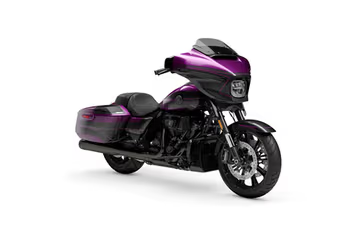
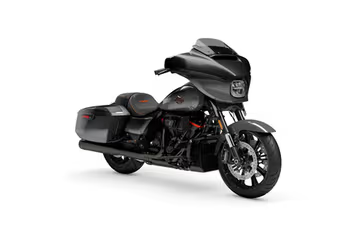
 CVO Street Glide & Road Glide

15.0 pts
Unweighted: 9 advantages
EnginePerformanceDimensionsBrakesTyresFeaturesOther

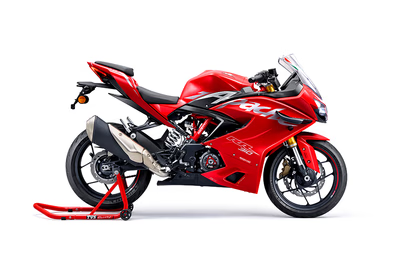
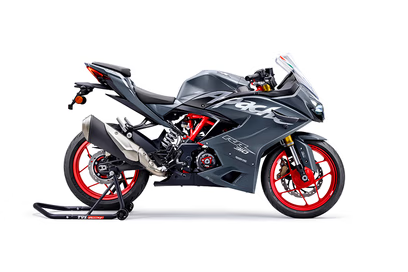
TVS Apache RR 310

15.5 pts
Unweighted: 12 advantages
EnginePerformanceDimensionsBrakesTyresFeaturesOther
Specification
 CVO Street Glide & Road Glide
 CVO Street Glide & Road Glide
Harley Davidson
₹2
TVS Apache RR 310
TVS Apache RR 310
TVS
₹277,999

Engine Specifications

Cooling System Air-cooled Liquid‑cooled Oil‑Coolant Technology
Displacement 1,977 cc 312.2 cc
Engine Type Milwaukee-Eight® VVT 121 V-Twin SI, 4‑stroke, 4‑valve, single‑cylinder, DOHC, reverse‑inclined
Power 116.6 PS @ 5020 rpm Sport 28 kW @ 9800 RPM ; Urban 22 kW @7600 RPM
Torque 189 Nm @ 3,500 rpm Sport: 27.3 Nm @ 7900 RPM ; Urban: 25 Nm @ 6700 RPM

Performance & Efficiency

Fuel Tank Capacity 22.7 litres 11 L
Mileage 34 Kmpl

Dimensions & Weight

Kerb Weight 380 174 
Seat Height 715 810

Brakes & Suspension

ABS Dual Channel Dual‑channel ABS
Front Brake Double Disc Disc 300mm Petal type with ABS
Front Suspension 47 mm Inverted 1x1 Front Forks KYB inverted cartridge telescopic fork
Rear Brake Disc Disc 240mm Petal type with ABS
Rear Suspension Dual adjustable emulsions suspension with remote preload adjustment on the left shock, and threaded preload on the right shock Two‑arm aluminium die‑cast swingarm with monotube floating‑piston gas shock

Tyres & Wheels

Front Tyre 130/60 B19 110/70‑ZR17 M/C 54W tubeless – Michelin Road 5
Rear Tyre 180/55 B18 150/60‑ZR17 M/C 66W tubeless – Michelin Road 5
Tyre Type Tubeless Tubeless
Wheel Type Cast aluminum Alloy

Features & Technology

Headlight LED (signature lighting) Bi‑LED projector

Other Specifications

Battery 12 V, 8 Ah
Bike Image 1 https://motoautiv.com/wp-content/uploads/2025/06/Poison-berry.avif https://motoautiv.com/wp-content/uploads/2025/07/Red-1.avif
Bike Image 2 https://motoautiv.com/wp-content/uploads/2025/06/Raven-fade.avif https://motoautiv.com/wp-content/uploads/2025/07/Bomber-Grey.avif
Bike Image 3 https://motoautiv.com/wp-content/uploads/2025/07/Anniversary-Edition-1.avif
Cluster 312 mm TFT touchscreen 5″ TFT (SmartXonnect connected)
Color Options Raven Fade | #2C2C2E Poison Berry | #8A2F6B Blue Streak | #1F4FA3 Sepang Blue Race Replica | #1D5AAE, #D6D6D6 Racing Red | #B00000 Bomber Grey | #5F6368 Black Champagne Gold Livery | #111111, #B08D57
Cons Weight Is Always Part of the Experience – Despite refinements to the chassis and engine, these remain large touring motorcycles that require effort when manoeuvring at walking pace or parking. Purchase Price Places Them in a Very Exclusive Segment – The CVO range sits at the top of Harley-Davidson's lineup and costs significantly more than standard touring models. The Size Can Be Limiting in Urban Environments – Dense traffic, narrow roads, and tight parking spaces highlight the physical dimensions of the motorcycles. Premium Paint Requires Care – The complex paint finishes are a major part of the motorcycles' appeal, but they can also make owners more cautious about scratches, chips, and cosmetic damage. Engine Heat Is Still Noticeable in Slow Traffic – Although modern engine management has improved thermal control, a large-capacity V-twin still generates noticeable heat during prolonged stop-and-go riding. Most of Their Strengths Are Best Appreciated on Open Roads – Features such as the fairing, luggage capacity, and touring ergonomics become less relevant during short urban rides. Replacement Parts and Accessories Can Be Expensive – Premium components and model-specific parts typically cost more than those used on standard motorcycles. The Feature List Can Feel Overwhelming to Some Riders – Compared with traditional Harley-Davidsons, the amount of technology and menu-based customization is considerably greater. Engine vibrations are still noticeable at certain RPM ranges, especially near highway cruising speeds. The committed riding posture can feel tiring during long city traffic rides or extended touring sessions. Heat management around the engine area can become noticeable in slow-moving traffic conditions. The gearbox and quickshifter setup, while feature-rich, may not feel as smooth as some higher-priced international sport bikes. Pillion comfort is limited because of the sporty rear seat design and aggressive ergonomics. The motorcycle sits in a pricing zone where buyers also start considering larger-capacity motorcycles and twin-cylinder alternatives. Service quality and ownership experience can vary depending on dealership location and technician expertise. Low-speed maneuvering feels slightly heavier compared to lightweight naked motorcycles because of the full-faired setup and riding posture.
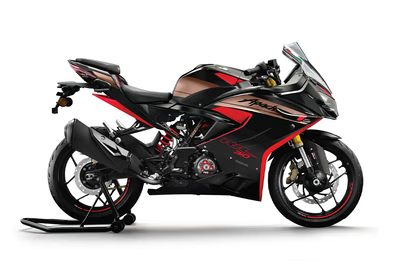
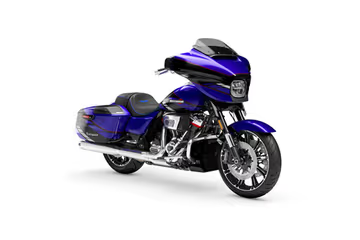
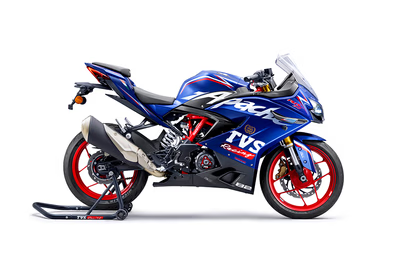
Detailed Overview The CVO Street Glide and CVO Road Glide sit at the top of Harley-Davidson’s touring range. While they share their foundations with the standard Street Glide and Road Glide, the CVO versions are built around a more extensive specification list, additional equipment, and exclusive finishes. Mechanically, the two motorcycles are very closely related, with the main distinction continuing to be the fairing design. The Street Glide uses Harley-Davidson’s Batwing fairing, mounted directly to the forks, while the Road Glide uses the Sharknose fairing that is attached to the frame. That difference affects the appearance of the motorcycles and contributes to subtle changes in steering feel and wind management, but the overall purpose remains the same. At the centre of both motorcycles is the Milwaukee-Eight VVT 121 engine. With a displacement of 1,977cc, it is one of the largest engines currently used in Harley-Davidson’s production motorcycles. Unlike earlier generations of large-capacity V-twins that relied on a relatively fixed valve setup, this engine incorporates Variable Valve Timing (VVT). The system continuously adjusts valve timing depending on engine speed and load, allowing the engine to operate differently across various riding conditions. A six-speed transmission transfers power to the rear wheel, and the engine remains a defining part of the motorcycles’ overall character due to both its size and configuration. The touring chassis underneath is designed around stability, passenger accommodation, and luggage carrying capability. Large dimensions and a substantial wheelbase contribute to the motorcycles’ presence on the road, while suspension components are tuned to support the weight of the machine, rider, passenger, and luggage. The setup is intended to maintain composure during extended highway use rather than prioritize rapid direction changes or sporty handling characteristics. One of the most visible differences between the CVO models and Harley-Davidson’s smaller motorcycles is the level of equipment integrated into the design. Both motorcycles feature hard saddlebags that form part of the bodywork rather than appearing as separate accessories. These storage compartments are designed to carry luggage while maintaining the motorcycles’ touring-focused appearance. Passenger accommodation is also a significant consideration, with large seats and ergonomics developed around long-distance travel. Technology plays a much larger role than it did on Harley-Davidson touring motorcycles of previous generations. A large TFT display serves as the central interface for navigation, vehicle information, media controls, and smartphone connectivity. Riders can interact with various settings through the display, while multiple electronic rider-assistance systems operate in the background. These include cornering-sensitive ABS, traction control, drag-torque slip control, hill-hold control, tyre-pressure monitoring, and selectable ride modes. Rather than existing as isolated features, these systems are integrated into the motorcycle’s broader electronic architecture. The motorcycles carry a fuel tank with a capacity of approximately 22.7 litres, reflecting their intended use as long-distance touring machines. Lighting systems use modern LED technology throughout, while premium audio components are incorporated into the fairing. These audio systems form part of the touring experience and are integrated directly into the motorcycles rather than being added as aftermarket accessories. Although the CVO Street Glide and CVO Road Glide share most of their major specifications, the Batwing and Sharknose fairings remain the defining visual and functional distinction between them. Beyond that difference, both motorcycles combine a large-capacity V-twin engine, touring-oriented chassis, integrated luggage, extensive electronic rider aids, and a substantial amount of onboard technology. Their specifications are arranged around the requirements of long-distance road travel, carrying both rider and passenger while accommodating luggage and electronic conveniences within a single touring platform. The TVS Apache RR 310 is built around the idea of offering a fully-faired sport motorcycle that can handle both everyday road riding and higher-speed performance riding without becoming too extreme for regular use. While the motorcycle clearly carries supersport-inspired styling and aerodynamics, its overall setup feels more balanced than a pure track-focused machine. The riding experience combines strong highway stability, modern electronics, and sporty handling with enough practicality to make the bike usable beyond weekend rides. Power comes from a 312.2cc single-cylinder, liquid-cooled engine that uses a reverse-inclined layout. This engine design helps centralize mass and improve handling characteristics while also contributing to better weight distribution. The motor produces around 38 PS and 29 Nm of torque in Track and Sport modes, giving the RR 310 strong acceleration through the mid and upper rev range. The engine feels smooth during regular riding but becomes more energetic once pushed harder, especially during highway overtakes and fast corner exits. A 6-speed gearbox handles transmission duties, and newer variants also receive a bi-directional quickshifter that allows clutchless upshifts and downshifts during spirited riding. The motorcycle includes four riding modes — Track, Sport, Urban, and Rain. These modes change throttle response, ABS behavior, power delivery, and traction control intervention depending on riding conditions. Track and Sport modes unlock the motorcycle’s full performance potential, while Urban and Rain modes soften throttle response and add more electronic intervention for smoother control on wet roads or city traffic. This system gives the RR 310 a more adaptable personality compared to many conventional sport motorcycles. Aerodynamics play a major role in the bike’s design. The fully-faired bodywork, sharp front profile, and windscreen are developed to improve airflow and stability at higher speeds. The motorcycle feels planted while cruising on highways, and the fairing helps reduce wind blast during long rides. At the same time, the aggressive styling with LED lighting, sculpted tank sections, split seats, and race-inspired graphics gives the RR 310 a strong visual presence on the road. The chassis setup focuses heavily on stability and handling precision. The bike uses a trellis frame combined with upside-down front forks and a rear monoshock suspension. The suspension setup keeps the motorcycle composed during fast cornering while still absorbing regular road imperfections reasonably well. The RR 310 feels stable during high-speed riding and maintains confidence during quick direction changes, though the sporty riding posture places more weight on the wrists compared to upright street motorcycles. Braking duties are handled by disc brakes at both ends along with dual-channel ABS. Higher variants also receive cornering ABS and traction control, which improve stability during aggressive braking and leaned-over cornering situations. Michelin Road 5 tyres further improve grip and road feedback, especially during fast highway riding and wet conditions. Technology is one of the most feature-rich aspects of the RR 310. The TFT instrument display supports TVS SmartXonnect connectivity with navigation assist, call alerts, ride telemetry, voice assistance, and riding statistics. Features like cruise control, cornering traction control, wheelie control, and adjustable suspension on selected variants give the motorcycle a premium feel usually associated with larger sport bikes. The bike carries an 11-litre fuel tank and weighs around 174 kg. Fuel efficiency generally stays around 30–35 km/l depending on riding conditions and throttle usage. Overall, the TVS Apache RR 310 combines aerodynamic sportbike styling, modern rider electronics, stable chassis dynamics, and strong highway performance into a motorcycle developed for riders who want a sporty but road-usable fully-faired machine.
Expert Review The CVO Street Glide and CVO Road Glide are less about introducing a fundamentally different riding experience and more about showing what Harley-Davidson's touring platform looks like when fitted with the company's highest-specification components and finishes. Beneath the exclusive paintwork, upgraded audio systems, and model-specific details, both motorcycles retain the core characteristics of Harley-Davidson's touring family. The Milwaukee-Eight VVT 121 engine brings a broader spread of performance than earlier touring engines, while the latest electronics package introduces a level of rider assistance and connectivity that would have been uncommon on Harley-Davidson motorcycles a decade ago. The distinction between the two models still comes primarily from their fairing designs. The Street Glide's fork-mounted Batwing fairing contributes to a different steering feel than the Road Glide's frame-mounted Sharknose setup, and riders often have strong preferences between the two approaches. Beyond that, both motorcycles are shaped by the same priorities: long-distance travel, rider comfort, luggage capacity, and highway stability. Their size, weight, and cost remain significant parts of the ownership experience, and those characteristics are difficult to separate from the motorcycles themselves. Rather than redefining the touring formula, the CVO models refine it through additional equipment, upgraded finishes, and a more comprehensive feature set., 4.7, MotoAutiv Team The TVS Apache RR 310 feels like a motorcycle developed with serious attention toward riding dynamics rather than just outright specifications. Once the bike starts moving, the chassis immediately stands out because of how stable and planted it feels through corners and at highway speeds. The 312.2cc reverse-inclined engine delivers strong acceleration and a smooth flow of power through the mid and top-end range, while the aerodynamic fairing helps the motorcycle remain composed during fast riding. TVS has also packed the RR 310 with a large number of electronic features including ride modes, cornering ABS, traction control, cruise control, and a bi-directional quickshifter, giving the motorcycle a much more premium feel than many bikes in this category. At the same time, the RR 310 does not try to behave like an extreme supersport machine all the time. The suspension setup and riding ergonomics still allow it to function as an everyday motorcycle, although engine heat, committed ergonomics, and vibrations at certain RPMs become noticeable during longer rides or city traffic. Overall, the RR 310 combines sporty handling, high-speed stability, modern electronics, and practical road usability into a fully-faired motorcycle designed mainly for riders who enjoy performance-oriented road riding., 4.6, MotoAutiv Team
FAQ (Manual Override) Q: What does CVO stand for? A: CVO stands for Custom Vehicle Operations, Harley-Davidson's factory-custom division responsible for producing limited-production, premium-specification motorcycles. Q: What is the difference between the CVO Street Glide and CVO Road Glide? A: The primary difference is the fairing design. The CVO Street Glide uses a fork-mounted Batwing fairing, while the CVO Road Glide uses a frame-mounted Sharknose fairing. The engine, electronics package, and overall touring purpose are largely similar. Q: Which engine powers the CVO Street Glide and CVO Road Glide? A: Both motorcycles use the Milwaukee-Eight VVT 121 V-twin engine with a displacement of approximately 1,977cc. Q: What does VVT mean? A: VVT stands for Variable Valve Timing, a system that adjusts valve operation to improve performance, efficiency, and torque delivery across different engine speeds. Q: Are the CVO models more powerful than standard Street Glide and Road Glide models? A: Yes. The CVO models receive the larger Milwaukee-Eight VVT 121 engine, while standard models use smaller versions of the Milwaukee-Eight engine. Q: Do the CVO models come with navigation? A: Yes. Both motorcycles feature a large TFT display with integrated navigation, smartphone connectivity, and infotainment functions. Q: Do they have cruise control? A: Yes. Electronic cruise control is standard equipment. Q: Are saddlebags included as standard? A: Yes. Integrated hard saddlebags are part of the standard touring package. Q: What is the fuel tank capacity? A: The fuel tank capacity is approximately 22.7 litres. Q: Do the motorcycles have ride modes? A: Yes. Multiple ride modes are available, allowing riders to alter throttle response and electronic intervention settings. Q: Are the CVO models comfortable for two-up touring? A: Yes. The seating layout, passenger accommodations, luggage capacity, and touring ergonomics are designed with long-distance two-up riding in mind. Q: Do they include rider-assistance systems? A: Yes. Features include cornering-enhanced ABS, traction control, drag-torque slip control, hill-hold control, tyre-pressure monitoring, and other electronic rider aids. Q: What is the approximate kerb weight? A: Depending on specification, the motorcycles weigh approximately 380–400 kg in running condition. Q: Can they be used for daily commuting? A: They can be ridden daily, but their size, weight, and touring-focused design make them better suited to open roads and highway travel than dense urban traffic. Q: What body type do the CVO Street Glide and CVO Road Glide belong to? A: Both are classified as Touring Motorcycles, more specifically Luxury Grand Touring Motorcycles. Q: Are CVO motorcycles limited-production models? A: Yes. CVO motorcycles are produced in smaller numbers than Harley-Davidson's standard models and typically feature exclusive paint schemes, finishes, and equipment packages. Q: What engine does the TVS Apache RR 310 use? A: The motorcycle uses a 312.2cc single-cylinder, liquid-cooled, reverse-inclined engine. Q: What is the power output of the Apache RR 310? A: The bike produces around 38 PS and 29 Nm in Track and Sport modes. Q: What is the top speed of the Apache RR 310? A: The motorcycle has an approximate top speed of around 160 km/h. Q: Does the Apache RR 310 have riding modes? A: Yes, the motorcycle offers Track, Sport, Urban, and Rain riding modes. Q: Does the RR 310 have a quickshifter? A: Yes, newer variants get a bi-directional quickshifter. Q: What type of brakes does the Apache RR 310 use? A: The motorcycle uses disc brakes at both ends along with dual-channel ABS. Q: Does the Apache RR 310 get traction control? A: Yes, higher variants include traction control and cornering traction control features. Q: What suspension setup does the Apache RR 310 use? A: The bike gets USD front forks and a rear monoshock suspension setup. Q: What is the fuel tank capacity of the RR 310? A: The motorcycle comes with an 11-litre fuel tank. Q: Does the Apache RR 310 support Bluetooth connectivity? A: Yes, the motorcycle supports TVS SmartXonnect connectivity with navigation and ride analytics. Q: Is the Apache RR 310 suitable for touring? A: Yes, the bike is capable of highway touring because of its stable chassis, aerodynamic fairing, and strong cruising performance. Q: What tyres are used on the Apache RR 310? A: The motorcycle uses Michelin Road 5 tubeless tyres on newer variants. Q: Does the Apache RR 310 have cruise control? A: Yes, selected variants offer cruise control functionality. Q: What is the kerb weight of the Apache RR 310? A: The motorcycle weighs around 174 kg.
Fuel System Fuel Injection Fuel Injection
Price Variants STD | 6303142 Red Without Quickshifter | 261240 Red With Quickshifter | 277190 Bomber Grey | 281790 Limited Edition | 314390
Pros Milwaukee-Eight VVT 121 Engine Adds Another Layer of Performance – The 1,977cc engine delivers strong torque throughout the rev range, but the addition of variable valve timing broadens the power delivery compared to Harley-Davidson's previous large-capacity touring engines. Extensive Factory Equipment – Unlike standard touring models that are often customized after purchase, the CVO models arrive with premium audio systems, upgraded finishes, advanced electronics, and exclusive components already fitted. Premium Paint and Finish Quality – The multi-layer paint schemes, intricate graphics, and detailing are among the most elaborate finishes Harley-Davidson applies to production motorcycles. Advanced Touring Technology – Features such as the large TFT display, navigation, ride modes, adaptive rider aids, premium audio systems, and smartphone connectivity form a substantial part of the ownership experience. Long-Distance Comfort Remains a Core Focus – The seating position, wind protection, and touring ergonomics are designed around spending extended periods on the road. Strong Highway Stability – Both motorcycles are developed primarily for highway use, where their weight, chassis, and fairing designs contribute to a planted feel. Integrated Luggage and Touring Practicality – Saddlebags are part of the design rather than an accessory, providing useful storage without altering the motorcycle's appearance. Distinctive Presence Compared With Standard Models – Beyond the paintwork, the wheels, trim pieces, finishes, and component choices make the CVO models visually different from standard Street Glide and Road Glide variants. The motorcycle feels very stable at higher speeds, especially on highways. The aerodynamic fairing, riding posture, and chassis setup help the bike maintain confidence during fast cruising and cornering. The 312.2cc reverse-inclined engine delivers strong acceleration and a noticeable top-end pull, making the RR 310 feel more performance-oriented than most smaller sport motorcycles. Ride modes such as Track, Sport, Urban, and Rain mode allow the motorcycle to adapt its throttle response and ABS behavior depending on riding conditions. The bike balances sporty handling with everyday usability better than many aggressive supersport motorcycles. It can still be used for regular commuting without feeling excessively uncomfortable. Features like cornering ABS, traction control, cruise control, bi-directional quickshifter, TFT display, and Bluetooth connectivity make the motorcycle feel technologically advanced within the segment. The fully-faired design gives the RR 310 strong road presence, and the race-inspired styling remains one of the most distinctive parts of the motorcycle. Suspension and braking performance feel premium, especially on variants equipped with adjustable suspension setups and Michelin tyres. High-speed stability and chassis feedback are among the strongest areas of the motorcycle, particularly during cornering and highway riding.
Starter Electric Self Start Only
Transmission 6-speed manual 6‑speed with bi‑directional quick‑shifter

If you like what we do, Stay connected with 🚗 Motoautiv.com ⚡

Leave your email 📧 below and Click subscribe Now 🔔✨