Quick Analysis
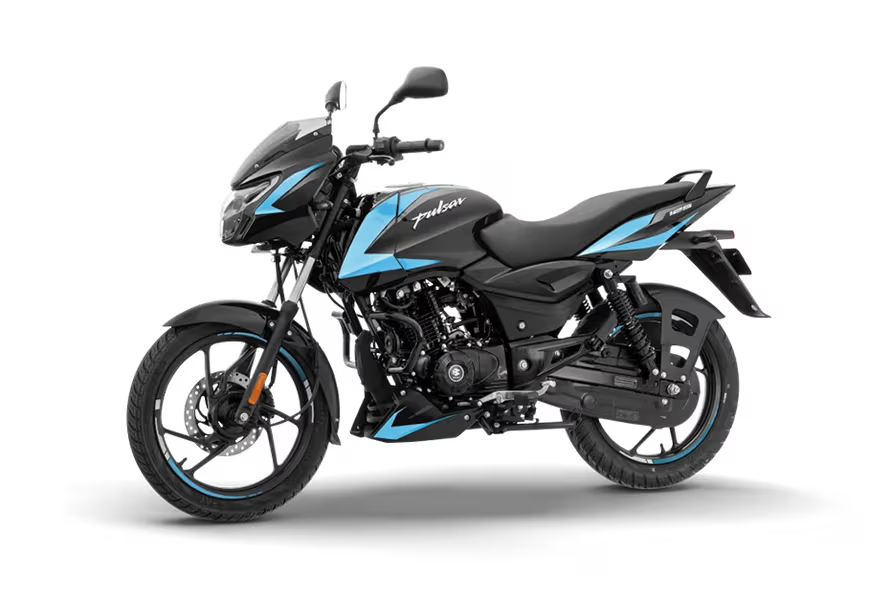
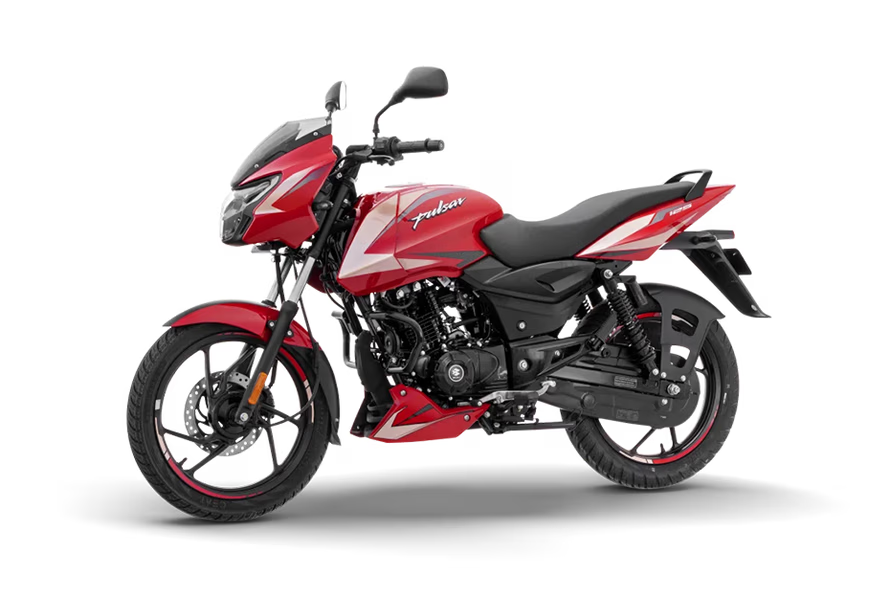
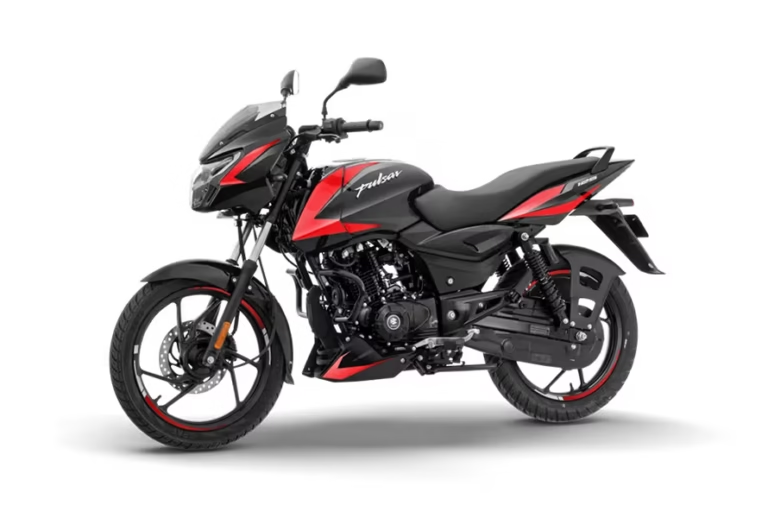
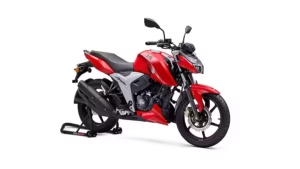
Bajaj Pulsar 125
15.0 pts
Unweighted: 9 advantages
EnginePerformanceDimensionsBrakesTyresFeaturesOther
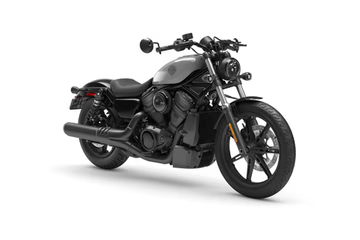
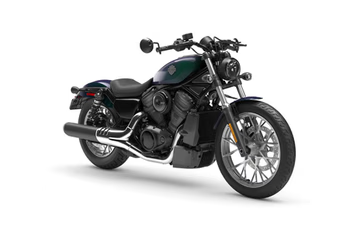
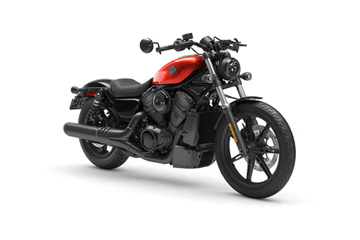
Nightster Special
19.0 pts
Unweighted: 14 advantages
EnginePerformanceDimensionsBrakesTyresFeaturesOther
| Specification | ||
|---|---|---|
Engine Specifications |
||
| Cooling System | Air‑cooled | Liquid‑cooled |
| Displacement | 124.4 cc | 975 cc |
| Engine Type | 4-Stroke, 2-Valve, Twin Spark BSVI Compliant Engine | Revolution Max 975T V‑twin (DOHC, VVT) |
| Power | 8.68 kW (11.8 PS) @ 8500 rpm | 89 HP (66 kW) @ 7,500 rpm |
| Torque | 10.8 Nm @ 6,500 rpm | 95 Nm @ 5,750 RPM |
Performance & Efficiency |
||
| Fuel Tank Capacity | 15 L | 11.7 L |
| Mileage | 51.46 Kmpl | 18.18 Kmpl |
Dimensions & Weight |
||
| Kerb Weight | Split: 144 / Single: 146 | 225 |
| Seat Height | 795 | 715 |
Brakes & Suspension |
||
| ABS | — | Dual‑channel ABS |
| Front Brake | 240 mm Disc | Disc |
| Front Suspension | 30mm Telescopic forks | 41mm SHOWA® Dual Bending Valve conventional forks. Aluminum fork triple clamps. |
| Rear Brake | 130 mm Drum | Disc |
| Rear Suspension | Twin Hydraulic Suspension | Rear suspension is dual outboard, direct-acting (no linkage) emulsion technology shock absorbers with coil springs and a threaded collar for pre-load adjustment. |
Tyres & Wheels |
||
| Front Tyre | 80/100 × 17 Tubeless | 100/90‑19 |
| Rear Tyre | 100/90 × 17 Tubeless | 150/80‑16 |
| Tyre Type | Tubeless | Tubeless |
| Wheel Type | Alloy | Aluminum cast, satin black |
Features & Technology |
||
| Headlight | 12 V HS1 35/35 W | LED |
Other Specifications |
||
| Battery | DC, 12V, 4Ah VRLA | — |
| Bike Image 1 | https://motoautiv.com/wp-content/uploads/2025/07/black-2.avif | https://motoautiv.com/wp-content/uploads/2025/06/Gray-1.avif |
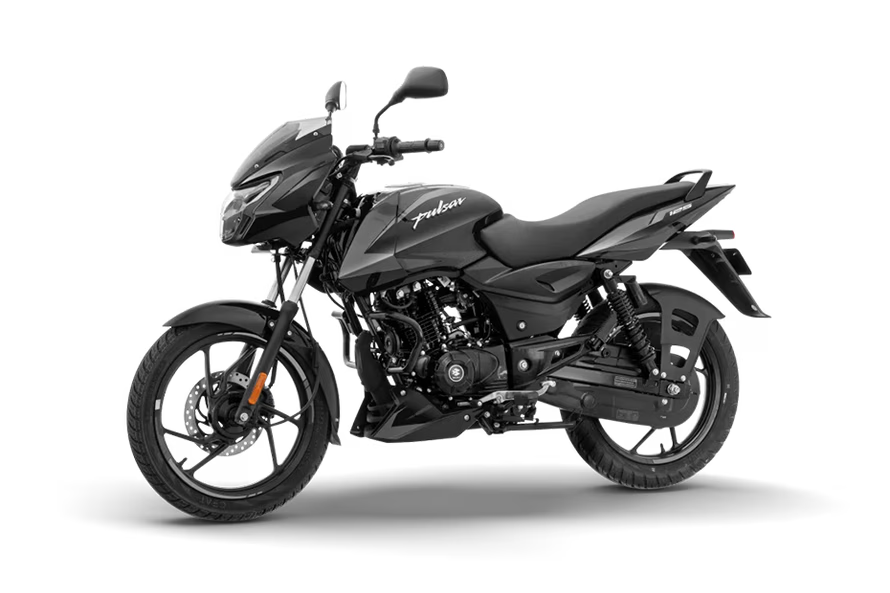
| Bike Image 2 | https://motoautiv.com/wp-content/uploads/2025/07/cyan.avif | https://motoautiv.com/wp-content/uploads/2025/06/snake-venom-1.avif |
| Bike Image 3 | https://motoautiv.com/wp-content/uploads/2025/07/red-3.avif | https://motoautiv.com/wp-content/uploads/2025/06/whiskey-fire-3.avif |
| Bike Image 4 | https://motoautiv.com/wp-content/uploads/2025/07/gold.avif | — |
| Cluster | Fully Digital LCD | Digital TFT (102 mm) |
| Color Options | Racing Red Tan Beige | #A50000, #C7A27C Black Race Red | #111111, #B00000 Black Cyan Blue | #111111, #00A3C7 Black Dark Grey | #111111, #5C6166 Black Gold | #111111, #B08D57 | Whiskey Fire | #A64B22 Vivid Black | #0F0F10 Billiard Gray | #6B7074 Snake Venom | #4F5A3D |
| Cons | The feature list feels basic compared to some newer 125cc motorcycles that offer fully digital displays, Bluetooth connectivity, and additional rider information. Engine vibrations become noticeable at higher RPMs and prolonged highway speeds. The motorcycle carries more weight than several competitors in the segment, which can make low-speed maneuvering feel slightly heavier. Rear suspension comfort can feel firm on badly broken roads, especially when riding solo. The design has evolved gradually over the years, so some buyers may find it less modern than newer rivals. Highway performance remains limited by the engine capacity, particularly when riding with a pillion or luggage at higher speeds. Lighting and instrumentation remain relatively simple on lower variants. | Fuel Capacity Is Modest for the Segment – The 11.7-litre fuel tank is smaller than what many riders expect from a motorcycle intended for highway use, which can limit range between fuel stops. Suspension Can Feel Firm on Broken Roads – Sharp bumps and poorly surfaced roads are transmitted more directly to the rider than on motorcycles with longer-travel suspension. Limited Wind Protection – The motorcycle is sold without a windscreen or fairing, leaving the rider exposed to airflow at sustained highway speeds. Passenger Accommodation Is Secondary – The compact rear seat and overall layout prioritize the rider more than two-up comfort. Engine Heat Becomes Noticeable in Congested Traffic – The liquid-cooled V-twin manages temperature effectively, but heat can still be felt around the rider during prolonged stop-and-go conditions. Storage Options Are Minimal – There are no integrated luggage solutions, and touring capability often requires aftermarket accessories. Traditional Harley Riders May Find It Unfamiliar – The engine character, chassis layout, and overall riding experience differ substantially from Harley-Davidson's classic air-cooled cruiser models. Weight Is Still Higher Than Many Middleweight Roadsters – Although lighter than most Harleys, it remains heavier than several similarly powered naked motorcycles and roadsters. |
| Detailed Overview | The Bajaj Pulsar 125 is a motorcycle that combines the practicality of a commuter bike with styling elements that are usually associated with larger motorcycles. It is designed for riders who want a motorcycle for daily transportation but also prefer a sportier appearance and a slightly more engaging riding experience than a traditional commuter model. The bike carries the familiar Pulsar design language, including a muscular fuel tank, sporty graphics, split grab rails on selected variants, and body panels that give it a larger road presence than many motorcycles in the 125cc category. Power comes from a 124.4cc single-cylinder, air-cooled DTS-i engine paired with a 5-speed gearbox. The engine produces around 11.8 PS of power and 10.8 Nm of torque. The tuning focuses on providing a balance between fuel efficiency and usable performance. In city traffic, the motorcycle feels responsive enough for daily commuting, while the engine also has sufficient power for occasional highway rides. The 5-speed transmission helps maintain smoother engine operation at moderate cruising speeds and allows the rider to make better use of the available power across different road conditions. Fuel efficiency is one of the important aspects of the Pulsar 125. Under normal riding conditions, real-world mileage generally ranges between 50 and 60 km/l, depending on traffic, riding style, road conditions, and maintenance. The motorcycle is equipped with an 11.5-litre fuel tank, which provides a useful riding range and reduces the need for frequent fuel stops during daily commuting. The riding position is designed to balance comfort and control. The handlebar is positioned in a way that allows a slightly sporty feel without putting excessive pressure on the rider’s wrists. The footpegs and seat placement create a natural riding posture that works well for city riding as well as longer daily commutes. The seat is wide enough for both rider and pillion, and the overall ergonomics are intended to support regular use in different riding environments. Suspension duties are handled by telescopic front forks and twin rear shock absorbers. The setup is tuned to absorb common road imperfections such as potholes, speed breakers, and uneven surfaces. This allows the motorcycle to remain comfortable during everyday riding while also maintaining stability on smoother roads. The chassis provides predictable handling characteristics, making the bike easy to maneuver in traffic and around corners at normal riding speeds. Braking performance depends on the variant selected. Higher variants are equipped with a front disc brake, while other versions use drum brakes. All variants use Combined Braking System (CBS), which helps distribute braking force between the front and rear wheels during braking. The motorcycle rides on alloy wheels fitted with tubeless tyres, which add convenience during punctures and routine maintenance. The instrument cluster combines analogue and digital elements. Riders can view information such as speed, fuel level, odometer readings, and other basic ride-related data. The layout remains straightforward and easy to read. Unlike some newer motorcycles in the segment, the Pulsar 125 does not focus heavily on connected technology or smartphone integration. The overall character of the motorcycle is shaped by its combination of commuter-friendly mechanics, sporty styling, practical ergonomics, and everyday usability. Its engine, suspension, braking system, and riding position are designed to handle regular commuting requirements while maintaining the visual identity associated with the Pulsar series. | The Nightster Special is based on the same platform as the standard Nightster, but it adds a number of technology and convenience features that change the motorcycle’s overall specification without altering its core mechanical layout. Within Harley-Davidson’s lineup, it occupies a position that is noticeably different from the company’s traditional cruisers. While the styling retains familiar Harley-Davidson cues such as a low stance, exposed V-twin engine, and compact bodywork, the engineering underneath follows a more contemporary approach. Power comes from the Revolution Max 975T, a 975cc liquid-cooled V-twin engine that serves as a structural component of the motorcycle. Rather than sitting inside a conventional frame, the engine itself forms part of the chassis, with separate frame sections attached directly to it. This design reduces the amount of frame material required and contributes to the motorcycle’s overall rigidity. The engine is paired with a six-speed gearbox and electronic throttle control, allowing rider-assistance systems and ride modes to interact with the powertrain. Unlike Harley-Davidson’s traditional air-cooled V-twins, the Revolution Max engine operates across a wider rev range and uses liquid cooling to manage temperatures. Fuel injection and electronic engine management systems continuously monitor operating conditions, while selectable ride modes adjust throttle response and electronic intervention levels. The engine’s design reflects Harley-Davidson’s broader shift toward modern performance-oriented powertrains. One of the motorcycle’s less obvious design features is its fuel storage arrangement. What appears to be a conventional fuel tank is actually an airbox cover. The fuel itself is stored beneath the seat, helping centralize mass and lower the centre of gravity. The fuel capacity is 11.7 litres, which contributes to the Nightster Special’s compact dimensions and narrow profile. The chassis uses conventional telescopic front forks and twin rear shock absorbers. This setup differs from Harley-Davidson’s Softail models, which conceal the rear suspension beneath the motorcycle. Suspension components are configured to support everyday road use while maintaining the motorcycle’s compact proportions. The wheelbase and overall dimensions are considerably smaller than those of Harley-Davidson’s larger cruiser and touring models, making the Nightster Special one of the more manageable motorcycles in the brand’s range. Braking is handled by a single front disc brake and a rear disc brake, supported by a range of electronic rider-assistance systems. These include ABS, traction control, drag-torque slip control, and cornering-enhanced safety functions. The systems use onboard sensors to monitor motorcycle behaviour and adjust intervention levels when required. The riding position combines elements from both cruisers and standard motorcycles. Mid-mounted foot controls place the rider’s feet beneath the body rather than far forward, while the handlebar position encourages a relatively upright posture. The seat height of approximately 705 mm keeps the rider close to the ground, contributing to accessibility and confidence during low-speed manoeuvres. The most noticeable distinction between the Nightster and Nightster Special is the technology package. A 4-inch TFT display replaces the simpler instrumentation found on the standard model and acts as the centre of the motorcycle’s connectivity features. Through this display, riders can access navigation functions, smartphone connectivity, vehicle information, and ride-mode settings. Cruise control is also included as standard equipment on the Special variant. Taken together, the Nightster Special combines a liquid-cooled Revolution Max engine, compact chassis architecture, modern electronic rider aids, and connected technology features within a motorcycle that remains visually linked to Harley-Davidson’s cruiser heritage. Its specifications reflect a platform developed around contemporary engineering solutions while retaining a design language that remains recognisably Harley-Davidson. |
| Expert Review | he Bajaj Pulsar 125 takes the familiar Pulsar formula and adapts it for riders looking for everyday practicality with a slightly sportier feel than a conventional commuter bike. The 124.4cc engine delivers smooth low and mid-range performance, which suits city traffic and routine commuting, while still providing enough response for occasional highway use. What stands out most is how the motorcycle carries the visual proportions and road presence of a larger bike despite belonging to the 125cc category. The riding posture feels natural for daily use, and the suspension setup is tuned to balance comfort and stability across different road conditions. The motorcycle does not focus heavily on modern electronics or premium features, instead relying on straightforward mechanical simplicity and familiar riding characteristics. Engine refinement remains acceptable for regular use, though vibrations become more noticeable as speeds increase. The overall package is centered around everyday usability, balanced performance, and the established character associated with the Pulsar name., 4.3, MotoAutiv Team | The Nightster Special is an interesting motorcycle because it sits between categories rather than fitting neatly into one. Its proportions and low seat height suggest a cruiser, but the riding experience is influenced just as much by the Revolution Max 975T engine and modern chassis as by traditional Harley-Davidson design cues. The engine is central to the motorcycle's character. It revs more freely than Harley-Davidson's older air-cooled V-twins and encourages riders to use a broader portion of the rev range. Around town, the compact dimensions make the motorcycle feel easier to manage than most of Harley-Davidson's larger models, while the upright riding position and mid-mounted controls create ergonomics that are closer to a standard motorcycle than a conventional cruiser. The Special variant adds a TFT display, connectivity features, cruise control, and a more comprehensive electronics package, but these additions do not fundamentally alter the motorcycle's nature. On longer rides, the absence of wind protection and the relatively small fuel tank become more noticeable, while rough road surfaces can highlight the firm suspension setup. Overall, the Nightster Special feels less like a scaled-down version of Harley-Davidson's traditional cruisers and more like a modern middleweight motorcycle that happens to wear Harley-Davidson styling and branding., 4.3, MotoAutiv Team |
| FAQ (Manual Override) | Q: What engine does the Bajaj Pulsar 125 use? A: It is powered by a 124.4cc single-cylinder, air-cooled, DTS-i engine. Q: How much power does the Pulsar 125 produce? A: The engine produces approximately 11.8 PS of power and 10.8 Nm of torque. Q: What mileage does the Bajaj Pulsar 125 deliver? A: Real-world fuel efficiency generally ranges between 50–60 km/l depending on riding conditions and maintenance. Q: What is the top speed of the Pulsar 125? A: The motorcycle can reach an approximate top speed of around 100–105 km/h. Q: Is the Bajaj Pulsar 125 suitable for highway riding? A: Yes, it can handle occasional highway rides comfortably, although it is primarily designed for city commuting and everyday transportation. Q: Does the Pulsar 125 have a front disc brake? A: Yes, higher variants are equipped with a front disc brake, while some variants are available with drum brakes. Q: Does the Bajaj Pulsar 125 have ABS? A: No, the Pulsar 125 does not offer ABS. It uses CBS (Combined Braking System). Q: What suspension setup does the Pulsar 125 use? A: The motorcycle uses telescopic front forks and twin rear shock absorbers. Q: What is the fuel tank capacity of the Pulsar 125? A: The motorcycle comes with a 11.5-litre fuel tank. Q: What is the kerb weight of the Bajaj Pulsar 125? A: Depending on the variant, kerb weight is approximately 140–142 kg. Q: Does the Pulsar 125 use tubeless tyres? A: Yes, all variants come equipped with tubeless tyres. Q: Is the Bajaj Pulsar 125 beginner-friendly? A: Yes, the motorcycle offers predictable power delivery, comfortable ergonomics, and manageable performance, making it suitable for new riders. Q: Does the Pulsar 125 have Bluetooth connectivity? A: No, the standard Pulsar 125 does not offer Bluetooth connectivity or smartphone integration. Q: What type of instrument cluster does the Pulsar 125 get? A: The motorcycle uses a semi-digital instrument cluster with an analogue tachometer and digital information display. Q: Is the Bajaj Pulsar 125 a commuter motorcycle or a sports bike? A: The Pulsar 125 is generally classified as a sporty commuter motorcycle. It combines commuter-bike practicality with styling and riding characteristics inspired by larger Pulsar models. | Q: What engine powers the Nightster Special? A: It uses Harley-Davidson's 975cc Revolution Max 975T liquid-cooled V-twin engine paired with a 6-speed gearbox. Q: How is the Nightster Special different from the standard Nightster? A: The Special adds a 4-inch TFT display, smartphone connectivity, navigation functions, cruise control, additional ride modes, and a more comprehensive electronics package. Q: Is the Nightster Special liquid-cooled? A: Yes. Unlike Harley-Davidson's traditional air-cooled cruisers, it uses a liquid-cooled V-twin engine. Q: Does the Nightster Special have cruise control? A: Yes. Cruise control is standard equipment on the Special variant. Q: Does it have ride modes? A: Yes. Riders can select from multiple ride modes, including Road, Rain, Sport, and Custom settings. Q: What is the fuel tank capacity? A: The Nightster Special carries 11.7 litres of fuel. Q: What is the seat height? A: The seat height is approximately 705 mm, making it one of the more accessible motorcycles in Harley-Davidson's lineup. Q: Does the Nightster Special support smartphone connectivity? A: Yes. The TFT display supports Bluetooth connectivity, navigation-related functions, and mobile device integration. Q: Does it have traction control and cornering ABS? A: Yes. The motorcycle includes traction control, ABS, drag-torque slip control, and cornering-enhanced rider-assistance systems. Q: What is the kerb weight? A: The Nightster Special weighs approximately 225 kg in running condition. Q: Is it comfortable for long-distance touring? A: It can handle highway travel, but the compact fuel tank, lack of wind protection, and limited luggage options mean it is not designed as a dedicated touring motorcycle. Q: Is the Nightster Special beginner-friendly? A: The low seat height and manageable dimensions help accessibility, but the performance and weight make it better suited to riders with some experience. Q: How is it different from the Sportster S? A: The Nightster Special uses the smaller 975T engine and adopts a more balanced approach, while the Sportster S focuses more heavily on performance and uses the larger 1250T powertrain. |
| Fuel System | Fuel Injection | Fuel Injection |
| Price Variants | Single Seat | 92170 Split Seat | 94229 Neon Single Seat | 107675 | | 1538000 |
| Pros | The 124.4cc engine offers stronger performance than most basic commuter motorcycles, making overtakes and daily city riding feel easier without significantly affecting fuel efficiency. The motorcycle retains the familiar Pulsar design language, giving it a larger and more muscular appearance than many other bikes in the 125cc segment. Ride quality is well balanced for everyday use. The suspension setup handles potholes, speed breakers, and uneven roads reasonably well while maintaining stability at regular commuting speeds. The riding position strikes a good balance between comfort and sportiness. The handlebar and footpeg placement allow comfortable daily commuting without feeling overly upright or aggressive. Fuel efficiency remains practical for daily use, with real-world mileage generally ranging between 50–60 km/l depending on riding conditions. The front disc brake variant provides better stopping confidence than many entry-level commuter motorcycles that rely entirely on drum brakes. Spare parts availability, service network reach, and maintenance costs are generally manageable due to the widespread presence of the Pulsar lineup across India. The motorcycle feels stable at moderate highway speeds compared to many lightweight commuter-focused alternatives. | The Revolution Max 975T Engine – Unlike Harley-Davidson's traditional air-cooled V-twins, the liquid-cooled 975cc engine is designed to operate across a wider rev range. It responds quickly to throttle inputs and feels comfortable in both city traffic and open-road riding. Compact Dimensions by Harley-Davidson Standards – The Nightster Special is noticeably smaller and lighter than the company's cruiser and touring models, making it easier to manoeuvre in everyday situations. Low Seat Height Creates an Accessible Riding Position – Despite its modern chassis and engine, the motorcycle retains a low seat height that helps riders feel connected to the motorcycle at stops and low speeds. Modern Electronics Package – Ride modes, traction control, cornering-enhanced ABS, drag-torque slip control, cruise control, and rider-assistance systems are integrated into the platform. TFT Display Adds Connectivity Features – The Nightster Special receives a colour TFT instrument screen with smartphone connectivity, navigation support, and expanded vehicle information. Neutral Riding Ergonomics – Mid-mounted foot controls and a relatively upright handlebar position create a riding posture that differs from traditional forward-control cruisers. More Agile Than Most Harley-Davidson Cruisers – The combination of its weight, wheelbase, and chassis design allows the motorcycle to change direction more readily than larger Harley-Davidson models. Minimalist Design Approach – Exposed mechanical components, compact bodywork, and a short rear section give the motorcycle a clean and uncluttered appearance. |
| Starter | Electric & Kick | Electric |
| Transmission | 5‑speed | 6‑speed manual |