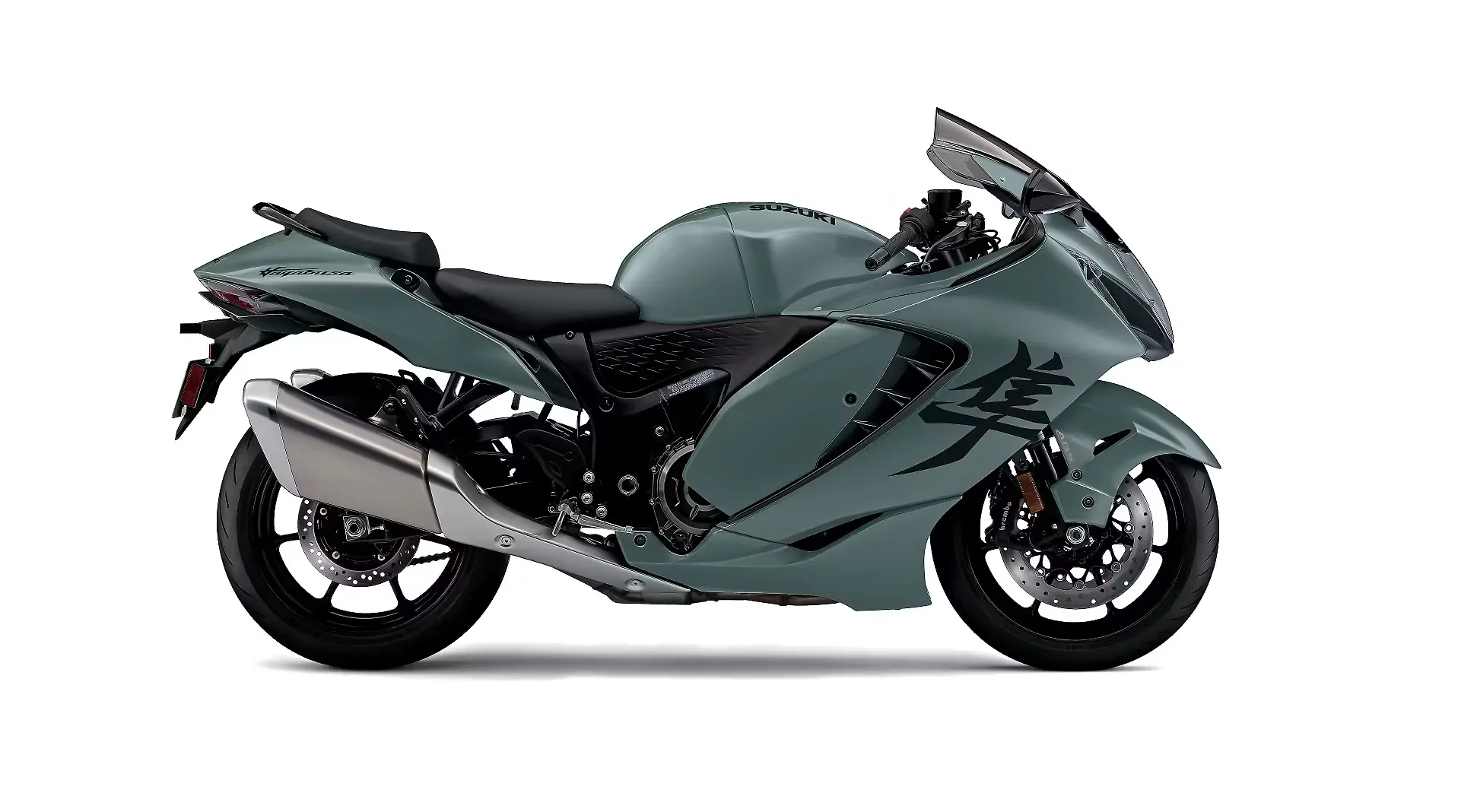
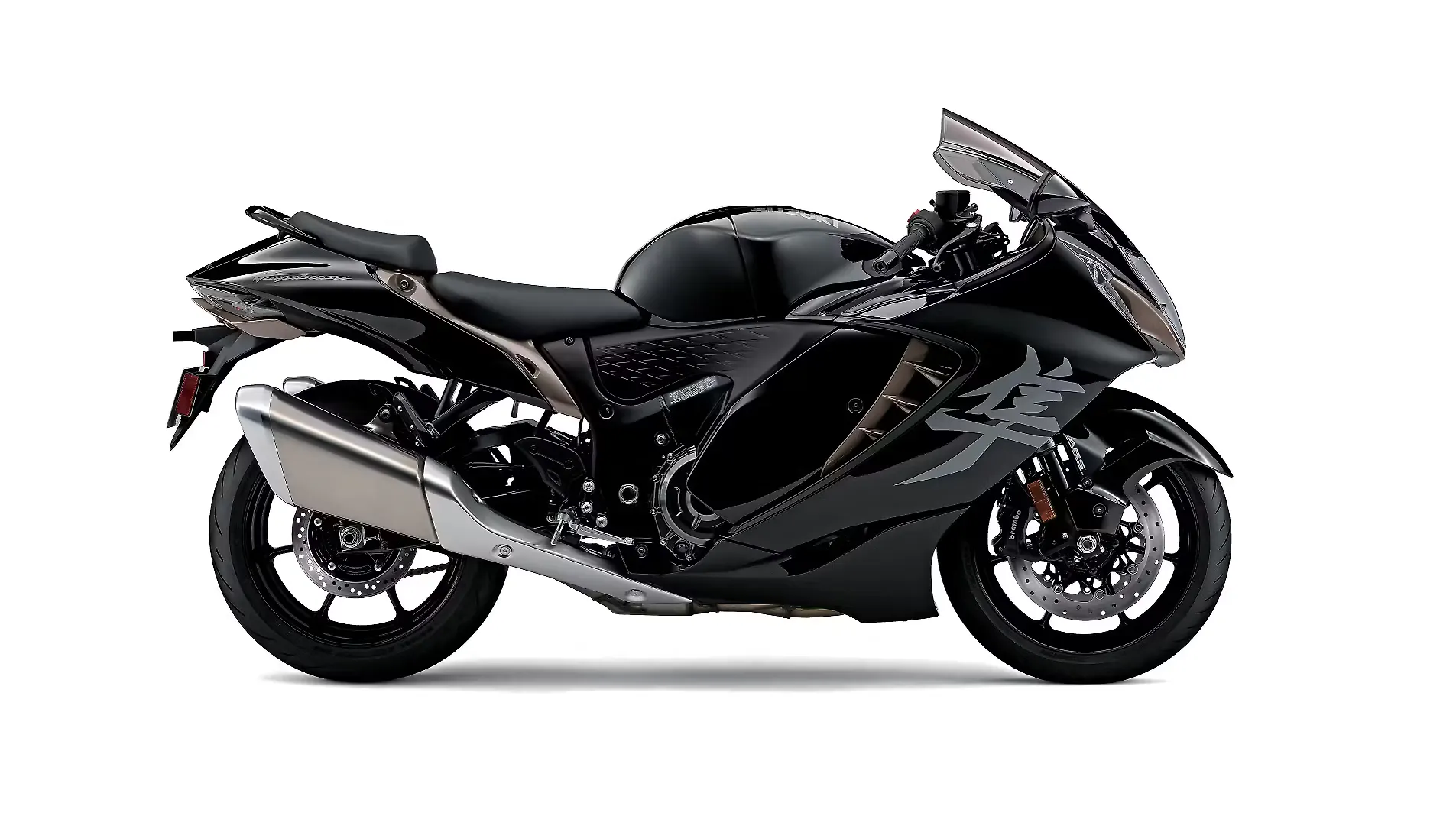
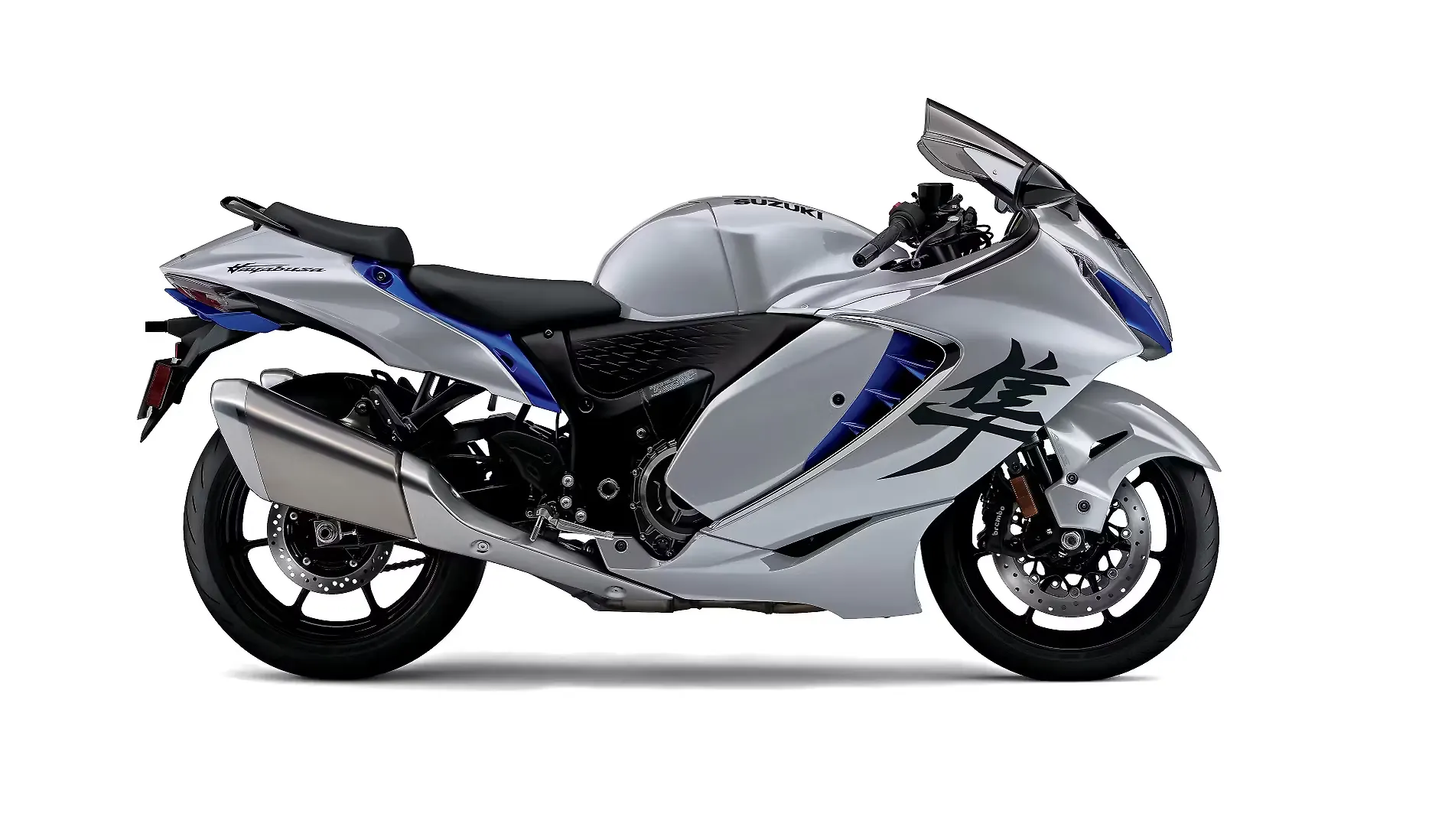
Riding the Hayabusa feels like holding a full-blown super-sport bike in your hands — it’s serious, but not brutal. At its heart sits a 1,340 cc, 4-stroke, liquid-cooled, DOHC inline-four engine.
With a bore/stroke of 81.0 mm × 65.0 mm and a relatively high compression ratio of 12.5:1, this engine isn’t about meek city-cruising — it’s about confident thrust.
What that means when you twist the throttle: a surge of torque and power, even before you’re deep into the rev-range. The newer design — with lighter pistons, refined internals, improved lubrication passages, and a “Twin Swirl Combustion Chamber” — helps make the power smoother, more usable and reliable — not just explosive at high revs.
On paper, power output is rated at 190 bhp at 9,700 rpm, with peak torque of 150 Nm at 7,000 rpm.
What’s special is that this power and torque are tuned so the engine behaves well even in everyday riding — not just on open highways. The ride-by-wire throttle, a 6-speed constant mesh transmission and a wet, multi-plate slipper/assist clutch help make gear shifts smooth and predictable, whether you are crawling in traffic or throttle-on for a highway burst.
You won’t miss performance on the open road — Hayabusa easily unleashes enough grunt to surge forward cleanly from mid-range, letting overtakes and roll-on acceleration happen without fuss. But thanks to the way Suzuki tuned the intake, combustion, and throttle control, it also avoids the jerkiness some high-power bikes suffer from — meaning daily commuting or city bursts become more manageable than a “raw” race-focused bike.
Movement and posture on the Hayabusa reflect its dual nature: part super-sport beast, part (almost) grand tourer. Overall, the bike spans 2180 mm in length, 735 mm in width and 1165 mm in height, with a wheelbase of 1480 mm.
A kerb weight of 266 kg and a seat height of 800 mm give it a substantial feel — you know you’re riding something serious.
The fuel tank holds 20 litres, which on long rides gives you decent range.
What that translates to in real life: on smooth roads and highways, the long wheelbase and weight lend the Hayabusa a stable, planted feel even at high speeds. On city roads, while it’s more weighty than a typical commuter bike, the slipper clutch, broad low-to-mid power band, and smooth throttle help manage manoeuvring and stop-and-go traffic without turning it into a monster.
The suspension setup reflects a nice balance for a big sportbike: front uses inverted telescopic forks (oil-damped, coil spring), rear has a link-type single shock (coil spring, oil-damped) — both capable of absorbing road irregularities while giving predictable feedback.
On an Indian road — where surfaces can vary — this setup helps smoothen things out, so you get a ride that’s firm enough for sporty riding but forgiving enough for real-world roads.
Braking and tyres are equally serious. Up front there’s a twin-disc setup with top-tier Brembo Stylema® calipers, and a single-disc Nissin caliper at the rear. Both are ABS-equipped. The wheels wear tubeless tyres (front 120/70ZR17, rear 190/50ZR17) which together with the chassis and suspension offer strong grip and stability — important when you push hard, lean into curves or deal with unpredictable road surfaces.
Where Hayabusa really steps ahead of “raw-power” bikes is its suite of electronics. The bike gets a comprehensive control package via its intelligent ride system: adjustable power modes (for sharp response or gentle city-friendly throttle), a bi-directional quick-shifter allowing clutchless up and down shifts, engine-brake control options, traction control that uses a 6-axis IMU to monitor lean/pitch/yaw (i.e. works even in corners), anti-lift (to prevent wheelies under heavy throttle), launch control, slope-dependent ABS, and more.
In practical terms, this means that whether you’re “going fast” on a highway sweep, carving corners, or just commuting daily — the Hayabusa adapts. If roads are rough or conditions tricky, softer throttle maps and traction/ABS interventions give you confidence; if you want raw performance, the electronics let you tap it with assurance. It’s a surprising but welcome versatility — making Hayabusa less of a “race-only toy” and more of a real-world (albeit high-performance) bike you can live with.
To sum up: riding Hayabusa feels like commanding a beast that knows how to behave. It has the grunt and top-end potential of a superbike, but thanks to Suzuki’s engineering — in engine design, chassis balancing, suspension tuning, braking, tyres and electronics — it’s also manageable enough for non-racetrack roads. On open highways you’ll feel its power truly — but even in city traffic or on back-roads, you won’t be fighting the bike; instead, you’ll be in control, enjoying its presence.