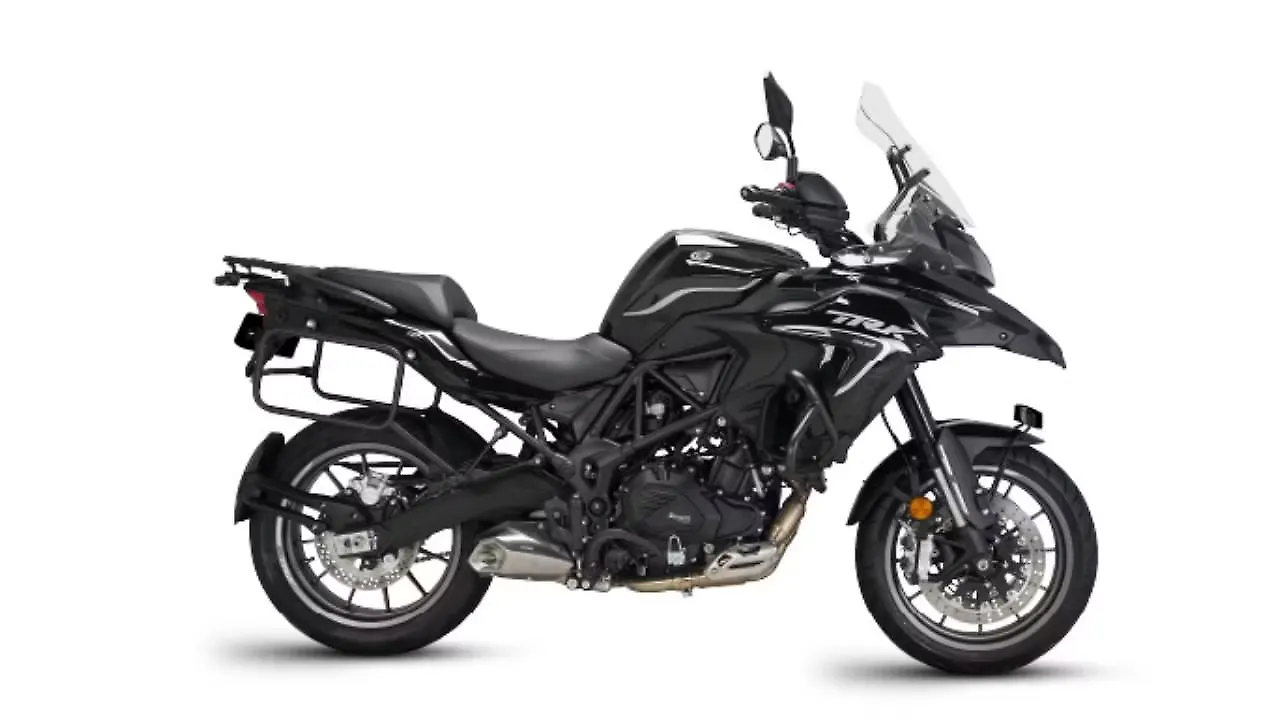
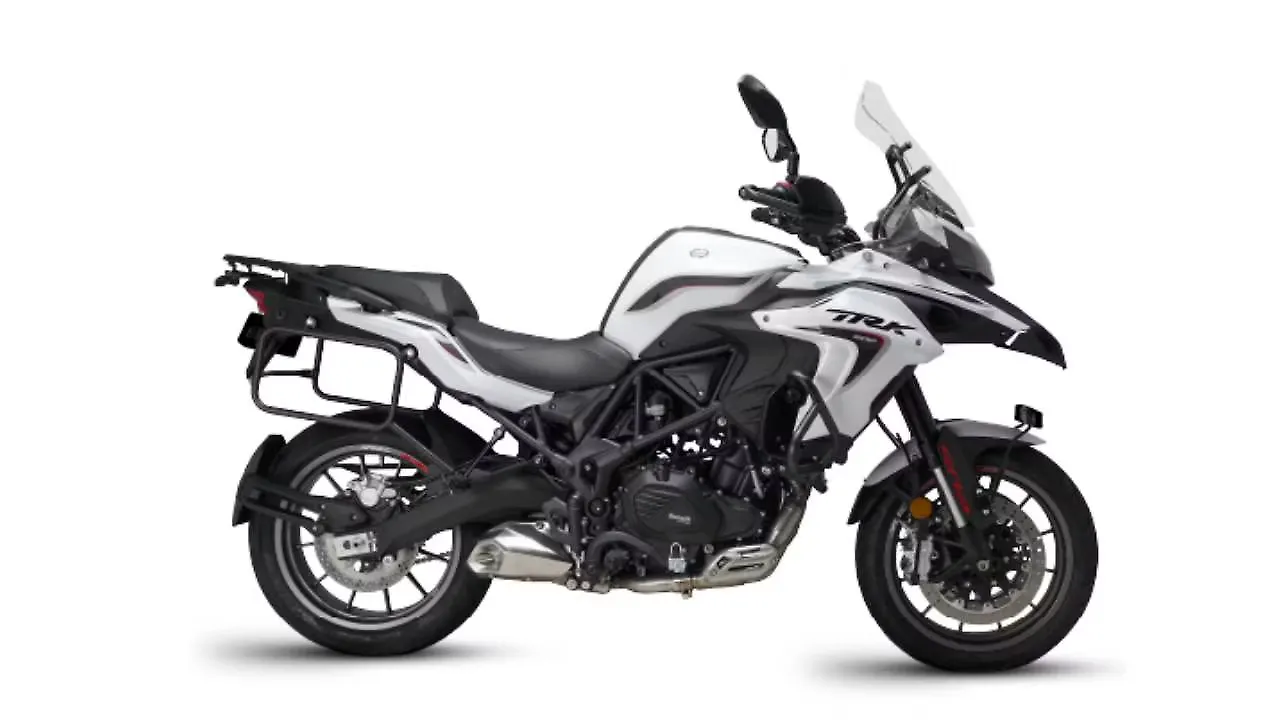
You swing a leg over the TRK 502 and you’re immediately aware that this is meant to be more than a city commuter; there’s a sense of presence, of readiness for longer roads. Under the tank sits a 500 cc, liquid-cooled, parallel-twin engine, running a DOHC layout with 8 valves. The bore and stroke (69 × 66.8 mm) and a compression ratio of 11.5:1 tell you that this engine is tuned for a healthy balance — it’s neither peaky and fragile, nor a torquey grinder. What you get instead is a smooth, flexible powerplant that builds revs steadily, giving enough grunt without being nervous or rough. At its peak, it delivers about 46.8-47.5 horsepower at 8,500 rpm and 46 Newton-metres of torque at around 6,000 rpm.
That output, in plain riding, doesn’t mean blazing superbike sprints. It means confidence: enough urge to overtake on the highway, enough midrange torque for loaded touring or two-up rides, and smooth throttle response for city or mixed-road use. The 6-speed gearbox with chain final drive feels just right — shifts are predictable and the clutch (wet multi-plate / slipper clutch depending on region) handles starts and slow manoeuvres without fuss.
Because this is meant for touring and everyday versatility, the chassis and suspension are built accordingly. A steel trellis frame acts as the backbone — sturdy enough to keep the bike stable at speed, yet with a bit of compliance to soak up normal road irregularities. Up front, there’s an upside-down telescopic fork (about 50 mm) with around 140 mm travel; at the rear a preload- and rebound-adjustable mono-shock with around 45 mm travel. What that gives on road is a setup that doesn’t punish you over bad surfaces but remains planted: potholes, imperfect tarmac or rough stretches are dealt with gracefully, while the bike stays composed even when you ask for speed or load it up with luggage and pillion.
Physically the TRK 502 is substantial — long and purposeful. Its overall length is about 2200–2220 mm, width around 915 mm, and height roughly 1450 mm (slightly more depending on variant). The wheelbase of 1505 mm gives it stable tracking on highways and at speed, but that length and mass mean low-speed manoeuvres require some care — U-turns, tight corners, or dense traffic will need respect and a bit of strength. The seat height — roughly 800-835 mm depending on model/market — places you in a commanding riding posture: good for visibility and control, but may feel tall for shorter riders. Ground clearance around 190 mm means you’re also not too worried about speed-bumps or rough rural surfaces.
When it comes to stopping and safety, TRK 502 doesn’t leave much to complaint. Twin 320 mm discs up front (with 4-piston calipers) and a 260 mm disc at the rear — both with dual-channel ABS — give you solid braking power and modulation. In everyday traffic or loaded touring, you get confident, progressive braking rather than abrupt grabs or fade, which is exactly what you want when you’re carrying luggage or a pillion.
Fuel-wise, the 20-litre tank (with a bit of reserve) gives a decent riding range. Fill up and you can reasonably expect to tackle long rides or highway runs without constant fuel stops — an important detail if you plan to use this bike for touring or inter-city travel. Combined with the engine’s fuel injection and tuning, the balance between performance and range is well-struck.
On the feature front, the TRK 502 comes decently equipped for its class. The instrument console mixes analogue and digital readouts (tachometer + digital speedo/fuel/odometer/trip) — enough to give you all the essential info clearly without overcomplicating the dashboard. Lighting, electrics and ergonomics are oriented toward usability: the riding position is upright, comfortable for long hours; footpegs and rider triangle are such that you don’t feel cramped even after a few hours of cruise. For everyday commuting, that means less fatigue; for touring, it means more hours in the saddle without strain.
When you take it out on the open road — open highway, winding roads, rolling hills — the TRK 502 reveals what it is built for: stability, comfort, and controlled performance. It doesn’t feel underpowered even when carrying luggage or with a pillion; the twin’s smooth torque curve helps you manage traffic or overtakes with ease. On rough or uneven roads, the suspension soaks up the imperfections, and the frame feels secure. The overall setup makes it a comfortable, confident companion for trips that are more than just short city commutes.
But there are trade-offs. Because the bike is fairly heavy and long, jockeying through tight city traffic or congested lanes means you’ll notice the bulk — quick zigzags or tight U-turns are not the bike’s forte. Seat height and weight can be challenging for shorter riders or those new to big bikes. The power-to-weight ratio is modest, so while it’s confident for touring or leisure riding, it doesn’t give the “sportbike thrill.” If you push it hard — say, frequent hard acceleration with two-up + luggage — you may find that intense use exposes the limits of a 500 cc twin configured for balance, not brute power.
Overall, the TRK 502 feels like what you’d expect from a middleweight touring-oriented motorcycle — not a race-bred machine, not a lightweight commuter, but a capable all-rounder that lets you ride relaxed yet with enough substance. It’s ideal for those who want a single bike to handle everything: daily commuting when needed, weekend adventures, city-to-city travel, even occasional touring with a pillion and luggage, all without demanding sport bike instinct or compromising comfort.