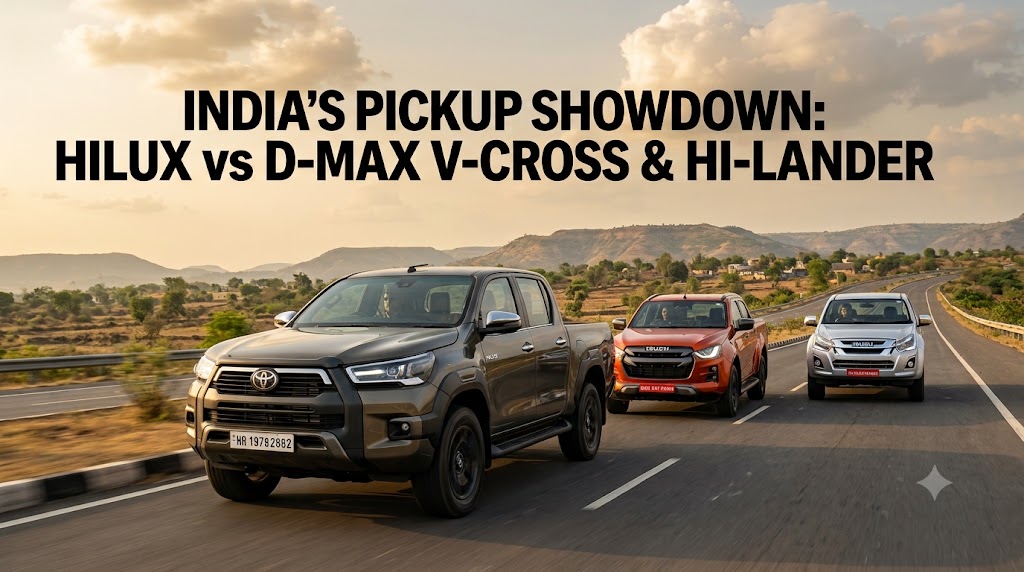
Until February 2026, “lifestyle pickup truck” in India meant a two-horse race. Autocar India’s own D-Max V-Cross buying guide puts it bluntly: “The D-Max V-Cross is the only direct rival to the Toyota Hilux.” That framing has quietly gone out of date. Isuzu’s February 2026 update gave the entry-level D-Max Hi-Lander a torque-converter automatic gearbox for the first time ever — a genuine third option for buyers who want pickup-truck presence without the V-Cross’s 4×4-only premium or the Hilux’s flagship price tag.
This guide treats it as the real three-way fight it now is: Toyota Hilux, Isuzu D-Max V-Cross, and the newly-automatic Isuzu D-Max Hi-Lander, compared on price, power, off-road ability, running costs and — most importantly — who each one is actually for.
Quick answer: if you want maximum power and genuine 4×4 capability and can stretch the budget, the Toyota Hilux (₹28.52–36 lakh) wins outright. If you want real off-road ability for meaningfully less money, the Isuzu D-Max V-Cross (₹25.50–30.28 lakh, 4×4-only since Feb 2026) is the sweet spot. If you just want pickup-truck looks, road-going comfort and the lowest price, the Isuzu D-Max Hi-Lander (from ~₹21.05 lakh) delivers that — but it is rear-wheel drive only, with no 4×4 or low-range option at all.
Why This Is Now a Three-Way Fight, Not Two
Every major comparison piece published before this year — Autocar India, evo India, and independent blogs alike — frames this segment as Hilux versus V-Cross and stops there. That gap exists because the Hi-Lander, until recently, was a bare-bones, manual-only workhorse that nobody cross-shopped against two flagship lifestyle trucks.
Isuzu changed that in February 2026. The Hi-Lander now gets a torque-converter automatic — its first ever — plus cruise control, a rear parking camera, power-folding ORVMs and a proper touchscreen, at a starting price of roughly ₹21.05 lakh ex-showroom, according to DriveSpark’s coverage of the launch. That is roughly ₹4–4.5 lakh below the cheapest V-Cross, and it removes the biggest practical objection — no automatic gearbox — that kept the Hi-Lander out of the “lifestyle pickup” conversation. It has not, however, gained four-wheel drive; more on that under Drivetrain below.
The result: three trucks, three distinct price-and-capability tiers, and a genuine buying decision that none of the existing two-way comparisons help you make.
Price & Variants Compared
Ex-showroom Delhi prices, current as of July 2026:
| Truck | Entry Price | Top Price | Transmission | Drivetrain |
|---|---|---|---|---|
| Isuzu D-Max Hi-Lander | ~₹21.05 lakh | ~₹23.60–23.88 lakh | 6MT / 6AT (new) | RWD only |
| Isuzu D-Max V-Cross | ₹25.50 lakh | ₹30.28 lakh | 6MT / 6AT | 4×4 only |
| Toyota Hilux | ₹28.52 lakh | ₹36.00 lakh (Black Edition ₹35.85 lakh) | 6MT / 6AT | 4×4 (H4/L4) |
The Hi-Lander’s pricing has a small wrinkle worth flagging honestly rather than picking one number: CarDekho lists the range as ₹21.50–23.60 lakh, while CarWale and DriveSpark put the base price at ₹21.05 lakh with the top automatic around ₹23.60–23.88 lakh. The gap is a few tens of thousands of rupees — not enough to change the buying decision, but enough that you should treat any single figure as approximate and confirm with your local dealer.
Two GST-related dates matter here. First, GST 2.0, effective 22 September 2025, scrapped the compensation cess on most vehicle categories, which pushed list prices down industry-wide (see our full GST 2.0 explainer for how that played out across segments). Second — and this is the part competing comparisons miss — Toyota then raised Hilux prices again in April 2026. Sources don’t agree on the exact quantum: Cars24 reports variant-specific hikes of ₹49,600 on the STD trim and ₹62,700 on the High MT/AT trims (with the Black Edition left untouched at ₹35.85 lakh), while GaadiKey describes a flatter ~₹56,000 (1.75%) rise across the board. Whichever number is precise, the direction is clear: some of the GST 2.0 saving on the Hilux specifically has since been clawed back.
Engine & Performance Compared
| Spec | Hi-Lander | V-Cross | Hilux |
|---|---|---|---|
| Engine | 1898cc turbo-diesel | 1898cc turbo-diesel | 2755cc turbo-diesel |
| Power | ~160-163 PS | 163 PS (120kW) @ 3600rpm | 204 PS (150kW) @ 3400rpm |
| Torque | 360 Nm | 360 Nm @ 2000-2500rpm | 420 Nm (MT) / 500 Nm (AT) |
The Hilux is the clear power leader here by a wide margin — its 2755cc engine, per Toyota’s official India showroom page, outguns the shared Isuzu 1898cc unit by 41-44 PS and up to 140 Nm on the automatic. That is the single biggest reason it costs what it costs.
The V-Cross and Hi-Lander share the same basic 1898cc engine, but you’ll see the power figure quoted differently depending on the source, and it deserves an honest reconciliation rather than a silently-picked number. Isuzu’s own official India specification page for the V-Cross states 163 hp (120kW) at 3600rpm — that is our anchor figure. For the Hi-Lander, no dedicated Isuzu India spec page could be reached this run (isuzu.in/hi-lander returns a 404), so its power figure comes from secondary sources: CarDekho lists 160.92 bhp (rounded to “163 hp” in the same breath), CarWale lists 161 bhp, and DriveSpark’s launch report says 160 hp. In practical terms this is the same tune of the same engine with rounding differences between sources — treat “160-163 PS” as one figure, not three different engines.
Drivetrain & Off-Road Ability
This is the distinction that matters most, and the one buyers most often assume incorrectly: the Isuzu D-Max Hi-Lander is rear-wheel drive only. There is no 4×4 option, no low-range transfer case, and no off-road differential lock on the Hi-Lander, at any price point or variant. CarWale’s own Hi-Lander FAQ is unambiguous: “No, Isuzu Hi-Lander doesn’t come with four wheel drive option.” CarDekho’s listing confirms the same 2WD-only configuration across both the manual and automatic Hi-Lander variants.
That makes the Hi-Lander a road-going lifestyle pickup, full stop — closer in spirit to a bakkie-styled saloon than to a genuine off-roader. If your buying criteria include mud, sand, river crossings or serious unpaved terrain, the Hi-Lander is not built for that job, regardless of how rugged it looks.
The V-Cross and Hilux, by contrast, are both genuine off-roaders, with a real capability gap between them. The V-Cross uses a shift-on-the-fly 4WD system with an auto-locking differential, standard on every 2026 variant now that the old 4×2 has been discontinued. The Hilux goes further: full-time H4/L4 (high and low range) 4WD, an electronic differential lock, and an auto limited-slip differential — the same off-road hardware set that underpins the Innova Crysta/Fortuner IMV platform it shares its bones with.
Dimensions, Payload & Practicality
| Spec | V-Cross | Hilux |
|---|---|---|
| Length x Width x Height | 5295 x 1860 x 1785mm | 5325 x 1855 x 1815mm |
| Wheelbase | 3095mm | Not independently confirmed this run |
| Fuel tank | 55 litres | 80 litres |
| Kerb weight | 1930-1995kg | Not independently confirmed this run |
| GVWR | 2510kg | Not independently confirmed this run |
The Hilux’s 80-litre fuel tank versus the Isuzu twins’ 55 litres is a genuinely practical difference on long highway runs — roughly 45% more range between fill-ups, useful if your routes take you away from fuel stations for stretches, which is exactly the kind of trip this class of vehicle gets bought for. The Hi-Lander, being the lightest of the three thanks to its RWD-only layout with no transfer case or front differential hardware, should also carry a modest efficiency advantage — addressed under Running Costs below. We did not carry over unverified payload/GVWR figures for the Hilux this run since we could not independently re-confirm them against a fetched source; if payload capacity is decisive for your use case, verify the exact number with your dealer before buying.
Features & Technology Compared
| Feature | Hi-Lander (AT) | V-Cross (Z Prestige) | Hilux |
|---|---|---|---|
| Touchscreen | 7-inch, Android Auto/CarPlay | 10.3-inch, wireless Android Auto/CarPlay | Touchscreen w/ e-Call, Android Auto/CarPlay |
| Camera | Rear parking camera | 360-degree camera | Not listed as standard on all grades |
| Airbags | Dual front | Up to 6 (AT) | 7 SRS airbags |
| Climate control | Automatic (AT) | Automatic + rear vents | Dual-zone automatic |
| Cruise control | Yes (AT only, new) | Yes | Yes |
The Hi-Lander’s February 2026 update is a genuine step up from its old bare-bones spec sheet — cruise control, a rear parking camera and power-folding mirrors arrive alongside the automatic gearbox for the first time. It remains, however, the most basic of the three on outright feature count: no 360-degree camera, a smaller 7-inch screen, and dual airbags rather than six or seven.
The V-Cross Z Prestige is the features leader relative to its price, packing a 10.3-inch wireless touchscreen, 360-degree camera and up to an 8-speaker system — kit you’d expect on something costing more than the Hilux, not less. The Hilux still leads on outright safety hardware with 7 SRS airbags, Vehicle Stability Control, Hill-Start Assist, Downhill Assist Control and Active Traction Control as standard.
Fuel Efficiency & Running Costs
| Truck | ARAI-claimed mileage |
|---|---|
| Isuzu D-Max Hi-Lander | No official figure independently confirmed this run — expected close to or marginally better than V-Cross AT’s 12.4 kmpl (estimate, not sourced directly) |
| Isuzu D-Max V-Cross (MT / AT) | 14.4 kmpl / 12.4 kmpl |
| Toyota Hilux | 10.0 kmpl |
The Hilux’s bigger, more powerful engine costs real money at the pump: at an ARAI-claimed 10.0 kmpl against the V-Cross’s 14.4 kmpl (MT) / 12.4 kmpl (AT), that’s roughly 20-30% worse fuel efficiency depending on gearbox. No official ARAI figure for the Hi-Lander specifically could be independently verified this run — treat any specific number you see quoted elsewhere with caution; expect it to land close to the V-Cross AT figure given the shared engine, possibly a touch better given the Hi-Lander’s lighter RWD-only kerb weight.
Illustrative 3-year running cost (fuel only, ~15,000 km/year, diesel at an assumed ~₹90/litre — figures are a calculation model, not a sourced claim):
| Truck | Approx. annual fuel spend | Approx. 3-year fuel spend |
|---|---|---|
| Hi-Lander (est. ~12-13 kmpl) | ~₹1.04-1.13 lakh | ~₹3.1-3.4 lakh |
| V-Cross AT (12.4 kmpl) | ~₹1.09 lakh | ~₹3.27 lakh |
| Hilux (10.0 kmpl) | ~₹1.35 lakh | ~₹4.05 lakh |
Beyond fuel, service and parts access is worth checking locally before you commit to either of these relatively low-volume pickups: authorised sales-and-service coverage for both Toyota and Isuzu thins out well outside major cities, so confirm your nearest service centre for whichever truck you’re considering rather than assuming either brand has broad reach by default.
Real-World Ownership: What Owners Say
Transparency note: this section was meant to draw on Team-BHP’s long-running Hilux ownership threads (a 20,000km daily-driving report and a 7,000km review), which the brief for this piece specifically flagged as sources. Both returned an HTTP 403 (access blocked) on every fetch attempt during this research pass, so — per this site’s no-fetch-no-cite rule — neither is quoted or cited here; they are listed as could-not-verify in this article’s source ledger rather than attributed with invented text.
What we can verify independently: aggregator-tracked mileage data (Cars24, 91Wheels) puts real-world Hilux economy in the same broad band as its ARAI figure, and consistently below the V-Cross’s — consistent with a heavier, more powerful vehicle. The practical trade-off owners describe across multiple listings is a familiar one for this class of vehicle: the Hilux is bought for capability and highway presence, not for frugality, and buyers who prioritise fuel cost over outright power and off-road ability tend to look at the V-Cross or Hi-Lander instead.
One more ownership factor worth weighing alongside the spec sheet: service network reach. Neither the Hilux nor the D-Max twins sell in mainstream-SUV volumes in India, so authorised sales-and-service coverage for both brands is comparatively thin outside major cities — this isn’t a case where either brand has a clear, independently-verified edge over the other. If you live or travel well outside a metro, call your nearest service centre for both brands and confirm parts availability and turnaround time before committing, rather than assuming coverage based on brand size alone.
Pros & Cons At a Glance
Toyota Hilux — Pros: most powerful engine (204 PS/500 Nm), genuine H4/L4 4×4 with diff lock, largest fuel tank, strongest safety kit (7 airbags). Cons: highest price by far (₹28.52-36 lakh), worst fuel efficiency (10 kmpl), hit by an April 2026 price rise on top of GST 2.0 gains.
Isuzu D-Max V-Cross — Pros: genuine 4×4 (now standard on every variant), best features-per-rupee (10.3-inch screen, 360 camera on Prestige), meaningfully cheaper than Hilux, better mileage. Cons: down 41+ PS on the Hilux, no version left under 4×2 for buyers who don’t need 4×4, mid-pack pricing still a stretch over the Hi-Lander.
Isuzu D-Max Hi-Lander — Pros: cheapest of the three by a wide margin (~₹21.05 lakh), first-ever automatic gearbox now available, lightest and likely most fuel-efficient, big feature step-up from before. Cons: no 4×4 or low-range at all, most basic feature set of the three, smaller touchscreen, fewer airbags.
Which One Should You Buy? Verdict by Buyer Type
There is no single “best overall” answer here — the right truck depends entirely on what you actually need from it. Here’s a quick persona matrix before the detailed reasoning below:
| You are… | Best pick | Why |
|---|---|---|
| A serious off-roader who tows or does real 4×4 trails | Toyota Hilux | Only truck with H4/L4 low-range + auto LSD; most power/torque |
| Want genuine 4×4 without flagship pricing | Isuzu D-Max V-Cross | 4×4-only since Feb 2026, auto-locking diff, best tech-per-rupee |
| Want pickup looks + automatic, purely for road use | Isuzu D-Max Hi-Lander | Cheapest by far, first-ever AT, but zero off-road hardware |
| Budget-conscious, need genuine 4×4 on a shoestring | None of these three | Consider a used V-Cross 4×2 (discontinued new) or a compact 4×4 SUV instead |
Buy the Toyota Hilux if: you want the most power and the most capable 4×4 system in this class, you regularly go somewhere a low-range transfer case actually matters, and budget is a secondary concern to capability. It’s the flagship for a reason, and the April 2026 price bump doesn’t change that positioning — it just makes the gap to the V-Cross wider.
Buy the Isuzu D-Max V-Cross if: you want genuine off-road ability — real 4×4, an auto-locking diff — without paying Hilux money, and you value features (that 10.3-inch screen, the 360 camera) more than outright power. For most lifestyle-pickup buyers who actually go off-road occasionally, this is the sensible middle ground.
Buy the Isuzu D-Max Hi-Lander if: you want pickup-truck looks, load-bay practicality and now an automatic gearbox, at the lowest entry price in this comparison — and you do not need 4×4 or low-range capability. If off-roading is even a maybe for you, this is the wrong truck; if it’s strictly a road-going lifestyle purchase, it’s the most sensible one on paper.
Buyers cross-shopping this segment against other 4×4 lifestyle vehicles should also see our Mahindra Thar vs Thar Roxx comparison and our look at the Jeep Wrangler’s off-road feature set for how these pickups stack up against dedicated 4×4 SUVs. If your use case leans more commercial than lifestyle, our Mahindra Scorpio N Pickup coverage and Mahindra mini-truck comparison are worth a look too.
Frequently Asked Questions
Is the Isuzu Hi-Lander available with 4×4?
No. The Hi-Lander is rear-wheel drive only across every variant, including the new automatic — there is no 4×4 or low-range transfer-case option, unlike the V-Cross and Hilux.
Which is the cheapest automatic pickup truck in India right now?
The Isuzu D-Max Hi-Lander automatic, starting from roughly ₹21.05 lakh ex-showroom (exact top-end pricing varies slightly by source, ₹23.60-23.88 lakh), is the cheapest automatic in this segment, undercutting the V-Cross AT by roughly ₹4-5 lakh.
How much more powerful is the Hilux than the D-Max twins?
The Hilux’s 2755cc engine makes 204 PS and up to 500 Nm (AT), against the shared 1898cc Isuzu engine’s 160-163 PS and 360 Nm in both the V-Cross and Hi-Lander — a gap of roughly 41-44 PS and up to 140 Nm.
Which has the better resale value?
No independently verified resale-value data was sourced for this specific three-way set this run, so we won’t assert a specific number; as a general pattern in this segment, genuine 4×4 capability (Hilux, V-Cross) tends to hold residual value better than RWD-only pickups, but confirm current used-market pricing locally before assuming this.
Is the Hi-Lander good enough for off-roading?
No — it has no 4×4 system, no low-range gearing and no differential lock, so it should be treated strictly as a road-going lifestyle pickup, not an off-roader, regardless of its rugged styling.